The challenge: costs for an above-garage master suite vary dramatically. A basic bedroom finish might run $45,000–$75,000. A full luxury suite on Martha's Vineyard can push past $250,000. Homeowners who skip the planning phase often discover structural surprises mid-project that blow the budget before a single finish goes on the wall.
This guide breaks down realistic cost tiers, the factors that move the price up or down, a full cost breakdown by category, and what to think through before you budget for this type of addition in a coastal Massachusetts market.
Key Takeaways
- Basic bedroom finish above garage: $45,000–$75,000
- Full master suite with ensuite bath: $80,000–$150,000
- Luxury or large-scale suite: $150,000–$250,000+
- Structural reinforcement is the most unpredictable cost — get an engineering assessment before finalizing your budget
- Adding a full bathroom is the next major cost jump, covering plumbing, drainage, venting, and HVAC
- Cape Cod and Martha's Vineyard projects consistently land at the higher end of national ranges
- Always budget a 15% contingency reserve on top of your quoted project cost
How Much Does a Master Suite Over Garage Cost?
There's no single fixed price for this type of project. Cost shifts significantly based on the scope of the suite, the structural condition of your existing garage, finish quality, and where on Cape Cod or Martha's Vineyard the home sits.
Two budgeting mistakes come up repeatedly:
- Homeowners plan for finish costs while overlooking structural and mechanical work
- They use national average figures without adjusting for regional cost premiums — and coastal Massachusetts carries significant ones
According to Angi's 2026 cost guide, adding a room above a garage runs $100–$300 per square foot nationally. In this market, expect to land in the upper half of that range or above it, given local labor rates and island logistics.
Here's how the three most common project scopes break down.
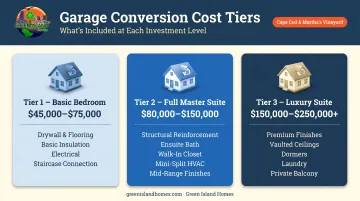
Tier 1 — Basic Bedroom Finish ($45,000–$75,000)
What's included: Drywall, basic insulation, flooring, electrical, windows, and a staircase connection to the existing home. No dedicated bathroom, minimal HVAC work.
Best for: Homeowners whose garage was already framed to carry living space above, or those creating a guest room or bonus room on a controlled budget.
Tier 2 — Full Master Suite with Ensuite Bath ($80,000–$150,000)
What's included: Structural reinforcement, a full bathroom (shower, vanity, toilet), walk-in closet, dedicated mini-split or new HVAC zone, proper insulation and soundproofing, mid-range finishes throughout.
Most common scope: This is where most design-build proposals in this market land — the right fit for homeowners who want a true primary suite retreat without over-building.
Tier 3 — Luxury or Large-Scale Suite ($150,000–$250,000+)
What's included: Everything in Tier 2, plus premium finishes (custom tile, stone countertops, high-end fixtures), vaulted ceilings, large windows or dormers, laundry, a sitting area, and potentially a private balcony.
Best for: Homeowners building their forever home on the Cape or Vineyard, where a premium finish is both a personal priority and a long-term investment in a high-value coastal market.
Key Factors That Affect the Cost of a Master Suite Over Garage
Pricing is determined by a combination of structural, mechanical, and design variables — and that mix varies for every home. Here are the four that move the number most.
Structural Condition of the Existing Garage
Most garages are built to carry a roof load, not a finished living space above. Floor joists, beams, and sometimes the foundation itself may need reinforcement before construction can begin.
Component-level costs give a sense of the range:
- Floor joist repair or replacement: $4,000–$12,000
- Foundation piering: $1,000–$3,000 per pier
- Structural engineering assessment: approximately $344–$776
The total reinforcement scope for an above-garage addition is project-specific and should be assessed by a licensed structural engineer before any budget is finalized. Older Cape Cod homes may have shallow footings or outdated framing techniques that add complexity.
Size, Layout, and Bathroom Location
Most above-garage suites run 350–700 sq ft — every additional square foot adds to structural, mechanical, and finish costs. Layout decisions also affect price significantly:
- A bathroom positioned above existing plumbing in the main house costs considerably less to connect than one in an unrelated location
- Staircase placement affects both the construction cost and how the addition connects to the existing home's flow
- Hallway requirements can consume square footage that could otherwise be part of the suite
Plumbing, HVAC, and Mechanical Systems
Adding an ensuite bathroom is the single largest cost variable after structural work. Typical cost ranges for mechanical work include:
- Full bathroom addition: $10,000–$50,000
- Master suite bathroom (full scope): $22,000–$90,000 depending on finish level
- Mini-split HVAC system: $2,000–$5,000 per zone
HVAC deserves equal attention. Above-garage rooms experience greater temperature swings than the rest of the house — cold floors in winter, heat buildup in summer — and typically need a dedicated solution rather than an extension of the existing system. A mini-split is often the most practical choice for this application.
Finish Quality and Regional Labor Costs
The gap between builder-grade finishes and custom selections can shift the total project cost by tens of thousands of dollars. Labor costs on Cape Cod and Martha's Vineyard also run above national averages. BLS May 2025 data shows Massachusetts carpenters earning $38.56/hour versus the national average of $30.85/hour, and that premium works through every phase of the project.
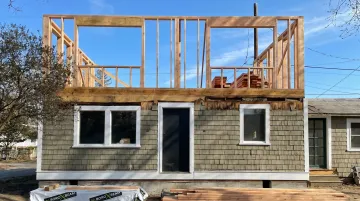
Island logistics on Martha's Vineyard add another layer. Ferry scheduling for materials and crews, limited subcontractor availability during peak seasons, and building department review timelines all affect both cost and schedule.
Full Cost Breakdown: What You're Actually Paying For
Understanding each cost category helps you build an accurate budget and avoid surprises during construction.
| Cost Category | Typical Range | Notes |
|---|---|---|
| Design & architectural fees | $10,000–$20,000 | Drawings, structural engineering, permit submissions, coordination |
| Permitting & code compliance | Varies by town | Barnstable: $50 application + $5.10 per $1,000 of construction value; island municipalities may have longer review timelines |
| Structural reinforcement | Project-specific | Highly variable; get an engineering assessment before budgeting |
| HVAC, electrical & plumbing | Included in Tier pricing | Second-story mechanical work is more complex than ground-floor additions |
| Interior finishes & fixtures | Widest discretionary range | Where homeowners have the most control over spend |
| Contingency reserve | 15% of total budget | Non-negotiable; structural surprises, material delays, and scope changes are common |
Three line items deserve closer attention:
Permitting in coastal Massachusetts is not just a paperwork step. The current Massachusetts building code (780 CMR 10th Edition, effective October 2024) applies, along with local zoning, energy code compliance, and — depending on the property — coastal flood zone requirements. Island municipalities, particularly in Dukes County, can have longer review timelines than mainland towns.
Structural reinforcement is the most unpredictable line item in any above-garage project. Until a structural engineer assesses the existing garage, this figure is an estimate. Budget toward the higher end of your projected range until that assessment is complete.
The contingency reserve is money you hold separately — no contractor bills against it. On a $120,000 project, 15% means $18,000 kept in reserve. On the Cape and Vineyard, where hidden structural issues and material logistics routinely surface mid-project, that cushion earns its place in every budget.
What Separates a Budget Build from a Premium One?
The difference goes beyond aesthetics.
Structural and mechanical shortcuts in a budget build often meet minimum code requirements but under-invest in the areas that matter most for livability:
- Insulation depth (floor, walls, and roof deck above the garage)
- Soundproofing between the garage ceiling and the living space above
- HVAC zoning so the room heats and cools independently
The result of skipping these is predictable: cold winters, hot summers, and road noise or garage sounds bleeding through the floor. A premium build targets all three from the start.
Finish durability matters more in coastal markets. Cape Cod and Martha's Vineyard see high humidity, salt air, and significant seasonal temperature swings. Lower-cost finishes degrade faster in these conditions. Moisture-resistant materials, quality windows with proper coastal ratings, and durable flooring selections pay off more here than they would in an inland location.
On resale value: the 2025 Cost vs. Value Report from JLC places the national midrange primary suite addition at a $170,517 job cost with approximately 32% recouped at resale. That figure reflects national averages — not the specific dynamics of high-demand coastal markets where median single-family sale prices in Barnstable County reached $789,500 in 2025 and Martha's Vineyard's median hit $1,325,000 in 2022. In markets like these, a suite that integrates seamlessly with the original home commands a meaningfully different return than one that reads as a tacked-on addition.
How to Plan and Budget for Your Above-Garage Master Suite
The most important first step — before floor plans, before finish selections, before any budget conversation — is a structural assessment of the existing garage by a licensed engineer or experienced contractor. Everything else depends on what that assessment reveals.
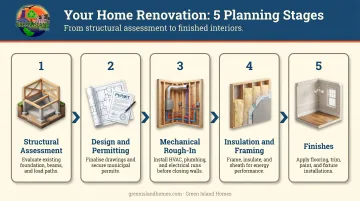
The planning sequence:
- Structural assessment — establishes what reinforcement is required and anchors the structural budget
- Design and permitting — architectural drawings, structural plans, permit submissions; in coastal Massachusetts, factor in 1–3 months for permitting
- Mechanical rough-in — HVAC, plumbing, and electrical before walls are closed
- Insulation and framing — critical in coastal climates; done right, this prevents the comfort issues that plague budget builds
- Finishes — where the suite's character comes together
Before finalizing any budget, lock in these inputs:
- Total square footage of the addition
- Bathroom scope (none, standard, or master bath level)
- Finish tier (builder-grade, mid-range, or custom)
- 15% contingency reserve calculated on the full project cost
- Whether structural reinforcement will be minor or significant (informed by the engineering assessment)
Working with a contractor who knows Cape Cod and Martha's Vineyard specifically matters here. Regional code requirements, seasonal construction windows, island logistics, and building department relationships all affect how a project runs — and how much it ultimately costs.
Green Island Homes, based in Edgartown, has that regional experience on both the Cape and the Vineyard. They manage these projects from initial planning through final finishes. Reach them at 774-563-9714 or sales@greenislandhomes.com to discuss your specific project.
Frequently Asked Questions
How much does it cost to build a master suite above an existing garage?
A full master suite with ensuite bath typically runs $80,000–$150,000 for mid-range finishes, with luxury builds exceeding $250,000. The range is wide because structural condition, bathroom scope, and finish quality vary significantly from one home to the next.
How much value does an above-garage master suite add to my home?
Nationally, primary suite additions recoup approximately 32% of project cost at resale per the 2025 Cost vs. Value Report. In high-demand coastal markets like Martha's Vineyard and Cape Cod — where single-family median prices are well above national averages — a well-integrated suite that reads as original to the home can outperform that figure.
Is a bedroom above a garage permitted in Massachusetts?
Yes, but it must meet residential building codes for egress, fire safety (fire-rated separation between the garage and living space), ventilation, structural load, and energy efficiency. Building, electrical, and plumbing permits are all required, and inspections apply at multiple phases.
How long does the project take from start to finish?
Design and permitting typically take 2–4 months; construction runs 3–6 months for most projects. Complex builds or those requiring significant structural work can run 9–12 months total. On Cape Cod and Martha's Vineyard, submitting permits early is especially important given regional review timelines.
Do I need permits on Cape Cod or Martha's Vineyard specifically?
Yes. Island municipalities in Dukes County routinely run longer review timelines than mainland Massachusetts towns — budget an extra 4–6 weeks into your schedule and submit as early as possible.
What are the biggest budgeting mistakes homeowners make?
The same mistakes surface on nearly every project:
- Treating structural reinforcement as optional rather than a baseline cost
- Skipping the contingency reserve entirely
- Using national average figures without adjusting for Cape Cod and Martha's Vineyard pricing
Any one of these can break a budget once construction is underway.