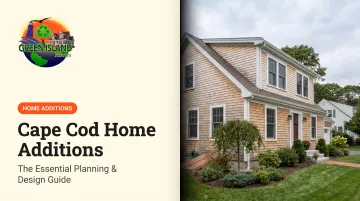
Get it right and your addition disappears into the home as though it was always there. Get it wrong and you've permanently altered one of New England's most recognizable house forms.
This guide is for Cape Cod and Martha's Vineyard homeowners weighing an addition. It covers the most common addition types, the design and structural considerations that determine whether a project succeeds, realistic costs, Massachusetts permitting requirements, and the planning steps that keep projects on schedule.
Key Takeaways
- Cape Cod homes can be expanded, but preserving the steep roofline, symmetry, and exterior materials is non-negotiable for a successful result
- The four most common addition types are dormers, rear additions, second-story additions, and garage/ADU builds — each with different costs, structural demands, and design complexity
- National benchmarks run roughly $80–$300 per square foot depending on addition type; projects typically take 5–9 months from design to completion
- Massachusetts requires permits for all structural work; Cape Cod towns add zoning, setback, and historic district requirements on top
- Hiring a locally licensed contractor familiar with coastal construction and town codes is the decision that most affects your outcome
What Makes Cape Cod Homes Unique — and Why Additions Require Careful Planning
According to SAH Archipedia's peer-reviewed architectural encyclopedia, Cape Cod houses are timber-framed, one- or one-and-a-half-story structures defined by a steeply pitched side-gable roof, central chimney, and clapboarded or shingled siding. The symmetrical facade — centered entry, paired windows flanking each side — is the defining visual feature that immediately reads as "Cape Cod" from the street.
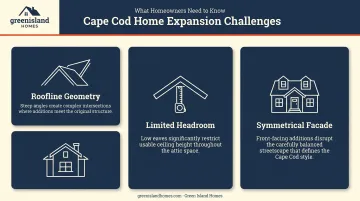
These traits create three specific expansion challenges:
- Roofline geometry — the steep pitch creates complex intersection angles when new roof sections meet old ones
- Limited second-floor headroom — the 1.5-story form means attic space tucks under low eaves, leaving little usable height without structural intervention
- Symmetrical street facade — any addition visible from the front disrupts the balanced appearance that defines the style
Coastal and Regional Complexity
Homes on Cape Cod and Martha's Vineyard face additional pressures that don't apply inland:
- Salt air exposure — accelerates wear on fasteners, siding, and window frames, requiring material choices suited to the marine environment
- Constrained lot sizes — many Cape towns leave little room to expand outward, pushing additions upward or toward the rear
- Historic district oversight — properties along Route 6A and in other designated areas require committee review before any exterior change can be permitted
These aren't obstacles that make additions impossible. They're the reason early planning — and contractors who know local permit boards by name — can mean the difference between a smooth approval and months of costly back-and-forth.
Popular Types of Cape Cod Home Additions
The right addition type depends on your goals, lot constraints, and what the existing structure can support. Each option below carries meaningfully different design, structural, and cost implications.
Dormer Additions
Dormers are the most cost-effective path to usable square footage because they convert low-ceilinged attic space into finished rooms without requiring a new foundation. Two types dominate on Cape Cod:
- Shed dormers run the full length of a roof slope, maximizing floor space and headroom — the preferred choice when you need a full bedroom or bathroom upstairs
- Gable dormers are smaller and symmetrical, preserving the classic Cape roofline while adding light and a modest headroom bump
According to Angi's 2026 dormer cost guide, dormer additions nationally average around $15,000, with costs running $80–$200 per square foot depending on size and design complexity. Complex shed dormers on Massachusetts homes will sit at the higher end of that range given regional labor costs.
Rear Additions
Rear additions are the most popular choice for expanding living space because they leave the street-facing facade unchanged. Designers have more flexibility at the rear: window sizes, materials, and roof forms can deviate somewhat from the original without damaging curb appeal.
Common uses include:
- First-floor primary suites and bathrooms
- Kitchen expansions and open-plan family rooms
- Sunrooms or screened porches with interior access
Regional benchmarks from the 2024 JLC Cost vs. Value Report for New England show a midrange primary suite addition costs approximately $170,310 in this region. A midrange bathroom addition runs around $60,115. Larger kitchen or family room additions will fall within or above that range depending on scope.
Second-Story Additions
When the lot won't allow outward expansion, a full or partial second story can nearly double livable square footage without changing the footprint.
This is also the most structurally intensive option. The Massachusetts 10th Edition Building Code includes provisions requiring review of existing load-carrying structural elements when adding gravity loads above them. In practice, that means a structural engineer needs to assess whether the existing foundation and framing can carry the added weight before design work gets too far.
Angi's 2026 second-story addition data puts the typical national range at $100,000–$250,000, with full second-story additions reaching $600,000 on complex projects and partial additions up to $300,000.
Garage and ADU Additions
An attached garage adds parking and storage, and the space above it — a guest suite or home office — can be finished for $60,000–$270,000 nationally according to Angi. On Cape Cod and Martha's Vineyard, where seasonal rental demand is intense, that upper level has obvious appeal.
ADUs (Accessory Dwelling Units) create self-contained living quarters for guests, extended family, or renters. Massachusetts ADU law, which took effect January 31, 2025, now allows ADUs by-right in single-family zoning districts — meaning municipalities can no longer require discretionary zoning approval. Units may be no larger than half the gross floor area of the principal dwelling or 900 square feet, whichever is smaller.
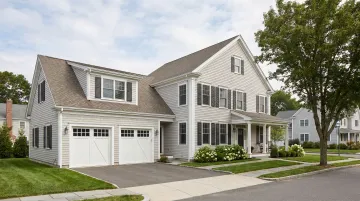
The Cape Cod Commission's January 2023 model ADU bylaw confirmed that all 15 Cape towns already had zoning allowing accessory dwelling units before the state law took effect. The Boston area ADU cost benchmark runs $110,000–$285,000 for new-construction detached units.
Key Design and Structural Considerations
Roofline Integration
Matching the existing steep pitch is the hardest part of any Cape Cod addition. A poorly designed roof intersection doesn't just look wrong — it collects water and snow, and without proper flashing, it leaks. Building Science Corporation's guidance on common flashing details establishes that flashing is required wherever a drainage plane is interrupted, and that water must drain "down and out" at every intersection.
New roof sections must match the pitch angle of the original. The junction between old and new framing requires:
- Correctly lapped building paper throughout the transition
- Metal flashing at every roof-wall intersection
- Adequate drainage slope to prevent water pooling
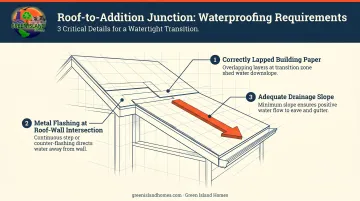
Getting these details right is essential weatherproofing — miss any one of them and the roof junction becomes a long-term liability.
Exterior Material Matching
Visual consistency depends on sourcing materials that match the original home as closely as possible. Mismatches in shingle texture, clapboard profile, or window proportion stand out immediately against a symmetrical facade.
For coastal applications, fiber-cement siding has become the preferred option. It resists rot, fire, and pests — and unlike cedar, it holds up in salt air without the same upkeep. When matching historic cedar shake profiles, custom-milled options exist but carry longer lead times.
Foundation and Infrastructure
New foundations must align with the existing floor height. Any difference in elevation creates framing and flooring complications that compound over time — a problem that's expensive to correct after the fact.
Older Cape Cod homes frequently have aging infrastructure that needs upgrading during an addition anyway. Common items include:
- Electrical panels that lack capacity for modern loads
- HVAC systems not sized for additional square footage
- Pre-war plumbing that needs partial replacement
Addressing these during construction rather than retrofitting later saves significant cost and disruption.
Coastal Material Selection
For Cape Cod and Martha's Vineyard construction, FEMA's coastal construction guidelines recommend stainless steel fasteners for buildings within 3,000 feet of the ocean, with grade 316 stainless steel specified for seacoast cedar applications. Impact-rated glazing is required in windborne-debris zones.
Energy performance matters just as much. ENERGY STAR recommends low-emissivity glass with low U-factors for northern climates — directly applicable to Cape and island homes. Spray-foam insulation addresses the air-sealing gaps common in older Cape structures, and both the DOE and FEMA support closed-cell spray polyurethane foam as an effective air barrier and moisture retarder for existing construction.
Budgeting, Permitting, and the Planning Process
Cost Ranges by Addition Type
| Addition Type | Typical Cost Range | Notes |
|---|---|---|
| Dormer | $80–$200/sq ft | No foundation; most cost-effective |
| Rear Addition | $60K–$170K+ (NE benchmark) | Kitchen/suite scope drives cost |
| Second Story | $100K–$600K | Structural complexity adds cost |
| Garage with living space | $60K–$270K | National benchmark |
| ADU (Boston area) | $110K–$285K | New-construction detached |
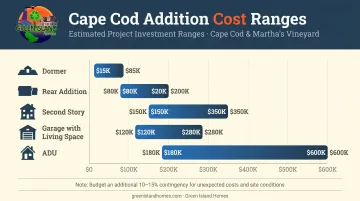
Set aside a 10–15% contingency fund above your base budget. Coastal construction, older homes, and complex permitting processes all create conditions where surprises are common.
ROI Expectations
The 2024 JLC Cost vs. Value Report for New England shows realistic addition ROI is lower than many homeowners expect. New England recoup rates: 40.7% for a midrange primary suite addition, 38.4% for a midrange bathroom addition. Upscale versions recoup less. An addition that fits the Cape Cod streetscape and scale holds value at resale — one that clashes with the original structure can pull it down.
Massachusetts Permitting
Massachusetts 780 CMR Section R105.1 requires a building permit before any construction, enlargement, or alteration of a structure. Review timelines vary by town, so build permitting time into your schedule early. In historic districts, a Certificate of Appropriateness must be issued before any permit can move forward:
- Yarmouth — Old King's Highway Historic District requires Certificates of Appropriateness for new construction and additions; meetings on second and fourth Mondays
- Barnstable — Old King's Highway Historic District Committee reviews all exterior changes and new construction
- Dennis — Old King's Highway Committee handles exterior change applications
- Chatham — Historic Business District Commission reviews exterior alterations; first and third Wednesdays
- Falmouth — Local Historic District Commission must take final action within 60 days of filing; no building permit issues until a Certificate of Appropriateness is granted
Each town also enforces its own setback requirements, lot coverage limits, and height restrictions. Properties near conservation land or wetlands may require additional review.
Project Timeline
| Phase | Typical Duration |
|---|---|
| Design | 2–4 weeks |
| Permitting | 6–12 weeks |
| Site prep and foundation | 2–3 weeks |
| Framing and exterior enclosure | 6–8 weeks |
| Mechanical, electrical, plumbing | 3–4 weeks |
| Finishes and final inspection | 4–6 weeks |
| Total | 5–9 months |
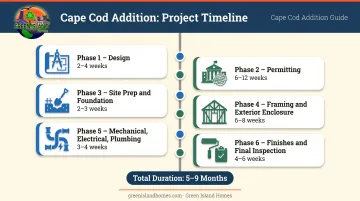
In historic districts, committee meeting schedules set hard deadlines — check your town's calendar before finalizing your project start date.
Smart Planning Tips to Keep Your Addition on Track
Lock in all material selections before construction begins. The most common source of delays and cost overruns is homeowners changing selections mid-build. Tile, cabinetry, fixtures, and windows should all be finalized during the design phase. Special-order items — divided-light windows, custom-milled siding profiles to match historic proportions — can have long lead times. Order them early.
Gather pre-construction documentation before finalizing plans. Before design work gets too far, you need current as-built drawings, a structural assessment, and a property survey in hand. These three documents prevent expensive redesigns when a structural engineer identifies a problem that wasn't visible in early sketches.
"Local expertise" means more than familiarity with the region. On Cape Cod and Martha's Vineyard, it means knowing which towns have historic district committees, how each building department handles addition applications, what coastal construction requirements apply to your specific lot, and what inspectors look for. A contractor without that regional knowledge can easily turn a straightforward permit into a months-long back-and-forth.
That's the kind of local knowledge Green Island Homes brings to every project. Fully licensed and insured — HomeAdvisor Screened & Approved, Top Rated, and Elite Service — the team serves both Cape Cod and Martha's Vineyard, handling all phases of construction with clear communication from initial consultation through final inspection.
If you're planning an addition and want straightforward guidance on what's feasible for your specific home and town, reach out at 774-563-9714 or sales@greenislandhomes.com.
Frequently Asked Questions
Can you add an addition to a Cape Cod house?
Yes — additions are common on Cape Cod homes. The key design priority is matching the existing steep roofline, exterior materials, and symmetry so the addition reads as original to the home rather than tacked on afterward.
What is the most cost-effective type of Cape Cod home addition?
Dormer additions are typically the most cost-effective option because they convert existing attic space without requiring new foundation work. Adding headroom and natural light through a dormer costs significantly less than a full rear addition or second-story build.
Do Cape Cod home additions require permits in Massachusetts?
Yes. Massachusetts 780 CMR requires a building permit for all structural work, obtained through the local town building department. Depending on location, Cape Cod projects may also require zoning board review, conservation commission approval, or historic district committee sign-off before a permit is issued.
How long does a Cape Cod home addition take from start to finish?
Most additions take 5–9 months from design to completion. Permitting alone runs 6–12 weeks and is typically the most unpredictable phase — especially for properties within historic districts where committee meeting schedules control review timing.
Will a home addition hurt the resale value of my Cape Cod?
A well-designed addition that respects the home's architectural character generally increases resale value. A poorly integrated addition that disrupts the roofline or breaks the facade's symmetry can reduce it — which is why design quality and material matching matter as much as square footage.
What is the biggest design challenge when adding onto a Cape Cod?
Roofline integration. New roof sections must match the existing steep pitch exactly, and the junction between old and new must be properly flashed and drained. A mismatched pitch angle or inadequate flashing creates both visual problems and long-term water intrusion risk.