A well-designed master suite addition changes that. It creates a private zone that functions more like a boutique hotel room than a spare bedroom — and in a coastal real estate market where Cape Cod single-family homes are selling at a median of $790,000 and Martha's Vineyard properties average $2.47M, the case for adding livable square footage is easy to make.
This guide covers how to size your addition correctly, make every square foot work, choose design features worth the money, and budget realistically for what's ahead.
Key Takeaways
- A master suite includes a private bedroom, ensuite bathroom, and dedicated closet — not just a bigger sleeping room
- Plan for roughly 400 sq. ft. total — the industry benchmark for a primary suite addition
- Layout sequence and clearance minimums matter as much as total square footage
- Spa bathrooms, walk-in closets, and smart lighting deliver the strongest daily comfort returns
- Budget a 10–15% contingency for surprises, and pull building, electrical, and plumbing permits before breaking ground
Master Suite vs. Master Bedroom Addition: What's the Difference?
What counts as a master suite?
A master suite combines three components into one cohesive private zone:
- Bedroom with dedicated sleeping and relaxing space
- Ensuite bathroom accessible only from the suite — no shared hall access
- Walk-in closet or dedicated dressing area
A master bedroom addition adds sleeping space but may still share a hall bathroom with other rooms. Without a private bathroom, you're adding square footage without solving the core privacy problem.
The cost gap is real too. Adding plumbing, tile, fixtures, and ventilation for a full ensuite roughly doubles the investment compared to a bedroom-only project — but it also delivers the experience and resale appeal that justifies the spend, particularly in a vacation and retirement market like Cape Cod and Martha's Vineyard.
How big should a master suite addition be?
The JLC 2025 Cost vs. Value Report models a midrange primary suite addition at 24' × 16' (384 sq. ft.), which includes a walk-in closet area and bathroom components. Angi models a comparable 400 sq. ft. scenario. Either way, this size range is where most projects land.
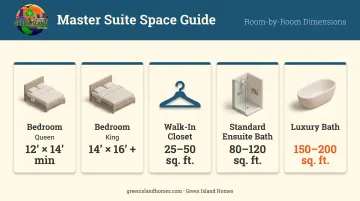
Here's how the square footage breaks down across components:
| Component | Practical Size Range |
|---|---|
| Bedroom (queen) | 12' × 14' minimum |
| Bedroom (king with nightstands) | 14' × 16' or larger |
| Walk-in closet | 25–50 sq. ft. |
| Standard ensuite bath | 80–120 sq. ft. |
| Luxury bath (double vanity, soaking tub) | 150–200 sq. ft. |
Suites above 500 sq. ft. can add sitting areas or expanded spa features, but every extra square foot raises structural and mechanical costs at the same rate. Build for what you'll actually use daily, not the largest footprint you can justify on paper.
How to Maximize Space in Your Master Suite Addition
Plan the layout and circulation first
Before you think about tile colors or vanity styles, figure out how you'll move through the suite. Two sequences work well:
- Bed → Closet → Bath: Keeps humidity away from clothing; better for people who dress before grooming
- Bed → Bath → Closet: Quieter morning route; ideal if one partner rises earlier
Neither is universally correct — the right choice depends on your household's daily rhythm. But committing to one before design begins prevents costly layout revisions later.
Circulation minimums to plan around:
- 36" walking paths through the bedroom
- 24–30" clearance on both sides of the bed
- 36–42" aisle widths inside the walk-in closet
A suite can be 500 sq. ft. and still feel cramped if these clearances aren't protected in the initial layout.
Ground floor vs. second story
Where you place the addition shapes the entire project — in cost, structural complexity, and how easily it connects to the rest of the house.
Ground-floor additions:
- Simpler foundation work
- Easier to connect to existing HVAC and plumbing
- Support aging-in-place design without stairs
- Generally lower structural cost
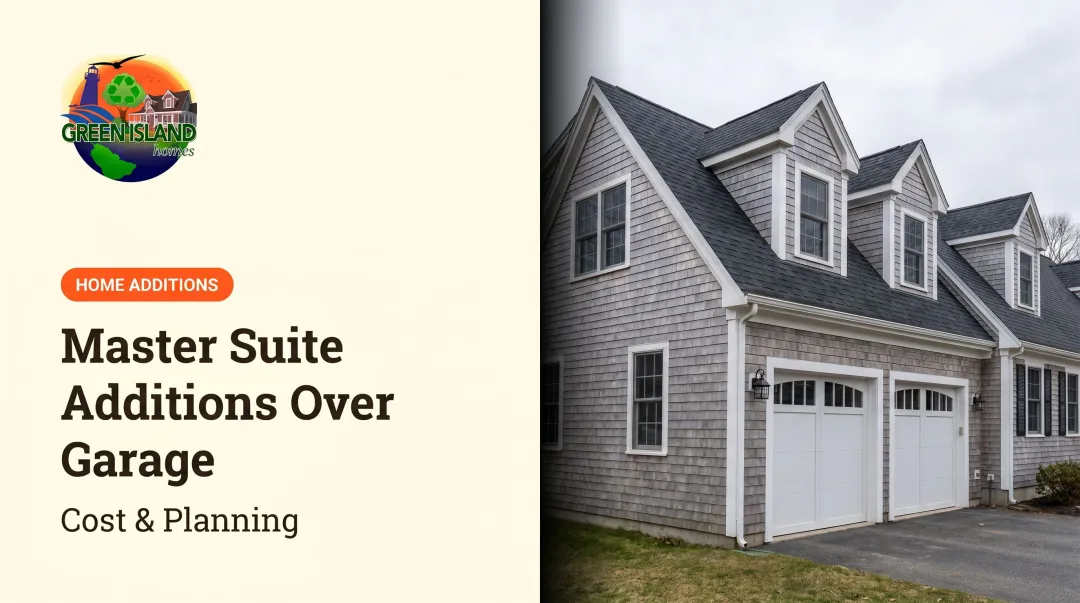
Second-story or above-garage additions:
- Require load path analysis and structural reinforcement
- Stair placement consumes floor area on both levels
- Often need separate HVAC zoning
- Angi reports ground-level build-outs at $80–$200/sq. ft. versus $300–$500/sq. ft. for second-story additions
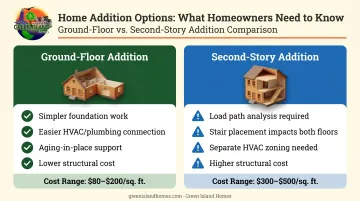
For most Cape Cod homeowners, a ground-floor addition is the more predictable path unless the site or floor plan makes it impossible.
Build up, not out — storage and vertical space
Floor-to-ceiling built-ins along a single wall can store as much as a separate room without consuming floor area. Specify 22–24" deep drawers for folded clothes and adjustable shelving that can be reconfigured as your wardrobe changes.
Walk-in closet design principles worth following:
- Mix double-hang sections (shirts, jackets) with single-hang (dresses, long coats)
- Extend shelving to 9'+ with a pull-down rod for seasonal items
- Add under-shelf LED lighting — it makes selection faster and looks finished
- Include one outlet for a steamer or cordless vacuum
Green Island Homes builds custom closet carpentry as part of master suite additions, so the built-ins are designed alongside the room — not retrofitted after the fact.
Make the space feel larger without adding square footage
A few specific choices have an outsized effect on perceived size:
- Light neutral walls reflect natural light and push perceived depth outward
- Large mirror positioned across from a window doubles the apparent size of the room
- Sliding or pocket doors for bathroom and closet entries reclaim the 9–12 sq. ft. of swing space a standard door requires
- Multi-functional furniture — beds with under-drawer storage, storage ottomans, nightstands with shelving — reduces the number of pieces competing for floor space
In a 400 sq. ft. suite, use an area rug and a reading chair by the window to define a separate sitting zone. That simple gesture makes the suite feel purposeful rather than just big.
Master Suite Design Ideas Worth Considering
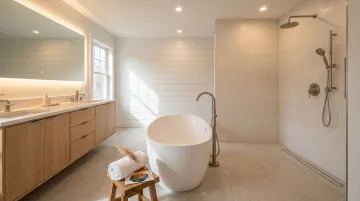
Design a bathroom that functions as a spa
The ensuite is where most of the investment goes and where you'll feel it most every morning. A few decisions shape everything else:
Shower: NKBA recommends a minimum 36" × 36" footprint; a curbless walk-in at 36" × 48" or larger adds accessibility and a cleaner look. According to NKBA's 2026 Bath Trends report, 55% of design professionals say enlarging the shower now matters more to clients than adding a soaking tub — worth knowing before you commit floor space to one you may rarely use.
Materials worth specifying:
- Large-format porcelain tile with minimal grout lines for low maintenance
- Stone as an accent surface, not a primary one — it's high maintenance and high cost
- Heated floors, cited by 69% of industry professionals in NKBA trend data, add daily comfort while helping moisture evaporate
Lighting: Layer three types for the best result:
- Task lighting at the vanity (mirror-integrated fixtures reduce glare)
- Dimmable ambient recessed fixtures
- A skylight or clerestory window if the layout allows
NKBA reports 91% of professionals cite lighting quality as critical in bathroom design — and it's the easiest place to create a spa effect without major structural changes.
Design a walk-in closet that works every day
Functional essentials:
- 36–42" aisle widths so two people can use the space simultaneously
- Mix of hanging heights to maximize vertical use
- Pull-out trays or open cubbies for shoes and accessories
- An outlet for a steamer or charging station
High-CRI LED lighting with a motion sensor handles both quality and energy savings. Adjustable shelving systems — unlike fixed cabinetry — let you reconfigure storage as your needs change without a full renovation.
Incorporate smart home and wellness features
Two additions make a meaningful daily difference without significant complexity:
Zoned HVAC: A quiet mini-split gives precise temperature control for the suite without affecting the rest of the house. ENERGY STAR-certified mini-splits use up to 60% less energy than standard electric resistance heating — relevant on the Vineyard and Cape where heating costs are notable.
Smart lighting and shades: Programmed scenes for wake, relax, and sleep — coordinated with motorized shades — change how the suite feels to live in. Tunable LEDs that shift color temperature through the day support natural sleep rhythms.
For coastal homeowners specifically, French door access to a private deck or terrace takes the suite from comfortable to resort-like.
Master Suite Addition Costs: What to Budget
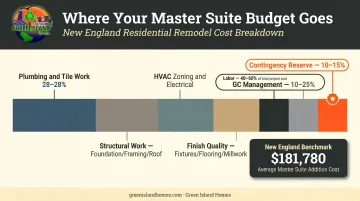
The JLC 2025 Cost vs. Value Report puts a midrange primary suite addition at $181,780 in New England, well above the $103,300 national average cited in Angi's cost guides.
On Cape Cod and Martha's Vineyard, where labor availability is seasonal and material delivery adds logistics costs, budgets at the higher end of that range are the more realistic baseline.
Resale context: The same JLC report shows New England midrange suite additions recouping 38.8% of cost at resale — meaningful, but not a full return. This is a lifestyle-driven project with partial resale recovery built in.
Primary cost drivers
| Driver | Impact |
|---|---|
| Plumbing and tile work | Largest share of bathroom costs |
| Structural work (foundation, framing, roof tie-in) | Biggest variable between ground-floor and second-story |
| HVAC zoning and electrical upgrades | Consistent add to mechanical line |
| Finish quality (fixtures, flooring, millwork) | Where budgets most often expand |
Labor typically accounts for 40–60% of total addition cost, with general contractor management adding another 10–25%.
Money-saving strategies that don't sacrifice quality
- Stack new plumbing near existing lines to minimize rerouting distance
- Keep roof forms simple ; a shed or flat roof tie-in costs far less than a gabled addition
- Use a prefab shower pan with tile walls instead of a fully custom tile shower floor
- Choose LVT flooring in the bedroom rather than hardwood ; most homeowners won't notice the difference underfoot
- Tile one feature wall rather than all four for nearly the same visual impact at half the material cost
Always hold a 10–15% contingency above your project estimate. Coastal construction on the Cape and Vineyard regularly surfaces conditions (ledge, older plumbing connections, undersized electrical panels) that weren't visible until walls opened.
Permit fees vary by town. For example, Barnstable's fee schedule runs $50 application plus $5.10 per $1,000 of construction value. Confirm current fees with your specific municipality before finalizing your budget.
Planning Your Master Suite Addition: How to Start Right
Define your priorities before the first contractor conversation
Know what you're building before you ask anyone to price it:
- Is the spa bathroom the centerpiece, or is closet space the real need?
- Do you want a sitting area, or would that space be wasted?
- First floor for easier construction and aging-in-place, or second story to preserve yard space?
These decisions shape every design and budget choice that follows. Walking into a contractor conversation without them typically produces a quote that doesn't match what you actually want.
What to look for when hiring a contractor
- Fully licensed and insured — non-negotiable for permitted addition work in Massachusetts
- References from similar addition projects, not just remodels
- Confirmation they will pull all required permits
- Scope, cost, and timeline in writing before work begins
Homeowners on Cape Cod and Martha's Vineyard can reach out to Green Island Homes — a HomeAdvisor Elite-rated local builder based in Edgartown — for a consultation on their master suite addition. They check every box on the list above: licensed, insured, and upfront about scope and cost from day one.
Common planning mistakes to avoid
Even with the right contractor in place, the planning phase is where most projects go sideways. These are the mistakes worth avoiding before a single permit gets filed.
- Rushing design before permits are approved — changes after permit submission cost time and money
- Underestimating mechanical needs — a new 400 sq. ft. zone needs its own HVAC solution, not a tapped extension of an existing system
- Choosing materials on aesthetics alone — natural stone looks beautiful but requires maintenance that most homeowners don't want to commit to
- Skipping the contingency — almost every addition project surfaces at least one condition that wasn't visible during initial scoping
Massachusetts 780 CMR requires permits for structural, electrical, and plumbing work on any addition. Your contractor pulls them — but as the homeowner, you're responsible for knowing what was inspected and signed off.
Frequently Asked Questions
How much does it cost to add a bathroom to a master bedroom?
Nationally, most projects fall between $37,500 and $150,000, with a national average around $103,300 per HomeAdvisor. In New England, the JLC 2025 Cost vs. Value benchmark puts a midrange primary suite addition at $181,780 — the more relevant number for regional planning.
How big should a master bedroom addition be?
A full master suite typically falls between 300–500 sq. ft. The bedroom alone needs at least 12' × 14' for a queen. The right total size depends on which components you're including — closet, bathroom, sitting area — and how much clearance you want around the bed.
What is a 20×20 addition to a house?
A 20' × 20' addition equals 400 sq. ft. of new space. The JLC Cost vs. Value Report models a comparable primary suite at 384 sq. ft. (24' × 16'), confirming that the 400 sq. ft. range comfortably accommodates a king bedroom, walk-in closet, and full ensuite bathroom.
What is the difference between a master suite and a master bedroom addition?
A master bedroom addition adds sleeping space only and may share an existing hall bathroom. A master suite addition includes a private ensuite bathroom and dedicated closet — it costs more, but adds more usable function and supports stronger resale value.
Do I need a permit for a master suite addition in Massachusetts?
Yes. Massachusetts 780 CMR requires building permits for all structural additions, with separate electrical and plumbing permits as well. Skipping permits can mean fines, mandated removal of work, or problems at resale — a licensed contractor manages the process for you.