Without a clear roadmap, the process gets derailed fast. Cost overruns, permitting delays, wrong builder choices, and decision fatigue are the most common pain points — and they're largely avoidable with proper preparation.
This guide walks through all 10 steps of building a custom home, what affects timelines and costs, and the mistakes that derail most first-time builders. If you're building on Cape Cod or Martha's Vineyard, there's a dedicated section covering the unique regional challenges you'll face.
Key Takeaways
- Plan for 18–24 months from early planning to move-in, including 6–12 months for design, permits, and selections before ground breaks
- Secure land before finalizing floor plans — your lot directly shapes what can be built and at what cost
- Construction loans disburse funds in staged draws and convert to a mortgage at completion — expect stricter qualification requirements than a standard home loan
- Choosing the right builder is the single most critical decision; prioritize local experience, communication, and transparent pricing over the lowest bid
- Hold a contingency reserve of at least 10–15% above your contract price for unforeseen costs
What to Know Before You Begin
The Chicken-and-Egg Problem
First-time builders hit a frustrating loop early: you can't get a firm price without plans, and you shouldn't finalize plans without a lot. The way out is to start with a lifestyle and needs assessment — clarify how you live, what you need, and what your budget range is before touching floor plans or lot listings.
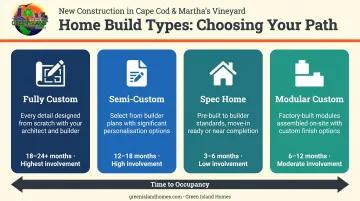
Custom, Semi-Custom, and Spec: Know What You're Signing Up For
| Type | What It Means | Time and Involvement |
|---|---|---|
| Fully custom | Designed from scratch for you, on your land | Maximum control, longest timeline, most decisions |
| Semi-custom | Starts from an existing plan with some modifications | Faster, fewer choices, less design freedom |
| Spec home | Builder-owned and pre-built, limited buyer input | Fastest path to occupancy, minimal customization |
| Modular custom | Sections built off-site to code, assembled on your lot | Can shorten schedule; still requires local permits and site work |
Custom Building Is Closer to a Part-Time Job Than a Purchase
A fully custom home involves hundreds of decisions — not just finishes, but structural details, trim profiles, mechanical placements, and window specifications. Homeowners who underestimate this volume end up making rushed choices mid-construction, which leads to costly changes. Builders who've seen both sides of that equation will tell you: the decisions you defer always cost more than the ones you make early.
The 10 Steps to Building a Custom Home
Step 1: Define Your Vision, Lifestyle Needs, and Budget
Start with a needs assessment before opening Pinterest. Consider:
- Family size now and in 5–10 years
- How you actually use spaces day-to-day
- Work-from-home requirements
- Accessibility needs, both current and future
- Non-negotiables vs. nice-to-haves
Lifestyle clarity comes first. Inspiration images are useful later, once you know what you actually need.
On budget: Research new construction costs per square foot in your specific local area, not national averages. NAHB's 2024 construction cost survey reported a national average of $162 per square foot for construction costs — but coastal markets like Cape Cod and Martha's Vineyard will differ significantly. Get local bids and architect estimates for meaningful numbers. Build in a contingency reserve of at least 10%, rising to 20% if you're acting as your own general contractor.
Step 2: Secure Your Land
Land selection must come before floor plan shopping. Lot width, slope, orientation, views, setbacks, and neighboring structures all directly determine what can be built — and at what cost.
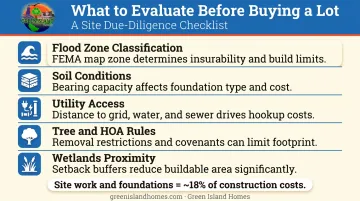
Before committing to a lot, evaluate:
- Flood zone classification — coastal Massachusetts lots may fall within the 1%-chance floodplain, where flood-resistant construction is required and FEMA Elevation Certificates are mandatory
- Soil conditions — rocky or unstable soils significantly impact excavation costs
- Utility access — especially critical in rural or island settings where connections can be expensive
- Tree preservation rules and HOA requirements
- Wetlands proximity — Massachusetts Wetlands Protection Act regulations govern work near wetlands and can add review layers before permits are issued
Significant slope adds real money in excavation and retaining walls. Site work and foundations combined account for roughly 18% of construction costs nationally — on a difficult coastal lot, that figure climbs.
Step 3: Arrange Construction Financing
A construction loan works differently from a standard mortgage. It's a short-term loan that funds the build in staged draws tied to construction milestones, then converts to a permanent mortgage at completion.
What lenders typically require:
- Credit score above 700
- Loan-to-value ratio of 75–80%
- Builder credentials, approved plans, and a detailed cost estimate
- Documentation of your contingency budget
Get pre-approved before approaching builders. It signals seriousness and gives you a realistic number to plan around. Work with local lenders who understand the regional market since a lender familiar with Cape or Vineyard construction will underwrite the project more accurately.
Step 4: Choose Your Custom Home Builder
Unlike most decisions in this process, a bad builder choice can't be undone midway through construction. Evaluate candidates on:
- Local experience — familiarity with regional permitting, subcontractors, and site conditions
- Pricing transparency — understand whether you're looking at a fixed-price or cost-plus contract (more on this below)
- Communication practices — how often do they update clients, and through what channels?
- Project volume — builders managing too many simultaneous projects often miss details that matter
- Verifiable references — past clients, not just testimonials on the builder's own website
For Cape Cod and Martha's Vineyard builds, working with a locally established builder matters more than it might elsewhere. Green Island Homes, based in Edgartown and serving both Cape Cod and Martha's Vineyard, is HomeAdvisor Screened & Approved, Top Rated, and Elite Service certified — and handles all phases of construction. Past clients describe them as "the dream construction person I didn't think existed" and highlight fair pricing and clear communication throughout the project.
Step 5: Design, Architecture, and Floor Plans
The design phase translates your needs assessment into actual drawings. Working with an architect or designer, you'll develop:
- 2D floor plans and elevations
- 3D renderings
- Structural engineering review
- Multiple revision rounds before plans are finalized
Design decisions here affect long-term performance, not just aesthetics. Heat gain and heat loss through windows account for 25–30% of residential heating and cooling energy use — so window placement is an energy decision, not just a visual one. Ceiling heights, insulation strategies, and material choices all affect durability and operating costs, particularly in coastal New England's salt air and humidity.
These plans go directly to permitting and lock in your construction budget. Time spent refining them now prevents costly changes later.
Step 6: Make Your Interior and Exterior Selections
The selections phase covers everything visible in the finished home:
- Cabinets, countertops, flooring, and tile
- Fixtures, appliances, and hardware
- Lighting — both fixtures and layout
- Exterior siding, roofing materials, and paint
Understanding allowances: Most contracts include allowances — pre-set budget placeholders for certain selections. If you choose flooring that costs more than your flooring allowance, the difference becomes a change order. One category of upgrades can shift total project costs by tens of thousands of dollars. Know your allowances before you fall in love with a finish.
Late selections are a direct cause of construction delays. When you miss a decision deadline, procurement stalls, trade schedules shift, and sometimes material prices change in the interim. Treat the selections schedule as seriously as the construction schedule.
Step 7: Obtain Permits and Approvals
Plans go to the local building department for review. Under Massachusetts State Building Code (780 CMR), the building official must issue or deny a permit in writing within 30 days of filing. But that 30-day clock isn't the whole story.
Additional review layers that can precede or condition the building permit:
- Wetlands review — after a hearing closes, the Conservation Commission has 21 days to issue an Order of Conditions; appeals add 10 more days
- Flood zone review — coastal lots in Special Flood Hazard Areas require elevation documentation
- HOA or architectural review board approval
- Martha's Vineyard Commission review for projects meeting Development of Regional Impact thresholds
Experienced builders manage permitting on the homeowner's behalf — they know the dependencies. Construction cannot legally begin until permits are issued. Trying to compress or skip this phase doesn't save time; it creates legal exposure.
Step 8: Site Preparation and Foundation
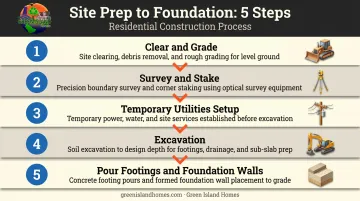
With permits in hand, site work begins:
- Clear and grade the land
- Survey and stake the building footprint
- Set up temporary utilities and site infrastructure
- Excavate for the foundation
- Pour footings and foundation walls
Foundation type — slab, crawl space, or full basement — is a major cost variable determined earlier in design. On Cape Cod and Martha's Vineyard, coastal lots with high water tables, flood zone requirements, or ledge rock can make this phase significantly more expensive than a straightforward inland site. Get geotechnical due diligence done before design is finalized.
Step 9: Framing, Mechanical Systems, and Building Envelope
This is the longest phase of active construction. The sequence:
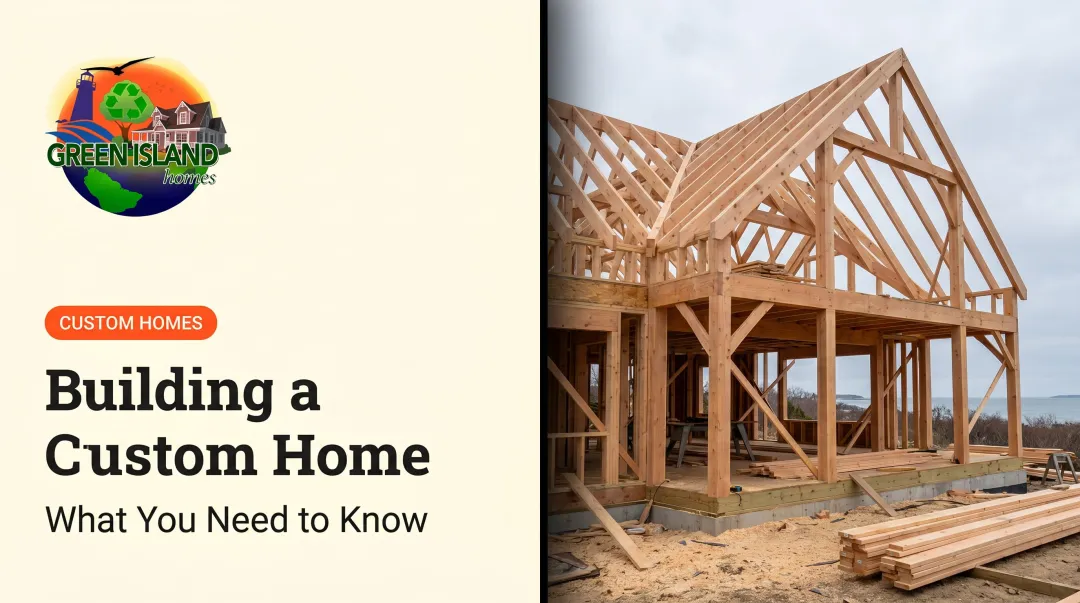
- Framing — walls, floors, and roof structure
- Roofing and exterior sheathing — making the structure weathertight
- Rough-in of electrical, plumbing, and HVAC — done while walls are open
- Insulation — critical in coastal New England; improper detailing here creates moisture and durability problems for decades
- Drywall
Consistent on-site supervision throughout this phase is what prevents coordination failures between trades. A superintendent who's present regularly catches conflicts between electrical, plumbing, and HVAC rough-ins before walls close and fixes become expensive.
Step 10: Interior Finishes, Final Inspections, and Move-In
The final stretch involves:
- Installation of cabinets, flooring, trim, countertops, and fixtures
- Appliance installation and lighting
- Paint throughout
- Landscaping and final grading
Once work is complete, you'll do a punch list walkthrough with your builder — a systematic review of incomplete or unsatisfactory items that need correction before handover. After punch list resolution:
- Final inspections by the permitting authority
- Certificate of occupancy issued
- Key handover with orientation to home systems
- Review of warranty documentation
Take the systems orientation seriously. Homeowners who understand their HVAC controls, plumbing shutoffs, and electrical panel layout handle minor issues themselves — and catch bigger problems before they escalate.
How Much Does It Cost to Build a Custom Home?
Custom home costs vary significantly by region, lot conditions, design complexity, and finish level. The national average construction cost in 2024 was $162 per square foot according to NAHB data — but this figure doesn't reflect what you'll actually pay in coastal Massachusetts.
On Cape Cod and Martha's Vineyard, expect that number to climb. Skilled labor demand, limited contractor availability, and — on the Vineyard specifically — ferry-dependent material deliveries all push costs well above mainland benchmarks.
Where Budgets Get Blown
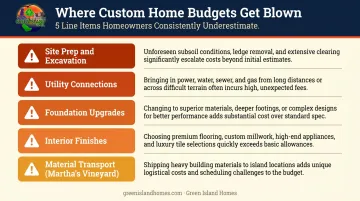
The categories that routinely cause cost overruns:
| Category | Why It's Underestimated |
|---|---|
| Site prep & excavation | Rocky or sloped lots require retaining walls and blasting |
| Utility connections | Rural and island locations can mean long runs and high costs |
| Foundation upgrades | Flood zone requirements often mean elevated foundations |
| Interior finishes | Selections that exceed allowances add up fast across every room |
| Material transport (MV) | Ferry logistics add cost and scheduling friction |
An example: Upgrading flooring across a 2,500 sq ft home from a standard allowance to premium hardwood can add $25,000–$40,000 or more to total cost. Multiply that across cabinets, countertops, and fixtures, and selections alone can shift your total by six figures.
Fixed-Price vs. Cost-Plus Contracts
- Fixed-price: You agree on a number upfront. Allowances and change orders still apply — the certainty is on base scope only.
- Cost-plus: Builder charges actual costs plus an agreed fee or percentage. More transparency into where money goes, less certainty on final total.
- Cost-plus with guaranteed maximum price (GMP): Adds a ceiling, provided scope and exclusions are clearly defined.
On Cape Cod and the Vineyard, where site surprises and material delays are common, knowing exactly what your contract covers — and what triggers a change order — is as important as the quoted number itself.
Building a Custom Home on Cape Cod and Martha's Vineyard
Building in this region means navigating three overlapping risk systems that most inland projects don't face.
Coastal Regulatory Requirements
Flood zone compliance is not optional. The Cape Cod Commission's Flood Area Design Guidelines address sea-level rise, storm surge, elevation requirements, and floodwater management. FEMA Elevation Certificates are required for new buildings in Special Flood Hazard Areas.
On Martha's Vineyard, projects meeting Development of Regional Impact thresholds go through Martha's Vineyard Commission review. In Edgartown, historic district review can add another layer for exterior work within the district. These reviews run on their own timelines, separate from the building department's 30-day permit clock.
Island Logistics and Seasonal Constraints
Martha's Vineyard construction operates under constraints that compress every phase:
- Materials travel by ferry — scheduling delays affect procurement lead times
- Local contractor availability is limited; specialized trades book far in advance
- Seasonal weather windows narrow the effective construction calendar
Build these constraints into your schedule from the start. Mid-project delays on the Vineyard are expensive and rarely quick to recover from.
Energy Efficiency in Coastal New England
Harsh winters, salt air, and coastal humidity demand a building envelope engineered for durability, not just comfort. In this climate, several details move from "nice to have" to non-negotiable:
- Moisture detailing to manage coastal humidity and condensation
- Wind-driven rain resistance at all penetrations and transitions
- High-performance insulation suited to New England winter loads
- Salt-air durable finishes for exposed exterior components
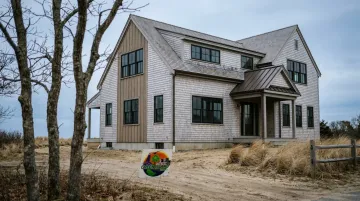
These aren't upgrades. They determine how long the home performs before requiring major repairs.
Green Island Homes builds energy-efficient modular homes to the same codes as site-built construction, engineered specifically for coastal New England conditions. Based in Edgartown, the team manages every phase in-house — design coordination, permitting, and construction — which matters in a region where subcontractor availability is tight and schedule gaps compound quickly. A builder who already knows the MVC review process, the local trades network, and Cape and Vineyard permitting realities keeps the project moving when those systems would otherwise slow it down.
Frequently Asked Questions
How much does it cost to build a custom home?
Costs vary widely by region, size, lot conditions, and finish level. Nationally, construction averaged $162 per square foot in 2024 — coastal Massachusetts markets will be higher. Budget at least 10–15% above your contract price as a contingency reserve.
Is it cheaper to build a custom home or buy an existing home?
Buying existing is typically less expensive upfront, but custom building gives you full control over design, systems, and energy performance. In tight markets like Cape Cod and Martha's Vineyard, limited existing inventory makes custom building a practical path for many buyers regardless of cost comparison.
How long does it take to build a custom home?
Plan on 18–24 months from early planning to move-in. Design, bidding, and permitting account for roughly 6–12 months; active construction takes 10–16 months depending on size, site complexity, and local permitting timelines.
Do I need to own land before talking to a custom home builder?
You don't need to own land first, but having a lot — or a shortlist of candidates — makes consultations far more productive. The lot directly shapes design possibilities and cost estimates.
What is a construction loan and how does it work?
A construction loan is a short-term loan that funds building in staged draws tied to construction milestones, then converts to a permanent mortgage at completion. Qualification requirements are stricter than standard mortgages — work with a local lender familiar with the Cape Cod and Martha's Vineyard market.
What is the difference between a custom home and a modular home?
Modern modular homes are built to the same codes as site-built homes but constructed in sections off-site and assembled on your lot. They can be fully customized in design and typically offer faster build timelines — an advantage in coastal markets where weather and permitting windows are unpredictable.