Introduction
Most raised ranch homeowners know the frustration: bedrooms that feel cramped, shared walls with no acoustic buffer, and a layout where privacy feels like a luxury. The split-entry design that made these homes popular from the late 1950s through the 1970s wasn't built with a true primary suite in mind.
Adding one is entirely doable. It's just not as straightforward as tacking a room onto a standard single-story ranch. The stacked split-level structure, low-pitched roofline, and partially below-grade lower level create a specific set of challenges that require more planning than most homeowners expect.
This guide covers what you need to know before breaking ground — from expansion options and suite design to cost drivers and what the process looks like from structural assessment through final finishes.
Key Takeaways
- Raised ranches (built primarily 1958–1975) have structural, roofline, and zoning considerations that differ from standard ranch additions
- Three expansion paths: upper-level extension, lower-level conversion, or full second-story addition — each with different costs and complexity
- A practical master suite covers 300–500 sq. ft. with a bedroom, en suite bath, and walk-in closet
- Hidden costs — electrical panel capacity, plumbing extensions, HVAC zoning, exterior matching — routinely catch homeowners off guard
- Cape Cod and Martha's Vineyard add permitting layers — plan for them early in the process
What Makes a Raised Ranch Master Suite Addition Different
The Structure You're Working With
Raised ranches built during their peak years of 1958–1975 share a consistent profile: the home sits elevated one-half story above grade, with main living space on the upper level, a semi-finished lower level, an integrated garage, and a continuous low-pitched roofline running the full length of the house.
That history matters for additions. Homes built in this era came with older framing assumptions, foundations that weren't designed for lateral expansion, and rooflines that behave differently than steep-pitched residential roofs.
Why Low-Pitched Roofs Complicate the Tie-In
Standard addition advice treats rooflines as a finish detail. On a raised ranch, the roofline is a structural risk. That risk has technical specifics worth understanding before any design work begins.
GAF's Pro Field Guide specifies that asphalt shingle roofs in the 2:12 to 4:12 pitch range require double-layer roof-deck protection, plus specific leak-barrier and metal-flashing details at any low-slope-to-shingle transition. These details are the minimum standard to prevent water intrusion at the joint — not optional upgrades.
A mismatched pitch at the tie-in point doesn't just create a leak risk; it visually breaks the home's horizontal silhouette, which raised ranches depend on for their clean street presence.
The Foundation Variable
Any outward addition on a raised ranch must tie into an existing foundation that wasn't designed with expansion in mind. Key issues to evaluate before design begins:
- Full basement, crawlspace, or slab — each foundation type requires a different tie-in approach
- Old-to-new foundation joints — where cold floors, cracking, and moisture problems typically show up first
- Original construction era — 1950s–70s engineering standards differ significantly from current Massachusetts code requirements
The upside: the raised ranch's two-level structure means a ground-floor suite addition stays on one plane without requiring a new staircase — an advantage flat single-story ranches don't offer.
Your Options for Adding a Master Suite to a Raised Ranch
Lot size, existing layout, zoning setbacks, and budget will determine which path makes sense. Here are the three primary options.
Option A: Upper-Level Outward Extension
This is the most practical approach for most homeowners. Extending the upper-floor footprint outward — to the rear or side — creates a private suite that connects directly to the main living level without disrupting the lower level.
What this requires:
- A new foundation section (crawlspace or full foundation preferred over slab for plumbing access and frost protection)
- Careful roofline integration at the tie-in, including proper flashing and water management for low-pitch transitions
- Compliance with local setback and lot coverage rules before design begins
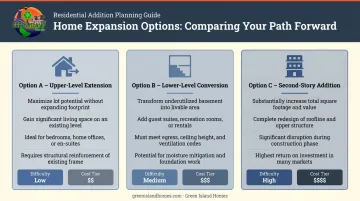
This option keeps the suite on the main living floor and typically allows the most design flexibility.
Option B: Lower-Level Conversion or Expansion
If the lower level has an unfinished basement or an oversized garage, converting it into a suite may appear cost-effective. Structurally, it often is — but code compliance is where this path gets complicated.
Two code thresholds apply to any lower-level sleeping space in Massachusetts:
- Ceiling height: 780 CMR R305.1 requires a minimum 7 ft. for habitable rooms, with 6 ft. 8 in. allowed for bathrooms and habitable basement spaces. Many raised ranch lower levels don't clear this without structural work.
- Emergency egress: IRC R310 requires every sleeping room to have a compliant escape opening — minimum 5.7 sq. ft. net clear area, 24 in. height, 20 in. width, and a sill no higher than 44 in. Windows that don't meet this standard must be modified before the space can legally function as a bedroom.
Option C: True Second-Story Addition
Adding a full second story preserves yard space entirely but carries the highest structural uncertainty and cost. The existing first-floor walls, foundation, and load paths all need engineering review before any design or cost estimates are made.
Massachusetts code requires construction documents prepared by a registered design professional when special conditions exist — and building officials are authorized to require them. Second-story additions on older raised ranch structures consistently trigger that requirement.
This option makes sense when keeping the yard intact is non-negotiable and budget is in place to cover the added engineering, permitting, and construction complexity. Without both, it's the hardest path to execute cleanly.
A note for Cape Cod and Martha's Vineyard homeowners: Local zoning rules vary significantly by town. Barnstable's residential districts show front setbacks of 20–30 ft. and height limits of 30 ft. Falmouth's dimensional regulations note maximum 25% lot coverage in certain districts, with special permit paths for exceptions. Any expansion plan should start with a parcel-specific zoning review before design work begins.
Designing Your Master Suite: Layout, Features, and Flow
Getting the Size Right
A 300–500 sq. ft. total footprint covers the core program for most homes: a comfortable sleeping area, a functional en suite, and a walk-in closet. A practical breakdown for a 400 sq. ft. suite might look like:
- Bedroom area: 220–240 sq. ft.
- En suite bathroom: 100–120 sq. ft.
- Walk-in closet: 60–80 sq. ft.
These aren't code requirements — they're planning targets sized for functional clearances without an oversized footprint.
Layout Sequencing
The most effective layouts route the occupant through the closet before entering the bathroom, or vice versa:
- Bed → Closet → Bathroom keeps the bathroom furthest from the main living corridor
- Bed → Bathroom → Closet works when the bathroom needs plumbing access closer to the existing stack
In either sequence, the closet acts as an acoustic buffer between the sleeping area and the rest of the home — particularly valuable in a raised ranch where the new suite connects to the main living level.
En Suite Bathroom Planning
NKBA's Bath Planning Guidelines recommend at least 30 in. of clear floor space from the front edge of any fixture — lavatory, toilet, tub, or shower — to any opposite wall or obstacle. That clearance requirement is what drives bathroom size beyond code minimum.
A functional baseline with double vanity and walk-in shower needs more floor area than a standard bath. Add a soaking tub and the layout expands again. Plan accordingly before finalizing the footprint.
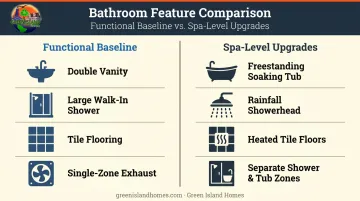
Feature considerations by tier:
| Functional Baseline | Spa-Level Upgrades |
|---|---|
| Double vanity | Freestanding soaking tub |
| Large walk-in shower | Rainfall showerhead |
| Tile flooring | Heated tile floors |
| Single-zone exhaust | Separate shower/tub zones |
Privacy and Acoustic Comfort
A suite that looks great on plans but transmits noise from the living room won't function as a retreat. Practical measures:
- Solid-core interior doors — JELD-WEN notes that an STC rating above 25 indicates improved sound resistance compared to standard hollow-core doors
- Mineral wool acoustic insulation in interior partition walls, particularly walls shared with hallways or living spaces
- High transom windows where privacy is a concern — they admit daylight while blocking sightlines from adjacent properties
Exterior Integration
On older raised ranches, original siding materials are often discontinued. Two approaches work: source salvage materials for street-facing facades — time-consuming but effective for a seamless result — or design the addition to read as intentional using complementary materials.
What undermines curb appeal regardless of approach:
- Mismatched siding that highlights the seam between old and new
- Rooflines at the wrong pitch relative to the original structure
- Window proportions that visually signal "addition" from the street
Cost and ROI: What to Budget for Your Addition
Understanding Cost Drivers
Published national figures for room additions range broadly — Angi's cost guides show bedroom addition ranges from $20,000 to $130,000 nationally, reflecting the wide variation in scope, location, and finish level. In coastal Massachusetts, labor costs and material logistics consistently push projects toward the higher end of national ranges.
What drives a raised ranch master suite to the high end:
- Foundation complexity at the tie-in point
- Bathroom placement far from the existing plumbing stack
- Roofline work requiring custom flashing and low-pitch waterproofing details
- Finish level — heated floors, custom tile, and premium fixtures add cost quickly
- Exterior matching on homes with discontinued original materials
Hidden Costs to Plan For
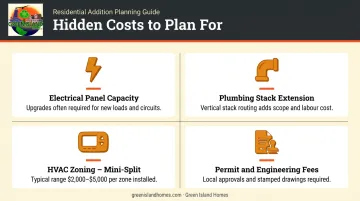
These items routinely appear as change orders when they're missed in early estimates:
- Electrical panel capacity — adding a bathroom, new lighting circuits, and HVAC equipment often pushes older panels past their rated load
- Plumbing stack extension — routing drain/vent lines to a new bathroom location adds both labor and material cost
- HVAC zoning — a new conditioned space requires either extending existing ductwork or adding a dedicated mini-split system (Angi's national data shows mini-split installation at $2,000–$5,000 on average)
- Permit and engineering fees — particularly for upper-level or roofline-affecting additions in coastal communities
ROI Perspective
Once you have a realistic handle on total project costs, the next question is what you get back. The 2024 JLC/Remodeling Cost vs. Value Report tracks resale value recovery across 150 U.S. markets. The consistent finding: bathroom-inclusive additions recover a meaningful portion of cost at resale.
On Cape Cod and Martha's Vineyard, square footage commands premium pricing and buyers expect primary suite amenities. The addition's effect on marketability is real, though exact resale premiums vary by property and timing. Most homeowners in these markets find that the daily quality-of-life improvement justifies the investment regardless of the resale math.
The Addition Process: From Planning to Move-In
Planning and Permitting
The planning phase for a raised ranch master suite addition typically includes:
- Structural assessment of the existing foundation and framing — required before design decisions are made
- Architectural drawings covering the addition footprint, roofline integration, and mechanical layout
- Permit application to the local building department, with construction documents that may need to be prepared or stamped by a registered design professional
Massachusetts building code (780 CMR) requires registered design professional documents where statute requires them or where special conditions exist — upper-level extensions and any work affecting load-bearing walls or rooflines typically trigger this requirement.
Coastal communities add layers beyond standard building permits. Mass.gov's environmental permitting guidance notes that projects in coastal Massachusetts may involve wetlands, floodplain, and coastal program reviews. Conservation Commission filings, historic district reviews, and Title 5 septic considerations can all affect the permitting timeline on Cape Cod and Martha's Vineyard.
Construction
A typical construction sequence for an outward wing addition:
- Site preparation and foundation work — excavation, footings, and foundation walls or crawlspace framing
- Framing — new addition walls, floor structure, and roof framing tied into the existing structure
- Roofline tie-in — the highest-risk phase for quality issues; proper flashing, underlayment, and water management at the joint are non-negotiable
- Rough-in — plumbing, electrical, and HVAC before walls close
- Insulation and air sealing
- Drywall and finishes — flooring, tile, cabinetry, and fixtures
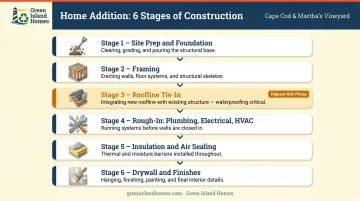
The foundation joint and roofline tie-in are where shortcut work shows up as problems later — water intrusion, cold spots, or structural movement at the seam. These phases deserve the most scrutiny during construction.
Green Island Homes handles every phase of projects like this, from the initial structural assessment through final finishes. Working with a single contractor across a complex addition eliminates the handoff gaps where coordination problems typically develop.
Timeline
A straightforward upper-level outward wing addition, from permit approval through completion, typically runs four to seven months depending on scope and site conditions. Factors that extend the timeline on Cape Cod and Martha's Vineyard projects specifically:
- Coastal permitting review processes that add lead time before construction can begin
- Material sourcing for exterior matching on homes with discontinued original products
- Weather delays during winter months on exposed coastal sites
Build permit and procurement lead time into your schedule. On Cape Cod and Martha's Vineyard, the planning-to-permit phase alone can run two to four months before a shovel goes in the ground.
Common Mistakes Homeowners Make
Three issues come up repeatedly on raised ranch additions — and each one is preventable with better sequencing upfront.
- Skipping the structural assessment: Many homeowners select a layout concept before confirming whether their foundation or framing can support it. On raised ranches built in the 1960s and early 70s, this leads to design rework, mid-project surprises, and permit rejections. The assessment needs to happen before any design decisions are locked in.
- Underestimating systems upgrades: Adding a full bathroom and a new conditioned zone almost always affects electrical capacity, plumbing routing, and HVAC load. These items frequently don't appear in early estimates — they arrive as change orders. Have your electrical panel capacity, plumbing stack location, and HVAC zoning evaluated before you sign a contract.
- Treating roofline integration as an afterthought: A new wing with the wrong roof pitch, mismatched siding, or different window proportions reads as a tacked-on addition from the street — and that hurts resale value. Exterior integration should be a defined scope item from the start, not a cost-cutting decision made late in design.
Frequently Asked Questions
How much does a raised ranch master suite addition cost?
Costs vary based on expansion type, bathroom scope, and local labor rates. National data shows room additions ranging from $20,000 to $130,000, but coastal Massachusetts projects typically run toward the higher end of that range due to labor costs, permitting complexity, and material logistics. Get local contractor quotes for accurate regional pricing.
Is adding a master suite to a raised ranch worth it?
For most homeowners, yes. A primary suite improves daily livability and makes the home more competitive in resale markets where buyers expect this feature. On Cape Cod and Martha's Vineyard, where square footage commands premium pricing, the investment adds both equity and marketability.
What is the best location for a master suite addition on a raised ranch?
A rear or side extension of the upper level is usually the most practical choice. It keeps the suite on the main living floor, connects directly to existing plumbing walls, and avoids disrupting the lower level. Lot size and local setback rules will determine what's actually buildable on your specific parcel.
How long does it take to add a master suite to a raised ranch?
A straightforward wing addition typically takes several months from permit approval to completion. Coastal permitting, material sourcing for exterior matching, and winter weather can all push that timeline out — so build in extra lead time for the planning-to-permit phase, which routinely runs longer than expected in Cape Cod and Vineyard communities.
Do I need a structural engineer for a raised ranch master suite addition?
Yes, and not just to satisfy code requirements. Any addition that affects the roofline, modifies load-bearing walls, or involves the upper level of a raised ranch should have a structural engineer review the load path before design is finalized — Massachusetts building officials will expect registered design professional documents for these conditions.