According to ACS Census data, nearly 15% of Barnstable County homes and over 22% of Dukes County homes were built before 1950. That's a large share of the local housing stock carrying decades of layered updates, aging systems, and kitchens that were never meant to do what we now ask of them.
This post walks through what a small kitchen remodel in an older home actually looks like — the before, the hidden surprises, the decisions made, and the result. If you're weighing a similar project on the Cape or Vineyard, here's the honest version of what to expect.
Key Takeaways
- Older Cape and Vineyard kitchens often hide outdated wiring, galvanized plumbing, and stacked flooring behind dated surfaces
- Keeping the original footprint controls cost significantly — reconfiguring beats expanding in most small kitchens
- Period-appropriate materials — shaker cabinets, soapstone or butcher block counters, restored hardwood floors — keep the result cohesive with the home's character
- Upgrading electrical, plumbing, and ventilation is non-negotiable in pre-1950 homes — budget and timeline depend on it
- Minor kitchen remodels recoup more than their cost nationally — and in a market like Martha's Vineyard, an updated kitchen carries real resale weight
The Before: A Small Kitchen Frozen in Time
What the Kitchen Looked Like
Picture a single overhead fixture casting flat light over a kitchen that last saw updates sometime in the mid-20th century. Laminate counters in a color that doesn't match the cabinet doors, which don't match the drawer fronts, which were clearly replaced at a different time than everything else. A layout where the prep area, the range, and the sink all compete for the same eighteen inches of usable surface.
Storage was the bigger problem. No dedicated pantry. Upper cabinets that didn't reach the ceiling, leaving a dusty gap too small for anything useful. The counter was always cluttered not because of poor habits, but because there simply wasn't enough room.
Every surface told a different story from a different era — and none of them told it well.
Hidden Challenges Lurking in the Walls
In older homes, demolition is where the real project begins. Open a wall and the scope shifts — sometimes in small ways, sometimes significantly.
Common discoveries in pre-1950 construction include:
- Knob-and-tube wiring — HUD guidance identifies this as standard in homes built before 1930, with insulation that becomes brittle and exposed over time
- Galvanized steel supply lines — HUD notes these have a 20–50 year service life, meaning pipes in a 1940s home are well past their functional lifespan
- Multiple flooring layers — JLC documented one older kitchen where vinyl, slate, and linoleum were stacked over a 1930s plank subfloor, with the floor running up to 3 inches out of level and rot hidden underneath
- Out-of-plumb walls and non-standard dimensions — standard 24-inch-deep base cabinets and 12-inch uppers were designed for new construction, not for walls that have shifted over 80 years

All of them affect budget and timeline — and none of them show up in a pre-demo walkthrough.
Planning the Remodel: Goals for a Small, Older Kitchen
The goals here were clear from the start: improve function, add storage, update all systems to current code, and create a result that felt like it belonged in this house — not like a modern kitchen dropped into an old shell.
Why Keeping the Footprint Was the Right Call
Expanding a small kitchen into an adjacent room sounds appealing. In practice, it often means structural work, additional permits, more exposed systems, and a budget that can escalate sharply. HomeAdvisor's 2025 data puts the gap plainly: minor remodels run $10,000–$20,000, while full layout makeovers with wall changes reach $65,000–$130,000+.
That cost difference is exactly why staying within the footprint made sense here. Working within it doesn't mean accepting the existing layout — repositioning the sink, relocating the range, and rebalancing upper versus lower cabinet ratios can transform how a small kitchen functions day to day, without touching a load-bearing wall.
The NKBA's kitchen planning guidelines set a clear benchmark: the work triangle (range, sink, refrigerator) should total no more than 26 feet, with each leg between 4 and 9 feet. Many older kitchens fail this test not because the space is too small, but because the original layout never accounted for it.
Why Contractor Choice Matters More in Older Homes
Not every contractor is equipped for older homes. Someone who primarily builds new construction in subdivisions brings a different skill set than one familiar with what Cape Cod and Martha's Vineyard houses actually contain. The complications are specific:
- Pre-war framing that doesn't match modern standards
- Permit pathways that vary across island and Cape towns
- Electrical, plumbing, and ventilation upgrades that must be coordinated as a single scope
Discovering any of these mid-project can derail both the budget and the schedule.
Green Island Homes, based in Edgartown and serving both Cape Cod and Martha's Vineyard, handles all phases of construction for exactly this type of project. Fully licensed and insured, the team manages multi-system remodels from initial scoping through final inspection — which matters when a kitchen remodel becomes a wiring replacement, a plumbing overhaul, and a flooring excavation before the finish work even begins.
The Transformation: What Changed and Why
Layout and Functionality
The first move was fixing the work triangle. With the range, sink, and refrigerator essentially in a row — all fighting for the same counter zone — prep, cooking, and cleanup constantly interrupted each other.
Repositioning the sink beneath the window (a change that also brought in more natural light) and shifting the range to break the single-wall arrangement created three distinct zones. The result isn't a larger kitchen. It's a kitchen where two people can move without stepping around each other.
A cased opening to the adjacent dining area was added rather than a full wall removal. Wide enough to borrow light and create visual connection, it preserved structural integrity and the home's original character. In older construction where load-bearing assessments matter, this is often the smarter call over a full open-concept approach.
Cabinets, Counters, and Storage
Ceiling-height upper cabinets replaced the old units that stopped eight inches short of the ceiling. That previously wasted gap now holds baskets with roll-outs on the topmost shelf, keeping less-used items accessible without a stepladder every time.
Storage decisions included:
- Pull-out shelving in base cabinets to eliminate the "dig to the back" problem
- A dedicated spice drawer replacing a cluttered rack that took up counter space
- A small built-in pantry section where an awkward corner previously held nothing useful
- Open shelving in one zone to avoid visual heaviness — closed cabinetry everywhere in a small kitchen reads as claustrophobic
For countertops, butcher block was chosen for the prep zone — warm, period-appropriate, and forgiving to work on — with a durable quartz surface at the primary work area for low maintenance. The counter depth was adjusted slightly to match the home's actual wall dimensions rather than forcing a standard modern spec that would have left gaps.
Systems Underneath the Surface
Older homes carry hidden costs in the walls. This kitchen required updates across three systems before finish work could begin:
- Knob-and-tube wiring was replaced throughout, outlets relocated to meet current Massachusetts code (per NFPA 70, 2026 edition), and under-cabinet lighting added. In any pre-1950 kitchen, this is the most impactful safety upgrade in the project.
- Galvanized supply lines were replaced with PEX. The original drain configuration under the sink was rerouted to serve both the sink and the new dishwasher location.
- The kitchen had no exterior-vented range hood, only a recirculating filter that moved grease-laden air in circles. A proper exterior vent was installed through an exterior wall, meeting Massachusetts residential code requirements.
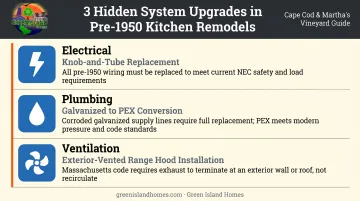
None of this appears in finished photos — but it's what separates a kitchen that looks good from one that's actually safe to cook in for the next few decades.
Design Choices That Respected the Home's Age
The goal wasn't restoration — it was compatibility. The kitchen needed to feel like it belonged in the house, not like a period recreation or a spec-home interior dropped into a century-old space.
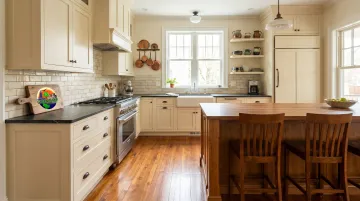
Cabinet style: Inset shaker doors echo the millwork found throughout the rest of the house — simple, clean, historically grounded without feeling theatrical.
Hardware: Oil-rubbed bronze throughout. Not polished chrome, not matte black. The slightly warm, slightly imperfect finish reads as belonging in a home that has some history to it.
Backsplash: Hand-glazed subway tile in an off-white. The slight variation in glaze color from tile to tile gives it a handmade quality that flat, uniform ceramic doesn't. It nods to early 20th-century kitchens without recreating them.
Flooring: The original hardwood was under the linoleum, and it was structurally sound. Refinishing it rather than covering it over was the right call — both aesthetically and in terms of respecting what the house already had. Reusing original materials when they're still sound is generally the right call — here, it was an easy decision.
Light and color: Cabinet faces in a warm off-white. The window treatment was removed entirely — the existing window was the best light source in the room, and it had been blocked. Glass-front doors on two upper cabinet sections prevent the upper zone from reading as a solid wall of closed storage.
The After: Results Worth the Effort
The transformation shows up in numbers first: usable counter surface nearly doubled, storage capacity increased significantly without changing the room's footprint, and the work triangle now functions as intended.
But the bigger change is harder to quantify. The kitchen went from a room people passed through to a room people linger in. The light is different, the proportions finally feel right, and the materials look like they've always been there.
What This Kind of Remodel Costs
According to the 2025 Cost vs. Value Report, a midrange minor kitchen remodel has a national average job cost of $28,458 and a resale value of $32,141 — a 113% return. A major kitchen remodel with layout changes recouped only 51%. The math favors working within the footprint.
Those national figures assume a relatively straightforward project. For an older home on Cape Cod or Martha's Vineyard, hidden system costs push the baseline higher. The typical drivers:
- Knob-and-tube replacement (nationally estimated at $12,000–$36,600 per Angi 2026 data)
- Galvanized pipe replacement
- Asbestos testing if pre-1980 materials are disturbed
- Custom cabinet fitting to accommodate non-standard dimensions
- Corrective subfloor and framing work discovered during demo
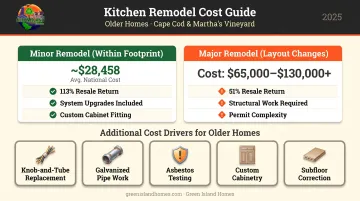
A realistic budget for a small older-home kitchen remodel that includes full system upgrades, period-appropriate finishes, and custom cabinetry can easily reach $60,000–$90,000 or more — well above the national minor remodel benchmark.
Getting an itemized quote from a contractor who has actually opened walls in older Cape and Vineyard homes is the only reliable way to plan.
Frequently Asked Questions
How long does a small kitchen remodel in an older home typically take?
General estimates put the construction phase at 6–10 weeks, plus planning time. In older homes, budget for longer. Hidden discoveries — failed wiring, rotted subfloor, out-of-level framing — require corrective work before finish installation can begin, adding weeks that aren't visible until demo.
What hidden problems should I expect when remodeling a kitchen in an older home?
The most common discoveries include:
- Knob-and-tube wiring requiring full replacement
- Galvanized supply lines past their service life
- Multiple flooring layers over a damaged subfloor
- No exterior-vented range hood
- Walls or floors significantly out of plumb or level
All are manageable — but each needs budget and timeline allowance.
How do I modernize a small kitchen without losing my older home's character?
Choose materials that have historical precedent: shaker or inset cabinet doors, oil-rubbed bronze or antique brass hardware, subway or hand-glazed tile, original hardwood floors refinished rather than covered. Work with a contractor experienced in older home construction who can advise on what to preserve versus what to replace.
Is it worth remodeling a small kitchen in an older home?
Minor kitchen remodels recoup more than 100% of their cost nationally — and on Cape Cod or Martha's Vineyard, an updated kitchen in a well-maintained older home is a meaningful selling point. The daily difference between a dysfunctional old kitchen and a well-designed one is hard to overstate.
Do I need permits to remodel a kitchen in an older home on Cape Cod or Martha's Vineyard?
Yes. Structural, electrical, plumbing, and gas work each require separate permits through your local building department — Barnstable, Edgartown, Oak Bluffs, and other towns each have their own offices. A fully licensed contractor handles the permitting process and ensures all work is inspected and code-compliant.
How much does a small kitchen remodel in an older home cost?
Nationally, minor kitchen remodels average around $28,000–$30,000. Older homes on the Cape and Vineyard typically run higher due to system upgrades, custom fitting, and the likelihood of uncovering issues during demo. Contact Green Island Homes at 774-563-9714 or sales@greenislandhomes.com for an itemized quote based on your specific home.