That feeling is familiar to most owners of 1950s Cape Cod homes. These kitchens were designed for a different era of living, and virtually nothing about them matches how families cook, gather, and entertain today.
This guide walks through the full before-and-after journey: what these kitchens originally looked like, why homeowners remodel them, the key design decisions that define the transformation, the step-by-step process, and what it realistically costs.
Key Takeaways
- 1950s Cape Cod kitchens were small, closed off, and built for utility — not modern family life
- The single biggest impact comes from opening the kitchen to the dining or living area
- Shaker cabinets, quartz or soapstone countertops, and a coastal color palette define the "after"
- Full remodels typically run $28,000–$83,000+, depending on scope and structural changes
- 1950s homes carry hidden costs: outdated wiring, old plumbing, and local permit requirements add up fast
What Did a 1950s Cape Cod Kitchen Look Like?
The Cape Cod house form, described by the Pennsylvania Historical and Museum Commission as a compact, boxy, one-and-a-half-story structure, was built for efficiency, not openness. That meant kitchens were small, walled-off utility rooms, not the social centerpieces they are today.
Layout and Separation
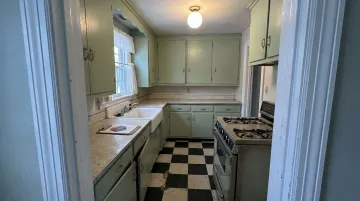
These kitchens were typically galley-style or box-shaped rooms, walled off from a separate formal dining room. The open-concept layout that feels standard today simply wasn't part of the design language. The kitchen was a utility room, tucked away from view.
The Levittown homes built between 1947 and 1951 — arguably the most documented example of postwar Cape Cod-style housing — show this clearly: two-bedroom, one-bath homes with a living room, kitchen, and bedrooms, but no flowing connection between spaces.
Original Materials
Original 1950s Cape Cod kitchens typically featured:
- Laminate countertops: The Smithsonian's Formica Collection notes that more than 2 million new homes built between 1947 and 1950 used Formica laminate in kitchens
- Steel or painted wood cabinets in pastel greens, yellows, and pinks — colors that date the space immediately
- Linoleum flooring: the Hagley Museum notes that plastic-based products largely replaced linoleum during the 1950s and '60s, making original floors a rarity today
- Porcelain or steel sinks with limited counter space on either side
Light and Structural Quirks
Natural light was scarce. Small windows, combined with the walled-off layout, made these kitchens feel dim at any hour of the day.
The one-and-a-half-story form adds another layer of complexity for remodelers. The half-story attic above the main living space means low ceilings and load-bearing considerations near the roofline — real constraints when planning layout changes.
Why Homeowners Remodel Their 1950s Cape Cod Kitchen
Functional Frustrations
The complaints are consistent across almost every homeowner who takes on one of these projects:
- No storage — minimal cabinetry and no pantry means overflow ends up in the basement
- Poor workflow — the classic kitchen work triangle doesn't exist when the sink, stove, and refrigerator are squeezed into a single-file layout
- Isolation — cooking while guests are in another room isn't how most families want to live
The Aesthetic Factor
Beyond function, there's the feeling of a kitchen stuck in time. Aged laminate, outdated appliances, and faded pastel finishes don't carry the warm, coastal character that Cape Cod living is known for. Those emotional frustrations tend to tip the decision — but the financial case is just as compelling.
The Home Value Case
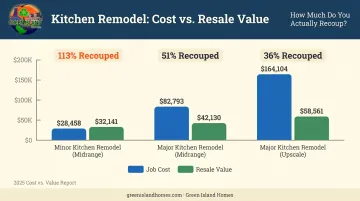
Kitchen remodels are one of the few renovations that return measurable value at resale. According to the 2025 Cost vs. Value Report from Zonda/JLC, a minor kitchen remodel — midrange scope — recoups 113% of its cost nationally. A midrange major remodel recoups around 51%.
The NAR's 2022 Remodeling Impact Report puts complete kitchen renovation cost recovery at 75% — solid ROI for a project that also makes the home noticeably better to live in.
Key Design Decisions That Define the After
Open Floor Plan
Removing the wall between the kitchen and dining room is consistently the most transformative single change in a 1950s Cape Cod remodel. The impact isn't just visual — it changes how natural light moves through the space, how the family uses the room, and how the home feels to anyone walking in.
According to the 2024 Houzz Kitchen Trends Study, over 2 in 5 renovating homeowners made their kitchen more open to interior spaces. Of those, 64% removed wall separation entirely.
One important caution: in a Cape Cod home's compact structure, walls near the roofline and central core may be load-bearing. This must be assessed by a structural professional before any demolition begins.
Once the structural decisions are settled, the material choices — cabinets, countertops, and finishes — determine the final character of the space.
Cabinetry
Shaker-style cabinets in white or soft off-white are the dominant choice for Cape Cod kitchen remodels. They're clean, period-appropriate, and visually expand a small space.
Key decisions to make:
- Painted white or soft grey is most popular; natural stained wood adds warmth in more rustic coastal styles
- Semi-custom offers significant style flexibility at a lower cost than fully custom builds
- Extending upper cabinets to the ceiling maximizes storage in kitchens that can't expand outward
Countertops
According to the 2025 Houzz Kitchen Trends Study, engineered quartz leads the market at 39% of renovating homeowners, followed by granite at 19%, quartzite at 11%, and butcher block at 9%.
For Cape Cod kitchens specifically:
| Material | Why It Works | Trade-off |
|---|---|---|
| Quartz | Durable, low-maintenance, wide color range | Less unique character than natural stone |
| Soapstone | Greenish tones suit coastal palettes; authentic character | Requires occasional oiling; softer surface |
| Butcher block | Warm, rustic feel; cost-effective | Needs sealing; not ideal near wet areas |
| Granite | Durable, natural variation | Needs periodic sealing |
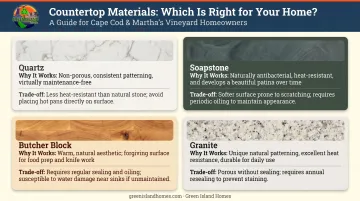
Laminate is authentic to the era but rarely chosen in modern remodels.
Color Palette and Finishes
The Cape Cod palette is whites, soft blues, sea greens, and sandy neutrals. Used correctly, it feels airy without being cold.
Practical guidance:
- Use darker tones on floors or countertops to ground an all-white scheme
- Beadboard paneling on lower cabinet faces or a kitchen wall adds authentic coastal texture without overwhelming a small space
- Hardware in brushed nickel or matte black adds contrast and a modern edge
Natural Light and Lighting
Addressing the original small-window problem requires two approaches: structural and decorative.
- Enlarging existing windows or adding a skylight dramatically changes the feel of the space — this is often worth the cost
- Pendant lights over a peninsula or island provide both task lighting and visual anchoring
- Under-cabinet lighting eliminates the dark corners that made original kitchens feel cave-like
The Remodel Process: Step by Step
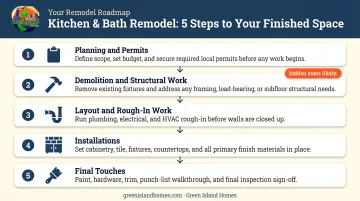
Step 1 — Planning and Permits
Don't skip this phase. In Massachusetts, permits for remodeling projects are issued by the local building department — and in some areas of Cape Cod and Martha's Vineyard, additional review applies.
Key facts to know:
- Under Massachusetts law, licensed master or journeyman plumbers and electricians must perform permitted trade work
- The 10th edition of the Massachusetts State Building Code became effective October 2024
- The Town of Barnstable Building Division oversees permitting and zoning enforcement for construction on Cape Cod
- Historic district commissions in Oak Bluffs and Edgartown (Martha's Vineyard) require review for changes visible from public ways
Working with a contractor who knows local requirements — Green Island Homes serves both Cape Cod and Martha's Vineyard and carries all required licenses — helps avoid costly delays at this stage.
Step 2 — Demolition and Structural Work
This is when the existing kitchen comes out. In a 1950s home, that means:
- Removing old cabinets, countertops, and flooring
- Checking wall status before removal — load-bearing walls require engineered solutions
- Assessing and addressing age-related issues: outdated wiring, old galvanized pipes, and subfloor damage are common discoveries in homes of this age
These surprises are the primary reason contingency budgets matter in older-home remodels.
Step 3 — Layout and Rough-In Work
This phase sets the mechanical foundation. New plumbing lines, electrical circuits, and HVAC adjustments happen here. Common rough-in tasks include:
- Relocating a sink or adding an island with a dishwasher connection
- Rerouting pipes around new structural or layout changes
- Upgrading an undersized electrical panel to support modern appliances
This is where unforeseen costs most often appear. Budget a contingency specifically for rough-in surprises — it's rarely wasted.
Step 4 — Installations
Cabinet installation, countertop fabrication and setting, backsplash tile, flooring, and appliance installation happen in sequence. In a well-managed remodel, each trade is coordinated so the project doesn't stall between phases.
Green Island Homes handles all phases of construction and maintains clear communication with homeowners throughout. That single point of coordination keeps trades sequenced and timelines on track.
Step 5 — Final Touches
The finishing details carry more visual weight than their cost suggests:
- Cabinet hardware (brushed nickel or matte black pulls)
- Open shelving installation for a coastal-styled display
- Pendant and under-cabinet lighting
- Fresh paint in the chosen palette
Choose these finishes early in the planning phase — lead times on lighting and hardware can delay an otherwise finished kitchen by weeks.
What a Transformed 1950s Cape Cod Kitchen Looks Like
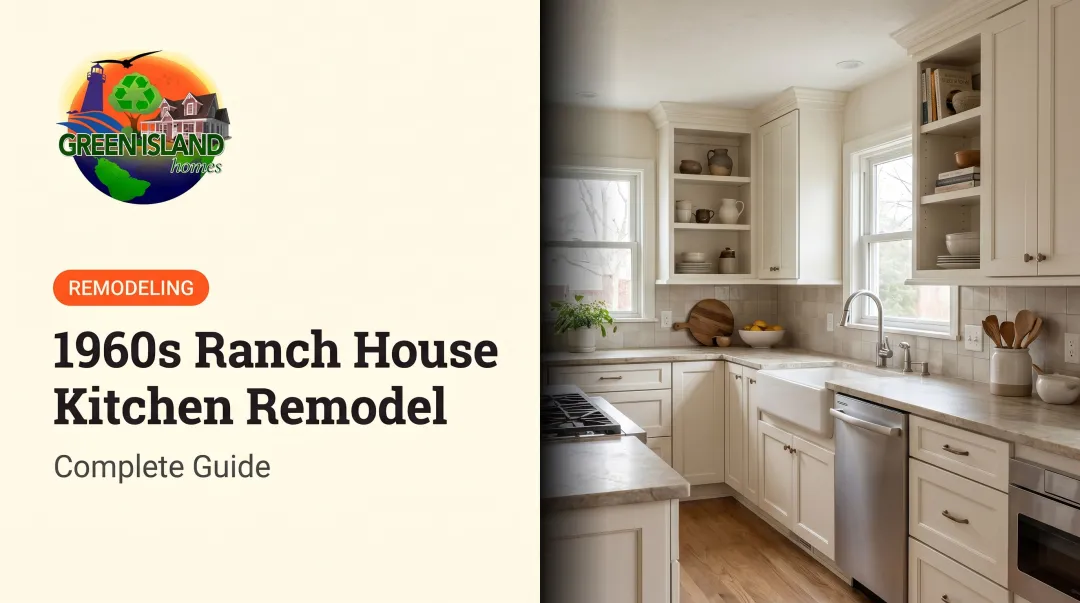
Walk into a well-executed Cape Cod kitchen remodel and the before-and-after difference is immediate. Natural light fills the space. The kitchen, dining area, and living room flow together as one open zone.
The signature elements of a finished Cape Cod kitchen remodel:
- White shaker cabinets running to the ceiling, replacing cramped original units
- A kitchen island or peninsula that didn't exist before — now the gathering point for meals and homework
- Quartz or soapstone countertops replacing worn laminate
- Open shelving displaying coastal-inspired pieces
- Beadboard accents and a palette of whites, blues, and soft greens
- Pendant lights and enlarged windows where a single fluorescent fixture once hung
Those details do more than look good — they change how the home actually functions. The kitchen that once existed only for cooking becomes the room where everyone lands: after school, before dinner, on weekend mornings. Getting more use out of your home's central space is the payoff that outlasts any trend.
What Does a 1950s Cape Cod Kitchen Remodel Cost?
General Cost Ranges
According to HomeAdvisor's 2025 kitchen remodeling data, the national average sits at $26,940, with a normal range of $14,590 to $41,534. Most kitchens cost $75 to $250 per square foot.
The 2025 Cost vs. Value Report provides useful benchmarks:
| Scope | Job Cost | Resale Value | Recouped |
|---|---|---|---|
| Minor remodel (midrange) | $28,458 | $32,141 | 113% |
| Major remodel (midrange) | $82,793 | $42,130 | 51% |
| Major remodel (upscale) | $164,104 | $58,561 | 36% |
For a 1950s Cape Cod home, budget for the structural and older-home factors that push costs above baseline:
- Electrical panel replacement: $1,300–$2,000 for a 200-amp upgrade (HomeAdvisor 2025)
- Repiping: national average $1,246, with added costs if old pipe disposal is needed
- Older wiring remediation: can reach $12,000–$36,600 for full replacement (Angi 2026)
Is $30,000 Enough?
At $30,000, you're close to the national minor-midrange benchmark of $28,458. That budget can realistically cover:
- Cabinet refacing or new semi-custom cabinets
- New countertops and backsplash
- Updated flooring and lighting
- New appliances
What it typically won't cover: a full open-concept wall removal, custom cabinetry, full appliance suite, and the electrical or plumbing remediation common in 1950s homes. Before locking in a scope, get an itemized quote — the tips below can help you stretch that budget further.
Budget Management Tips
- Prioritise structural changes first — wall removal and plumbing relocation are significantly more expensive to add later than to include in the original scope
- Choose semi-custom over fully custom cabinets — the aesthetic difference is minimal; the savings can be substantial
- Set aside a 10–15% contingency — in a 1950s home, something unexpected is less a risk than a near-certainty
Frequently Asked Questions
Frequently Asked Questions
Is $30,000 enough for a kitchen remodel?
$30,000 aligns with the national minor-midrange remodel benchmark and can cover a solid cosmetic update — new cabinets, countertops, flooring, and lighting. A full structural conversion with open-concept wall removal and older-home remediation in a 1950s Cape Cod home typically requires a higher budget. Get a detailed itemized quote based on your specific scope before committing to a budget.
What did kitchens look like in the 1950s?
They were compact, closed-off spaces with galley or box layouts, pastel-painted metal or wood cabinets, laminate countertops, linoleum floors, and minimal counter space. A formal dining room was typically separated from the kitchen by a wall — the opposite of today's open-concept standard.
When was the Cape Cod house style most popular?
Cape Cod homes surged in popularity after World War II through the 1950s, driven by postwar housing demand and the affordability of the form. Levittown, Long Island — built between 1947 and 1951 with 17,447 nearly identical Cape Cod-style homes — is the most documented example of that era's construction boom.
How long does a 1950s Cape Cod kitchen remodel typically take?
Extensive remodels involving gut work and layout changes typically take 8 to 12 weeks; full project timelines including planning run around 4 months, according to Angi and HomeAdvisor (2024). Older-home surprises — plumbing, electrical, structural — are the primary variables that extend timelines.
What are the most popular countertop choices for a Cape Cod kitchen remodel?
Quartz leads at 39% of renovating homeowners nationally (Houzz 2025) and is favoured for durability and low maintenance. Soapstone is a strong choice for its coastal character and natural greenish tones. Butcher block suits more rustic Cape Cod styles and offers warmth at a lower price point than stone.