A freestanding deck roof solves all three problems — but it introduces its own structural, permitting, and material decisions that deserve careful attention before breaking ground. This guide covers what a freestanding deck roof is, when it makes more sense than an attached design, how it's built to code, and what homeowners on Cape Cod and Martha's Vineyard specifically need to know about local load requirements and permit processes.
Key Takeaways
- A freestanding deck roof stands on its own posts and footings with no structural connection to the house
- It's the right choice when existing roof framing can't bear added loads, rooflines are complex, or the deck sits away from the house
- Massachusetts requires footings to reach 48 inches below grade to clear the frost line
- Roof styles include shed, gable, hip, and pergola — each with different wind, snow, and cost tradeoffs
- National benchmarks run $4,000–$12,000; Cape Cod and Martha's Vineyard projects typically run higher due to coastal engineering and local labor rates
What Is a Deck Roof Not Attached to the House?
A freestanding deck roof is an overhead covering supported entirely by its own posts anchored to independent footings. No part of the structure transfers load to the home's walls, eaves, or roof framing.
This distinguishes it from an attached (lean-to) design, where a ledger board is bolted to the house wall and serves as one support point. There's also a middle-ground configuration worth knowing: a beam that lightly contacts the house for lateral stability only, while all vertical roof load travels through independent posts. This isn't truly freestanding — it still requires a house-wall connection — but it's a common hybrid in practice.
The Three Main Configurations
- Pergola-style — open lattice or exposed beam structure; filtered shade without full weather protection
- Solid-roof pavilion — full roofing surface (metal, shingles, or polycarbonate); complete rain and weather shelter
- Hybrid or partial-coverage — solid panels over a portion of the deck, open framing over the rest
Which category applies to your project shapes everything that follows — how many footings you need, whether a permit is required, and what materials make sense for your climate.
When a Freestanding Design Makes More Sense
Structural Limitations of the Existing House
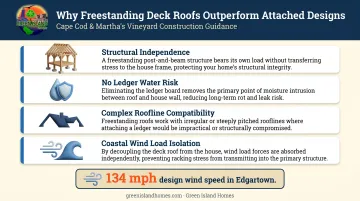
Attaching a roof cover to an existing home isn't simply a carpentry task — it's a load transfer problem. ICC Appendix I requires patio covers to sustain dead loads plus a minimum vertical live load of 10 psf, plus applicable snow loads. If the home's wall framing or roof structure wasn't engineered to absorb those forces, attachment is unsafe without reinforcement. Freestanding construction sidesteps that problem by creating an independent load path.
Ledger Water Risk
Building Science Corporation identifies careful detailing and flashing of a deck ledger connection as necessary for the integrity of the building drainage system. Every ledger attachment creates a penetration in the home's water-management envelope — a potential failure point. Freestanding construction eliminates that risk by keeping the structure clear of the house wall.
Site, Layout, and Design Considerations
- Complex rooflines: Dormers, multiple pitches, or steep angles make ledger attachment difficult and prone to water infiltration at the junction
- Deck placement — ground-level decks extending well into the yard, or those near a pool, often can't reach the house wall without impractical spans
- Design freedom: Freestanding structures can be placed, oriented, and scaled independently of the home's architecture — useful on irregular lots or when sun and shade positioning drives the layout
The Coastal Factor
On Cape Cod and Martha's Vineyard, prevailing wind and snow loads add a structural argument for freestanding design. Wind speeds in towns like Edgartown reach 134 mph (ultimate design wind speed, per 780 CMR), and freestanding construction avoids transmitting uplift forces back through a ledger into the home's existing structure.
How a Freestanding Deck Roof Is Structurally Supported
Footings: The Critical Starting Point
Every freestanding deck roof begins underground. Footings must be sized to handle the roof's dead load (materials) and live load (wind, snow), and in Massachusetts they must reach 48 inches below grade to clear the frost line. There are no verified county-level exceptions for Barnstable or Dukes County — treat 48 inches as the statewide minimum unless a local building official approves an alternative.
Near the coast, soil conditions can complicate footing requirements further. Sandy or unstable soil may require larger footing diameters or helical piers rather than standard poured concrete. Projects on the Cape and Vineyard should use an engineered design — not just a prescriptive guide — to account for these site-specific conditions.
Posts and Beams
Posts transfer the roof load down to the footings. One critical rule: posts must run uninterrupted from footing to roof beam. Stacking a new post on top of an existing deck post is not structurally sound and typically fails code inspection. If the existing deck posts weren't designed to carry roof loads, new independent posts with their own footings are required.
Horizontal beams span between posts and carry the rafters. Rafters then run from beam to beam — or from beam to ridge on a gable — and support the roofing surface. Lumber sizing varies by span, species, grade, and load; specific dimensions should come from an engineered plan or a local building official, not a generic online table.
Water Management
Without a house attachment point, drainage requires careful planning:
- Roof eaves should extend past the deck perimeter to shed water clear of the structure
- Gutters should direct runoff away from post footings and any adjacent foundation
- Ground grading around and beneath the deck should prevent water from pooling near post anchors
For homeowners on Cape Cod and Martha's Vineyard, working with a licensed and insured contractor like Green Island Homes helps ensure that post sizing, footing depth, and load calculations meet local coastal building requirements — where wind exposure and snow accumulation add complexity that generic prescriptive guides don't address.
Roof Styles and Material Choices
Comparing the Four Main Styles
| Style | Best For | Key Consideration |
|---|---|---|
| Shed | Smaller decks, modern aesthetics | Use steeper pitch in Massachusetts; low slopes trap snow and ice |
| Gable | Traditional Cape Cod-style homes | Good drainage, classic look — more complex framing than a shed |
| Hip | Exposed coastal properties | Smaller wind pressures than gable roofs in high-wind regions; most complex and expensive to build |
| Pergola | Ambiance, partial shade | No rain protection; retractable canopies or climbing plants can enhance coverage |
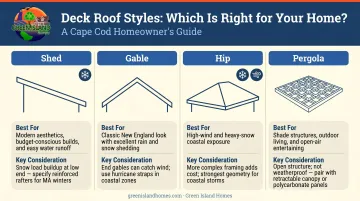
For properties in Edgartown, Chatham, or other exposed coastal locations where ultimate wind speeds exceed 130 mph, a hip roof's wind-load advantage over a gable is worth weighing against the higher framing cost. a hip roof's wind-load advantage over a gable is worth weighing against the higher framing cost. Your framing material choice will further affect how well the structure holds up in that environment.
Structural Framing Materials
- Pressure-treated lumber — widely available, cost-effective, suitable for most residential applications
- Cedar or redwood — natural decay resistance without chemical treatment; still requires corrosion-resistant fasteners in salt air
- Aluminum or steel — commonly specified for coastal environments where salt air accelerates wood deterioration; verify manufacturer warranty terms and any coastal exclusions
Roofing Surface Options
- Corrugated metal — durable, lightweight, long-lasting; amplifies rain noise, which bothers some homeowners
- Asphalt shingles — affordable and matches most existing home roofs; requires adequate pitch for proper drainage
- Polycarbonate panels — admits natural light beneath the cover; rated for -40°F to 248°F and resistant to significant light-transmission loss over time, making them a practical choice for year-round New England use
Permits, Building Codes, and Contractor Considerations
Massachusetts Code Framework
Massachusetts follows the 10th edition of 780 CMR, which became effective October 11, 2024, and is based on the 2021 IBC and 2021 IRC. This is the current baseline for any 2025–2026 project. Local municipalities — including Barnstable County towns and Dukes County — may layer additional requirements on top.
The residential code does exempt some small detached structures from permit requirements, but the criteria are narrow: structures must be 200 square feet or less, no more than 30 inches above grade, not attached to a dwelling, and not serving as a required exit. A roofed freestanding deck cover will almost certainly require building-department review.
What the Permit Process Covers
Expect the permit process to address:
- Setbacks from property lines, easements, and wetlands (set by local zoning, not state code — check your town zoning bylaw directly)
- Footing depth and size for the specific snow and wind loads applicable to your town
- Structural connections and uplift hardware
- HOA restrictions, which are common in coastal communities on the Vineyard and Cape — covering height, materials, style, and setback from the shoreline
Falmouth's building department notes that permit review typically takes 10 to 30 days for standard residential projects. Coastal parcels may also trigger Conservation Commission review under wetlands and floodplain regulations.
Why a Licensed Contractor Matters
That permit and review process is easier to navigate with a licensed contractor managing it. A qualified contractor will:
- Submit engineered drawings to the building department
- Schedule the required inspection sequence — footing, framing, and final
- Confirm code compliance before any concrete is poured or lumber goes up
Catching a structural or setback issue on paper costs nothing. Catching it after framing is a different story.
What Does a Freestanding Deck Roof Cost?
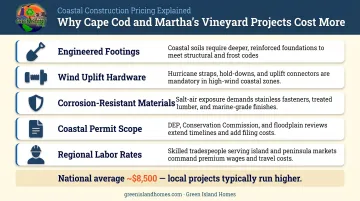
National benchmarks from Fixr put covered patio projects in the $4,000–$12,000 range, with a national average around $8,500. Pergola-style open structures tend to run $2,500–$6,000. Treat these as a starting point — not as quotes for Cape Cod or Martha's Vineyard projects.
Why Local Costs Run Higher
Several factors push Cape and Vineyard projects above national averages:
- Engineered footings — coastal soil conditions and 48-inch frost depth requirements add material and labor costs not reflected in national benchmarks
- Wind uplift hardware — town-specific wind speeds (up to 134 mph in Edgartown) require upgraded connectors and lateral bracing
- Material choices — corrosion-resistant framing and fasteners cost more than standard pressure-treated assemblies
- Permit scope — coastal parcels may require Conservation Commission review in addition to standard building permits
- Regional labor — construction labor on Cape Cod and Martha's Vineyard runs above national average rates
Budgeting Guidance
- Plan a 15–20% contingency for unexpected findings — poor soil, existing deck rot, or material cost fluctuations can add up quickly
- Get multiple written quotes before committing to a contractor
- Confirm what's included — engineered drawings, permit fees, and inspections are sometimes quoted separately
Frequently Asked Questions
Can I build a deck roof without attaching it to the house?
Yes. A fully freestanding deck roof is a common and code-compliant approach. It relies on independently engineered posts and footings rather than the home's structure, and avoids the water-management risks of a ledger attachment.
Do freestanding deck roofs require a building permit?
In virtually all Massachusetts municipalities, yes. A roofed freestanding structure over a deck will exceed the narrow exemption thresholds under 780 CMR and require building-department review covering footings, framing, setbacks, and inspections.
How much does a freestanding deck roof cost?
National benchmarks run $4,000–$12,000, but Cape Cod and Martha's Vineyard projects typically exceed those figures due to engineered footings, wind uplift requirements, and regional labor rates. Plan for a 15–20% contingency on top of any written quote.
Is a freestanding deck roof as strong as an attached one?
When properly engineered with correctly sized footings, posts, and uplift connections, a freestanding roof is equally durable. In high-wind coastal environments, it is often preferable: it doesn't transmit uplift forces back through a ledger into the home's existing structure.
What is the best roof style for a freestanding deck cover?
It depends on climate, aesthetics, and budget. Shed roofs are the simplest to frame; gable roofs offer classic Cape Cod appeal with good drainage; hip roofs provide the strongest wind performance for exposed coastal locations and are worth the added cost in high-exposure sites.
What materials hold up best near the coast?
Aluminum framing and metal or composite roofing surfaces resist salt-air corrosion better than untreated or even pressure-treated wood over the long term. Verify manufacturer warranty terms and any coastal exclusions before specifying materials for Vineyard or outer Cape properties.