Introduction
Planning a home addition forces a decision most homeowners don't see coming: what to do with the roofline. Done poorly, the addition looks like a trailer hitched to the back of the house. Done well, it reads as part of the original structure — and nobody notices where the old house ends.
A shed roof — sometimes called a lean-to, skillion, or mono-pitched roof — is consistently one of the simplest and most affordable routes for an addition. But simple framing doesn't mean simple decisions. Pitch ratios, headroom loss, material minimums, and attachment complexity can each derail a project that looked straightforward on paper.
For homeowners on Cape Cod and Martha's Vineyard, there's an added layer: coastal wind loads, snow accumulation, and salt air exposure shift the material calculus in ways that national guides skip over entirely.
This guide covers all of it — what a shed roof addition actually is, where it works and where it doesn't, how pitch affects the space inside, which materials hold up on the coast, and what to expect from permits and costs in this market.
Key Takeaways
- A shed roof (lean-to, skillion, mono-pitched) uses a single slope — the simplest and most affordable roof form for a home addition.
- Headroom is the primary constraint: the farther the roof extends, the lower the ceiling drops at the outer wall.
- Best applications: sunrooms, screened porches, and single-story bump-outs.
- Material choice depends on pitch: asphalt shingles require at least 2:12, while EPDM and TPO membranes work as low as 1/4:12.
- Permits, flashing, and structural review are all required for a code-compliant addition.
What Is a Shed Roof for a Home Addition?
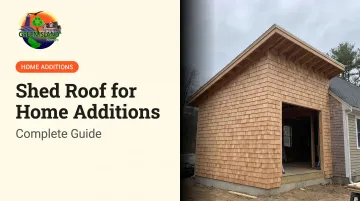
A shed roof addition is a single-slope roof attached to the existing house at a high point, then slanting downward to the outer wall of the new space. One continuous plane covers the addition — no ridge, no valleys, no intersecting slopes.
You'll see it listed under several names depending on where you look:
- Shed roof — most common residential term
- Lean-to — used in trade literature and building code documents
- Skillion or mono-pitched — common in architectural plans and contemporary design references
- Pent roof — older term, still appears in historic renovation contexts
None of these names carry legal weight. The IRC and Massachusetts residential code classify roofs by pitch, covering type, and load — not terminology. When you're reading contractor quotes or pulling permits, what matters is the pitch and roofing material, not what you call it.
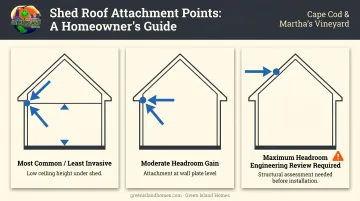
The Three Common Attachment Points
Where the shed roof ties into the existing house determines ceiling height and structural complexity:
- Low on the exterior wall, under the existing eave — the most common and least invasive attachment; limits ceiling height but requires minimal structural modification to the existing home.
- At the wall plate, where the main roof frame rests — gains some ceiling height while still attaching to proven structural members.
- Higher up on the existing roof slope — maximizes headroom, but transfers load onto rafters or trusses not originally designed for it. This option almost always requires an engineering review before permits are issued.
Pros and Cons of a Shed Roof Addition
Advantages
- Framing is straightforward — a single plane requires no complex carpentry, which means faster builds and more predictable contractor pricing.
- Fewer materials overall — no ridge framing, no intersecting valleys, and lower labor hours add up to real cost savings compared to a gable or hip roof.
- Attaches to almost any exterior wall or slope without requiring significant changes to the main structure.
- Water drains in one controlled direction — no valleys to collect debris or trap ice dams.
- On contemporary or mid-century homes, a well-designed shed roof reads as intentional rather than tacked on.
Drawbacks
- Headroom shrinks the further you go — the dominant constraint of shed roof design. At a 2:12 pitch, a 12-foot-deep addition loses 2 feet of ceiling height at the far wall. More on this math below.
- A poorly pitched or mismatched shed roof reads as cheap from the street. Some HOAs and municipalities restrict shed roofs over occupied living spaces — confirm restrictions with your local building department before finalizing the design.
- The joint where the shed roof meets the existing home is the highest-risk leak point in any addition. Low-pitch roofs compound this — water moves slowly, so any gap in the flashing eventually becomes a problem.
Pitch, Headroom, and Structural Considerations
Understanding Roof Pitch and What It Means for Ceiling Height
Pitch is expressed as a ratio: rise over 12 inches of horizontal run. A 3:12 pitch means the roof rises (or drops) 3 inches for every foot of horizontal distance. For a shed roof on an addition, the roof drops as it moves away from the house.
Concrete example: Start with an 8-foot ceiling height at the house wall. The addition extends 12 feet outward.
| Pitch | Drop over 12 feet | Ceiling height at outer wall |
|---|---|---|
| 2:12 | 2 feet | 6 feet |
| 3:12 | 3 feet | 5 feet |
| 4:12 | 4 feet | 4 feet |
A 2:12 pitch over 12 feet is marginal but livable at 6 feet. A 4:12 pitch over the same span produces a 4-foot ceiling — not a usable room. This is why most shed roof additions are limited to 10–14 feet of depth unless the attachment point is raised.
Minimum pitch requirements by material (per IRC 2021):
| Material | Minimum slope | Notes |
|---|---|---|
| Asphalt shingles | 2:12 | IRC R905.2.2; GAF treats 2:12–4:12 as low-slope requiring enhanced underlayment |
| Standing-seam metal | 1/4:12 | Strong low-pitch option |
| EPDM (thermoset) | 1/4:12 | IRC R905.12.1; 38-year expected service life per EPDM Roofing Association |
| TPO (thermoplastic) | 1/4:12 | IRC R905.13.1; positive drainage must still be achievable |
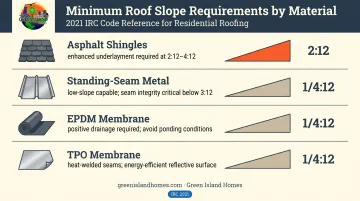
Don't specify asphalt shingles below 2:12 — IRC R905.2.2 prohibits it, and the physics of water infiltration on shallow slopes confirms why.
Structural and Engineering Factors
Pitch decisions don't live in isolation — they directly shape the structural demands placed on your addition. The shed roof transfers both vertical load and outward lateral thrust onto two points: the existing wall where it attaches, and the outer wall of the addition. Assess both before framing starts.
When engineering review is required:
- Attachment is made high on the existing roof slope, loading existing rafters or trusses
- The addition span exceeds approximately 14–16 feet
- The existing wall framing or foundation shows any signs of previous modification or inadequacy
Coastal climate loads in Massachusetts are town-specific, not regional averages. Massachusetts 10th edition residential code (effective October 2024) publishes design values by municipality. A few examples from Table R301.2(2):
| Town | Ground snow (Pg) | Flat roof snow (Pf) | Ultimate wind (Vult) |
|---|---|---|---|
| Barnstable | 30 psf | 25 psf | 130 mph |
| Falmouth | 30 psf | 25 psf | 131 mph |
| Edgartown | 25 psf | 25 psf | 134 mph |
| Aquinnah | 25 psf | 25 psf | 134 mph |
These values directly affect rafter sizing, sheathing thickness, fastener schedules, and tie-down hardware. "Coastal Massachusetts" is not a single design condition. Edgartown's 134 mph wind speed requirement and Barnstable's 30 psf snow load each demand specific structural responses — using a regional average for either will leave your design undersized for the actual site.
Best Roofing Materials for Shed Roof Additions
Material selection starts with pitch, then considers coastal exposure.
Asphalt shingles are the default for most residential additions. They match existing roofs well, carry the lowest installed benchmark cost (JLC 2025 Cost vs. Value puts Boston asphalt replacement at roughly $11.89/sf), and are straightforward for any licensed contractor. The limitation is the 2:12 floor — at 2:12–4:12, enhanced underlayment and low-slope manufacturer instructions are required.
Standing-seam metal is the stronger choice for coastal sites. It works at pitches as low as 1/4:12, handles hurricane-level wind loads, and carries a 30–50+ year lifespan per the Metal Roofing Alliance. JLC benchmarks installed metal at roughly $18.68/sf — higher upfront, but the durability payoff is clear on exposed coastal sites. Within 1,500 feet of open water, specify aluminum panels over steel for corrosion resistance at exposed edges.
EPDM membrane is the right call when pitch is very low and shingles aren't viable. The EPDM Roofing Association reports an expected service life of 38 years for properly maintained systems. Flashing at the wall connection is especially critical with membrane roofing — the detail has to extend well up beneath the existing cladding to prevent water infiltration at the high edge.
TPO covers the same low-slope applications as EPDM with a reflective surface option. Both require careful detailing. On street-facing additions, the flat commercial appearance is a real consideration — for rear bump-outs, it rarely matters.
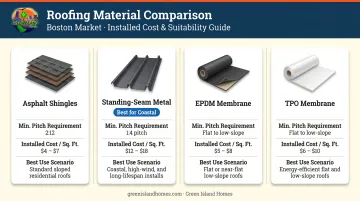
Here's a quick comparison to guide your decision:
| Material | Min. Pitch | Installed Cost (Boston) | Best For |
|---|---|---|---|
| Asphalt shingles | 2:12 | ~$11.89/sf | Standard residential additions |
| Standing-seam metal | 1/4:12 | ~$18.68/sf | Coastal sites, low-pitch roofs |
| EPDM membrane | Near-flat | Varies | Very low-slope, high durability |
| TPO membrane | Near-flat | Varies | Low-slope with reflective option |
Design Tips: Blending the Addition with the Existing Home
A shed roof addition can look intentional or it can look like an afterthought. The difference usually comes down to four decisions:
- Pitch relationship to the main roof. The shed roof doesn't need to match the main pitch exactly, but it should feel related. A 2:12 shed roof hanging off a 10:12 gabled cape creates obvious visual tension. A 3:12 or 4:12 shed roof on the same house reads as a subordinate slope rather than a mismatch.
- Scale subordination. The addition should read as secondary to the main structure. Keep the shed roof below the existing ridge, and keep the addition's footprint from overwhelming the original home's massing. This is both an aesthetic principle and, in many municipalities, a zoning requirement.
- Match materials precisely. Align roofing material, fascia profile, soffit depth, and siding between the addition and the main house. Mismatched colors or textures will make the addition read as a separate project — regardless of how well it's built.
- Leverage clerestory opportunities. Where the shed roof meets the existing wall, there's often a chance to add clerestory windows — high, narrow glazing that draws daylight into the back of the addition. Extended eaves at the outer wall can create a covered transition to a patio or deck, turning a functional roof form into a design feature.
Cost, Permits, and Hiring the Right Contractor
What to Expect on Cost
There's no reliable published figure for shed-roof-addition framing cost per square foot that can be directly compared to gable additions. What exists in verified public data are roofing material benchmarks from the JLC 2025 Cost vs. Value report for the Boston/New England market:
- Asphalt replacement scope: ~$11.89/sf installed (30-square scope)
- Metal replacement scope: ~$18.68/sf installed (3,000 sf scope)
These are roof-covering scopes, not complete addition prices. A full shed roof addition also includes foundation work, wall framing, interior finishing, windows, and mechanical rough-ins — all of which can dwarf the roof cost itself.
Cape Cod and Martha's Vineyard additions run higher than national averages due to Massachusetts labor rates (BLS data puts Massachusetts roofer wages above the national mean), ocean-exposure detailing requirements, corrosion-resistant fastener specifications, and — for Vineyard projects — ferry and logistics constraints.
Permits and the 25% Rule
Every home addition that involves structural work and a new roofline requires a building permit. In Massachusetts, the 10th edition building code (based on 2021 IRC) governs residential additions, and permit fees are calculated on construction value. Barnstable and Edgartown, for example, both use a $50 application fee plus $5.10 per $1,000 of construction value.
The "25% rule" you may have read about online is often misapplied. In Massachusetts, the 25% roof area trigger for bringing the full roof up to code does not apply as a blanket rule — the state's amendments tie any upgrade requirements to the entire roof diaphragm, not a percentage of surface area. Don't assume that tying into a quarter of your existing roof automatically requires a full reroof. Scope of work — as reviewed by your local building official — is what determines requirements.
Contact your town's building department before finalizing the design. Permit timelines vary by municipality, and some coastal towns require additional sign-offs.
Working with a Licensed Contractor
Shed roof additions look simple on paper but concentrate structural, waterproofing, and code-compliance demands at a single joint: the connection between the new roof and the existing home. That's where most failures originate.
Homeowners on Cape Cod and Martha's Vineyard can work with Green Island Homes, a fully licensed and insured builder based in Edgartown with HomeAdvisor Elite Service recognition. The company handles all phases of addition construction — from structural planning and permit coordination to roofing and interior finishes. Reach them at 774-563-9714 or sales@greenislandhomes.com.
Frequently Asked Questions
Are shed roof houses cheaper to build?
Shed roofs are generally among the most cost-efficient roof styles due to simpler framing and fewer materials. However, the overall cost of a home addition depends on far more than the roof type — foundation, square footage, finish level, and site access all drive the final number.
How much should it cost to reroof a shed?
Reroofing costs depend on size, pitch, and material. In the Boston market, asphalt replacement runs roughly $11.89/sf and standing-seam metal around $18.68/sf based on JLC 2025 data. A home addition shed roof typically costs more than a standalone outbuilding because of the flashing and wall connection work required.
What is the 25% rule for roofing?
The IEBC's 25% rule triggers code upgrades when more than 25% of a roof area is replaced. In Massachusetts, that area trigger does not apply as written — state amendments use a full-roof-diaphragm standard instead. Confirm the exact requirement with your local building department.
What pitch is best for a shed roof on a home addition?
A 3:12 or 4:12 pitch works well for most asphalt shingle applications while keeping headroom loss manageable. For shallow additions or tight ceiling situations, a 1:12–2:12 pitch with membrane roofing is a practical alternative.
Can a shed roof addition hurt my home's resale value?
Design execution matters more than roof style. A shed roof with mismatched materials, poor pitch relationship, or inadequate scale can hurt curb appeal and buyer perception. Done well — quality materials, proportions that suit the existing home — it holds and adds value.
Do I need a permit for a shed roof home addition?
Yes. Any structural addition with a new roofline requires a building permit in every Massachusetts municipality. Contact your local building department early — permit requirements, review timelines, and fee structures vary by town.