The answer has two distinct layers — permit requirements and contractor licensing — and confusing one for the other leads to expensive mistakes. A deck that doesn't need a permit might still require a licensed contractor. A permit doesn't automatically mean any person who shows up with tools can legally do the work.
This guide covers what Massachusetts law actually requires: when permits are triggered, what contractor credentials the state mandates, what the local Cape and Vineyard landscape adds to that picture, and what's at stake if either step gets skipped.
Key Takeaways
- Most decks attached to a home or over 30 inches above grade require a building permit in Massachusetts
- Paid contractors building decks must hold HIC registration and typically a Construction Supervisor License (CSL)
- Owner-builders can pull their own permits in limited circumstances, but cannot hire unlicensed labor to do the work
- Skipping permits can trigger fines up to $1,000 per day, complicate home sales, and affect insurance claims
- Verify a contractor's HIC number and CSL before signing any contract
Do You Need a Building Permit to Build a Deck?
Massachusetts has a statewide small-deck exemption, but it's narrow. Under 780 CMR R105.2, a deck is exempt from permit requirements only when it meets all four of these conditions:
- Does not exceed 200 square feet
- Is not more than 30 inches above grade at any point
- Is not attached to a dwelling
- Does not serve the required exit door under R311.4
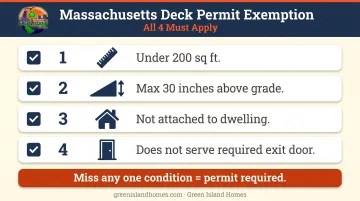
Miss even one condition and a permit is required. An attached deck, an elevated deck, or a deck that serves as your primary exit triggers the permit process automatically — regardless of size.
What Else Triggers a Permit
Beyond the deck structure itself, 780 CMR R105.1 requires permits for any regulated electrical, gas, mechanical, or plumbing systems. That means:
- Outdoor lighting circuits
- Gas lines for a fire pit or built-in grill
- Plumbing for an outdoor kitchen
- Electrical connections for a hot tub
Each of these may require its own separate permit on top of the structural building permit.
Local Variations on Cape Cod and Martha's Vineyard
The statewide threshold applies across Massachusetts, but each municipality administers its own building department. A few examples from the region:
- Oak Bluffs publishes the same four-part exemption test on its town website
- Falmouth's 2025 fee schedule explicitly lists decks, porches, and similar structures as permit-required work
- Edgartown's building department handles permits online
The rules are consistent in principle, but always confirm with your specific town's building department before starting. Setbacks, zoning overlays, and local fee structures vary by parcel.
Do You Need a Licensed Contractor to Build a Deck?
In Massachusetts, permits and contractor licensing are separate requirements — one doesn't cover the other. A deck that qualifies for a permit exemption doesn't mean anyone can legally build it for pay. And pulling a permit doesn't validate an unlicensed contractor's work.
Understanding which credentials your contractor needs is just as important as knowing whether your project requires a permit.
HIC Registration vs. Construction Supervisor License
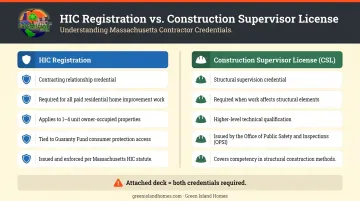
Massachusetts uses two distinct credential systems for residential construction work:
Home Improvement Contractor (HIC) Registration
- Required for any contractor, subcontractor, or company that solicits, bids, or performs work on existing owner-occupied residential property with 1–4 units
- Administered by the Office of Consumer Affairs and Business Regulation (OCABR)
- Tied to consumer protection, including access to the Home Improvement Guaranty Fund (capped at $10,000 per claim)
Construction Supervisor License (CSL)
- Required when work affects the structural elements of a building — including any deck attached to a dwelling
- A higher-level credential than HIC registration, focused on code supervision and technical competency
- Issued by the Office of Public Safety and Inspections
For a deck attached to your home, both typically apply. The contractor needs HIC registration to legally enter into the home improvement contract, and a licensed Construction Supervisor must be responsible for the structural work.
The "Deck Builder" Problem
Anyone can market themselves as a deck builder. The title carries no legal weight in Massachusetts. A person with a truck, tools, and a Facebook page can call themselves a deck builder without holding either an HIC registration or a CSL.
For the homeowner who hires them, that gap has real consequences:
- No Guaranty Fund access — if the work fails or the contractor disappears, you have no claim
- Personal liability — injuries on an improperly built deck may fall back on you
- Failed inspections — unlicensed work often can't be signed off, leaving the structure in limbo
The Owner-Builder Option
Massachusetts does allow homeowners to act as their own general contractor and pull permits for their primary residence. However, this exemption is narrow. OCABR explicitly warns that homeowners who pull their own permit may lose access to the Home Improvement Guaranty Fund protections. The owner-builder status also does not give you free rein to hire unlicensed third parties to do structural work — that restriction remains.
Deck Permits and Contractor Licensing in Massachusetts
Verifying Credentials Before You Sign Anything
Massachusetts makes both credentials searchable online:
- HIC registration: Search the MA Contractor Hub HIC Contractor Search
- CSL: Check through the Office of Public Safety and Inspections license lookup
Before signing any contract, ask for both numbers and verify them yourself. A reputable contractor will provide this without hesitation.
Cape Cod and Martha's Vineyard Overlays
State law sets the floor, but Cape Cod and Vineyard projects often have additional layers:
- Wetlands Protection Act (310 CMR 10.00): Massachusetts explicitly lists deck construction as regulated work near resource areas. Properties near ponds, wetlands, or coastal banks may need a Notice of Intent filed with the local Conservation Commission before any building permit is issued.
- Edgartown Conservation Commission: Administers both MGL c.131 s.40 and the Edgartown Wetlands Bylaw — a process entirely separate from the standard building permit.
- Coastal permitting: Projects along the shoreline may trigger additional state coastal permitting requirements.
- Martha's Vineyard Commission: Larger projects meeting DRI thresholds may require MVC review, though a standard residential deck addition doesn't automatically trigger this.
If your property sits anywhere near the water, check with both the building department and the Conservation Commission before assuming a standard building permit covers everything.
What Happens If You Build Without a Permit or Hire an Unlicensed Contractor?
Legal and Financial Consequences
Skipping permits isn't just a procedural issue. Massachusetts law provides real enforcement teeth:
- Stop-work orders: The building official can halt construction immediately when work violates code, with written confirmation required within 48 hours
- Criminal penalties: MGL c.143 s.94 authorizes fines up to $1,000, imprisonment up to one year, or both — and each day of violation can be treated as a separate offense
- HIC violations: MGL c.142A includes penalties up to $2,000 or one year imprisonment for knowing and willful violations of the home improvement contractor law
The Home Sale Problem
Those legal consequences don't disappear once construction ends — they follow the property. Unpermitted work creates serious complications when you sell. Real estate licensees in Massachusetts are required to disclose known material defects honestly. Beyond disclosure, the Fannie Mae Selling Guide requires appraisers who identify additions without required permits to comment on that fact and its potential impact on market value.
In the Cape Cod and Martha's Vineyard market — where home values run high and buyers often conduct thorough due diligence — an unpermitted deck can stall or kill a deal.
Insurance Exposure
The Insurance Information Institute advises homeowners to contact their insurer before major remodeling work and to verify contractor insurance coverage. While no regulation automatically voids all claims for unpermitted work, a deck built without permits or by an uninsured contractor can complicate or limit claim recovery if the structure causes injury or property damage.
The Retroactive Permit Process
Retroactive permitting is possible, but never inexpensive. It typically involves:
- Additional fees beyond standard permit costs
- Current-code inspections of existing work
- Potential structural modifications to meet today's standards
- Timeline delays during any sale or refinancing
On Cape Cod and Martha's Vineyard, where permit offices are busy and construction seasons are short, retroactive work can add months — and thousands of dollars — to a project that should have been straightforward.
Liability When an Unlicensed Contractor Is Involved
If an unlicensed contractor is injured on your property during construction, or causes damage to neighboring properties, you — the homeowner — bear full financial responsibility. An unlicensed contractor holds no license bond and likely carries no adequate insurance, leaving you with no coverage to fall back on.
What to Look for When Hiring a Deck Contractor on Cape Cod and Martha's Vineyard
Non-Negotiables Before Signing a Contract
Vet every contractor on these four points before any agreement is signed:
- HIC registration (Home Improvement Contractor) — verify at contractorhub.mass.gov
- Construction Supervisor License (CSL) — verify through the OPSI license lookup
- General liability insurance — request a certificate naming you as an additional insured
- Workers' compensation — confirm coverage for every person on your property
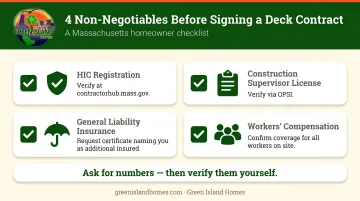
Ask directly. Request the registration and license numbers, then check them yourself.
Permitting Should Be the Contractor's Job
Once you've confirmed credentials, the next thing to nail down is who owns the permit process. A reputable licensed contractor handles the building permit application, coordinates required inspections, and ensures the deck passes final review. Confirm this in writing before work begins — some builders leave permitting to the homeowner, which puts you on the hook if inspections are missed or work fails review.
If you're planning a deck on Cape Cod or Martha's Vineyard, Green Island Homes checks all the boxes above — fully licensed, insured, and HomeAdvisor Screened & Approved. You can reach them at 774-563-9714 or sales@greenislandhomes.com.
Frequently Asked Questions
Do I need a licensed contractor to build a deck?
In Massachusetts, any paid contractor building a deck on a residential property must hold HIC registration. Attached or structural decks also require a Construction Supervisor License. Hiring someone without both credentials exposes you to legal, financial, and safety risk.
What happens if you build a deck without a building permit?
Consequences include stop-work orders, fines up to $1,000 per day under MGL c.143 s.40, potential forced demolition of the structure, complications with homeowners insurance claims, and appraisal or mortgage issues when you sell.
How much does it cost to build a 20x20 deck?
According to HomeAdvisor's 2025 deck cost guide, pressure-treated wood runs $15–$25/sq ft ($6,000–$10,000 for 400 sq ft); composite runs $30–$60/sq ft ($12,000–$24,000). Local permit fees and labor rates on Cape Cod and Martha's Vineyard will affect your final number.
Can a homeowner pull their own building permit for a deck in Massachusetts?
Massachusetts allows owner-builders to pull permits for their own primary residence, but OCABR warns this may affect Guaranty Fund protections. You also cannot hire unlicensed third parties to perform structural work under an owner-builder permit.
Does hiring a licensed contractor mean they handle the permits?
Reputable licensed contractors typically manage the permit application and inspection process as part of the project. Confirm this explicitly in your written contract before work begins, since not every contractor includes permitting in their default scope.
What is the difference between an HIC registration and a Construction Supervisor License in Massachusetts?
HIC registration is required for the contracting relationship itself — any paid home improvement work on a residential property. A CSL is a separate, higher-level credential required when work affects load-bearing or structural elements of a building. For an attached deck, you want a contractor who holds both.