Introduction
On Cape Cod and Martha's Vineyard, outgrowing your home puts you in a difficult position. The 2025 median single-family sale price on Cape Cod reached $790,000, while Martha's Vineyard averaged $2.6M — and inventory has tightened considerably, with single-family supply under $500,000 dropping 34% year-over-year. Trading up simply isn't realistic for most homeowners.
A second-story addition offers a different path: significant square footage gained without losing your yard, your location, or the mortgage rate you've locked in.
This guide covers everything you need to make a confident decision:
- Types of second-story additions and which fits your home
- Popular design ideas for new upper-level space
- How structural feasibility works — and why it must come first
- Realistic cost ranges for Cape Cod and Martha's Vineyard projects
- A practical planning roadmap from first assessment through construction
Key Takeaways
- Second-story additions are often more cost-effective than moving to a larger home in high-cost markets like Cape Cod and Martha's Vineyard
- Five addition types to know: full, partial, pop-top, dormer, and modular — each with distinct cost and disruption trade-offs
- Always get a structural engineer assessment before any design work begins
- Costs typically range from $100,000–$450,000 depending on scope, finishes, and local labor rates
- Budget a contingency fund of at least 10% for unforeseen structural discoveries
Types of Second-Story Additions: Understanding Your Options
Not every second-story addition looks the same. The right approach depends on how much space you need, what your home's structure can support, and what your budget allows.
Full Second-Story Addition
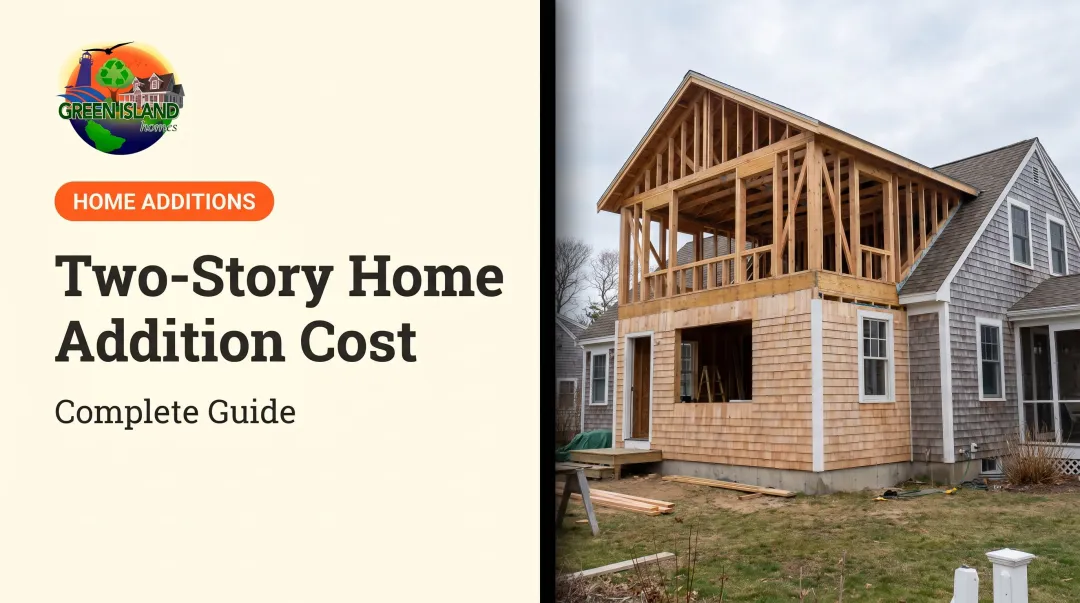
A full addition removes the existing roof entirely and constructs a complete new level across the home's entire footprint. It delivers the maximum square footage gain, but comes with the highest cost, the longest timeline, and the most disruption: the home is essentially open to the elements during framing. This option suits homeowners who need a dramatic transformation — multiple bedrooms, a primary suite, and added living space all at once.
Partial Second-Story Addition
A partial addition builds out over just one section of the home: above a garage, over a rear wing, or above a specific room cluster. It's more targeted, generally less expensive, and less disruptive than a full build-out. This works well when you have one specific need — like adding a primary suite above the garage — rather than reimagining the entire home.
Other Addition Types Worth Knowing
| Type | What It Is | Best For |
|---|---|---|
| Pop-top | Raises the roofline to create livable headroom on an upper level | Ranch-style homes with low-pitched roofs |
| Dormer | Converts unused attic space into habitable rooms by adding vertical wall sections with windows | Homes with existing attic volume but limited headroom |
| Modular/prefabricated | Upper-level components built off-site and installed on-site, reducing construction duration and weather exposure | Homeowners prioritizing speed and budget predictability |
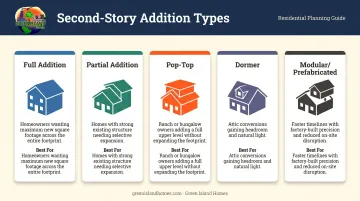
Modular construction — a specialty of Green Island Homes — is worth a closer look for second-story additions. NAHB reports that nearly 90% of modular structure can be built off-site, with site preparation happening simultaneously, which compresses the overall timeline considerably.
Second Story Addition Ideas: What Could Your New Space Look Like?
Luxurious Primary Suite or Private Retreat
The most popular use of new upper-level space. Moving the primary bedroom upstairs creates a genuine private sanctuary — physically separated from main-floor activity, kids' bedrooms, and guest traffic.
A well-designed suite typically includes:
- A spacious bedroom with room for a sitting area
- An en-suite bathroom with quality fixtures (walk-in shower, soaking tub, double vanity)
- A walk-in closet with custom organization
On the resale side, the 2025 Cost vs. Value report puts a midrange primary suite addition at $170,517 in construction cost. In coastal markets where price-per-square-foot already runs high — Dukes County hit $982/sq ft as of early 2026 — well-executed additions can recapture meaningful value.
Home Office or Creative Studio
The Martha's Vineyard Commission's 2024 Housing Needs Assessment found that remote work drove a direct influx of mainland residents — people who chose the Vineyard precisely because they could work anywhere, then discovered their homes lacked adequate workspace.
A dedicated upper-level office solves that directly: physical separation between work and living. A second-floor room with ocean views and no foot traffic gives you a workspace that's actually separate from the house it sits above.
Kids' Bedrooms and Dedicated Play Zone
Moving children's bedrooms and a playroom upstairs works in both directions at once:
- The main floor reclaims room for shared living, dining, and entertaining
- Kids get their own domain, naturally separated from adult common areas
- The layout scales as children get older — no expensive reconfiguration needed
For growing families who don't want to move (and who can't afford to in this market), it's one of the more practical configurations available.
Guest Suite or In-Law Apartment
This option carries particular weight on Martha's Vineyard and Cape Cod. A well-designed second-story guest suite or semi-independent in-law apartment with a private entrance can serve dual purposes: family hosting year-round and seasonal rental income during the summer months.
The short-term rental market here is substantial. The Vineyard Gazette reported approximately 4,000 short-term rental units islandwide, and STR tax revenue on the Vineyard rose from $2.1M in FY19 to nearly $9M in FY23 — reflecting the volume of demand.
Green Island Homes designs and builds custom additions across Cape Cod and Martha's Vineyard, handling all phases from structural planning through finished interior work.
Flex Room: Media Room, Gym, or Hobby Space
Families change. A dedicated flex room planned correctly now can serve as a home gym, a media room, or a craft and hobby space — and transition between uses without expensive renovation.
The key is planning infrastructure upfront:
- Durable flooring that handles both equipment and furniture
- Robust soundproofing (important above bedrooms or a quiet study)
- Ample electrical circuits to support audio/visual equipment or power tools
Is Your Home Ready? Assessing Structural Feasibility
Foundation Assessment: The Mandatory First Step
Most single-story homes were engineered to support exactly one story. Adding a new level introduces thousands of pounds of new load (walls, floor framing, roofing, furniture, and occupants) that the original foundation was never designed to carry.
A licensed structural engineer must inspect the foundation, footings, and first-floor framing before any design work begins. On Cape Cod and Martha's Vineyard, many homes were built decades ago and may not meet current structural standards. Foundation reinforcement, when required, typically starts at $5,000 and scales up based on what the inspection reveals.
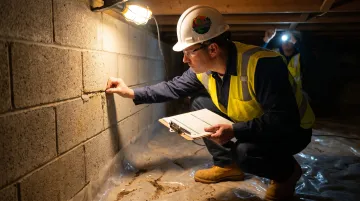
Do not skip this step. Discovering a foundation problem mid-design means expensive revisions and wasted fees.
Ceiling Joists vs. Floor Joists: Why Attic Framing Isn't Enough
The beams visible in an attic are ceiling joists, sized to hold up drywall and light insulation. They are not designed to support people, furniture, or interior walls.
The 2021 IRC requires 30 psf live load for sleeping rooms and 40 psf for other habitable rooms. Ceiling joists are sized under entirely different attic-load provisions , well below these thresholds. True floor joists, engineered to handle full occupancy loads, must be designed and installed as part of any second-story addition.
Assuming existing attic framing can serve as a second-story floor is a serious structural and safety error.
Roofline Integration
The new roof structure must tie into the existing roofline to ensure weatherproofing and visual continuity. Poor integration creates water intrusion paths and an addition that reads as an afterthought rather than part of the original home.
Standard practice is matching the pitch, profile, and materials of the existing roof. On Cape Cod and shingle-style homes, roofline consistency directly affects curb appeal and appraised value.
HVAC, Electrical, and Plumbing Integration
Systems integration must be planned during design, not figured out after framing begins. Key questions to resolve early:
- HVAC: Can the existing system handle the added square footage, or does the new level need its own zone? A separate mini-split system is often the cleaner solution.
- Plumbing: Stacking bathrooms vertically — locating new bathrooms directly above existing ones — significantly reduces pipe runs and labor cost. Design for this from the start.
- Electrical: Is the current panel capacity sufficient, or does an upgrade need to be built into the project budget?
Structural Engineer vs. Architect: Who Goes First?
For most second-story additions, engage both simultaneously or in close coordination. The engineer determines what's structurally possible and what reinforcements are required. The architect translates those constraints into a functional design.
Finalizing a detailed design before getting structural input almost always leads to costly revisions when the engineer identifies load issues the design didn't account for.
How Much Does a Second-Story Addition Cost?
Typical Cost Ranges
According to HomeAdvisor's 2025 data, most second-story additions fall within these benchmarks:
| Scope | Cost Range |
|---|---|
| National average | ~$175,000 |
| Typical national range | $100,000–$250,000 |
| Full addition (1,500 sq ft home) | $150,000–$450,000 |
| Per square foot | $100–$300 (up to $500 for high-end finishes) |
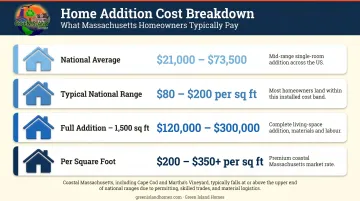
Construction costs in coastal Massachusetts run higher than national averages. Labor, logistics, seasonal demand, and island supply chain constraints on Martha's Vineyard all push project costs upward. Gordian's 2025 data shows labor wages up 4.1% year-over-year nationally — a trend that hits high-demand coastal markets harder.
Key Factors That Drive Cost Up or Down
- Larger square footage directly increases materials, labor, and project duration
- Foundation upgrades and new floor joists add substantial cost when structural reinforcement is needed
- Complex rooflines (dormers, hip-to-gable transitions, custom profiles) cost significantly more than simple gable or shed extensions
- Higher-end finishes — spa bathrooms, custom tile, millwork — can push a single room's budget well past a basic bedroom
- Panel upgrades, new HVAC zones, and added plumbing all layer onto the baseline cost
Knowing which of these factors apply to your project early — before design gets too far along — is one of the best ways to avoid budget surprises.
Smart Budgeting Rules
AIA recommends a design contingency of 5–10% of construction cost; NAHB advises lenders to require at least 10% as a minimum buffer. On older Cape Cod and Vineyard homes where hidden structural conditions are common, budgeting 15% is smart.
Also research your home's current market value before committing to a project scope. Spending $400,000 on additions to a home worth $600,000 creates a value gap that's difficult to recover through resale.
Ways to Manage Costs Without Cutting Corners
- Use standard-sized windows and doors rather than custom dimensions
- Stack bathrooms vertically to minimize plumbing runs
- Choose durable mid-range finishes now; upgrade cosmetic elements later when budget allows
- Consider modular or prefabricated construction for faster timelines and more predictable pricing — Green Island Homes has modular construction expertise and can help you determine if it's the right fit
Design and Planning Tips for a Successful Second-Story Addition
Match Your Home's Architectural Style
The best additions look like they were always there. Key design principles for architectural consistency:
- Match siding, trim, and roofing materials exactly
- Align second-story window openings vertically with first-floor windows
- Mirror the pitch and profile of the existing roofline
- Use trim details — corner boards, fascia, rakes — that match the original
This matters especially on Cape Cod, colonial, and shingle-style homes common throughout the region. An addition that fights the original architecture affects curb appeal and can complicate appraisals.
Plan the Floor Layout for Real-Life Function
Good-looking rooms that don't function well frustrate homeowners daily. Layout principles worth following:
- Position the new staircase near an existing hallway to preserve ground-floor circulation
- Group bedrooms and bathrooms together rather than scattering them
- Keep noisy rooms (laundry, bathrooms) away from quiet spaces below
- Design window placement for natural light, not just exterior symmetry
Navigate Permits and Local Regulations Early
Building permits are required for every second-story addition, and timelines vary. A few key regulatory facts to plan around:
- Massachusetts 780 CMR requires building officials to review applications within 30 days — but that's a review standard, not a guarantee of approval
- Real-world backlogs can extend timelines significantly; Cape Cod departments have logged roughly 100 permits awaiting review during peak periods
- Historic district properties require HDC approval before building permits can be issued
- Edgartown's Historic District Commission meets twice monthly, with application deadlines the Monday before each hearing
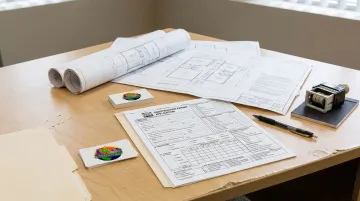
Green Island Homes is fully licensed and insured, based in Edgartown, and has direct experience navigating local permitting processes across Cape Cod and Martha's Vineyard.
Build the Right Team from Day One
Three professionals are essential:
- Structural engineer — determines what the structure can support and what reinforcements are required
- Architect or designer — translates structural constraints into a functional, beautiful space
- Licensed general contractor — manages construction, coordinates trades, and holds the project together
Get all three aligned before breaking ground. When these roles aren't coordinated from the start, mid-project changes become expensive fast. Request at least three detailed bids, verify licenses, and check references before committing.
Frequently Asked Questions
What is the average cost of a second-story addition?
Costs vary considerably based on scope and finishes. Partial additions typically range from $100,000–$250,000, while full second-story additions for a 1,500-square-foot home can reach $150,000–$450,000. Coastal markets like Cape Cod and Martha's Vineyard tend toward the higher end of any national range.
What is the difference between a full and partial second-story addition?
A full addition adds a new level across the entire home footprint and requires complete roof removal. A partial addition builds over just one section — above a garage or rear wing, for example — making it less expensive and less disruptive. Homeowners who need one additional space typically choose the partial route.
Can my existing foundation support a second story?
Most single-story homes were engineered only for their original load. A licensed structural engineer must assess the foundation, footings, and framing before any design planning begins. This is the single most important step in the process — don't skip it to save time or money upfront.
Do I need permits to add a second story to my home?
Yes, always. Building permits are required for all second-story additions in Massachusetts. Homeowners in historic districts or coastal zones should budget additional time for supplemental reviews, which can add weeks to the approval timeline.
How long does a second-story addition take from start to finish?
The full timeline — design, permitting, and construction — typically runs 6 to 12 months. Design and permitting alone can take 2–4 months. Active construction adds another 3–6 months depending on scope, and regional permit backlogs can push the front end out further.
Do I need to move out during a second-story addition?
It depends on scope. Partial additions may allow homeowners to stay, though dust, noise, and disruption are significant. Full additions require removing the entire roof — most families relocate temporarily, so build those housing costs into your budget from the start.