
Introduction
For homeowners on Cape Cod and Martha's Vineyard, the math on moving is brutal. Median single-family home prices on Cape Cod hit $790,000 in 2025, according to CCIAOR's year-end market report — and inventory sits at just 2.0 months of supply. When you need more space, selling and buying somewhere larger often costs more than expanding where you already are.
A two-story home addition doubles your usable floor area without shrinking your lot or giving up a location you've already invested in. But costs vary dramatically — and the gap between what national cost calculators show and what you'll actually pay in this region is substantial.
This guide breaks down realistic pricing ranges, what drives costs up, where money gets wasted, and how to budget realistically for what this region actually costs.
Key Takeaways
- Two-story addition costs typically range from $150,000 to $500,000+, or $150–$500+ per square foot depending on size, complexity, and location
- The biggest cost drivers: foundation work, structural requirements, finish selections, systems upgrades, and coastal/island labor premiums
- Building two stories from one foundation often improves cost per square foot vs. a single-story build-out, provided structural tie-in costs don't offset the savings
- Always hold a 15–20% contingency fund; unexpected structural issues are especially common in older Cape and Vineyard homes
- Get local bids, not national estimates. Regional premiums are real and online cost calculators won't capture them.
How Much Does a Two-Story Home Addition Cost?
A two-story home addition is a new two-story wing or structure added beside your existing home — not the same as adding a second floor on top of an existing single-story house. You get new living space on both a ground floor and an upper floor simultaneously, served by one new foundation and one new roof section.
The most common budgeting mistake: homeowners find a per-square-foot number online, multiply by their desired square footage, and treat that as their budget. It never holds. Structural work, systems upgrades, professional fees, and permits can add 20–30% on top of the base construction quote before framing begins.
Typical Cost Ranges
| Tier | Cost Per Sq Ft | Best For |
|---|---|---|
| Entry-level | $150–$250 | Simple layouts, standard finishes |
| Mid-range | $250–$400 | Moderate complexity, upgraded finishes |
| High-end | $400–$500+ | Custom design, premium materials, coastal builds |
Most homeowners land in the mid-range. Entry-level works only for simple rectangular additions with no structural complications. High-end costs are driven by custom rooflines, significant foundation work, or coastal logistics — Martha's Vineyard projects frequently reach this tier because materials must be ferried in and contractor availability is limited.
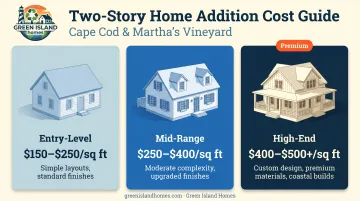
Note: These ranges are based on HomeAdvisor's 2025 second-story addition data as a national proxy. Actual costs in Cape Cod and Martha's Vineyard markets require local bids — regional premiums are not captured in national calculators.
What These Ranges Include and Exclude
Typically included in a contractor's base quote:
- Framing, roofing, and exterior siding
- Windows and exterior doors
- Insulation and drywall
- Basic interior finishes and electrical rough-in
That base quote can look deceptively clean. The items below are routinely left out — and together, they can add $30,000–$80,000 to the final cost:
Budget these separately:
- Architect fees and structural engineering stamps
- Building permit and inspection fees
- HVAC expansion or new zoning
- Electrical panel upgrades
- Plumbing rough-in for new bathrooms
- Temporary housing during disruptive phases
- Landscaping restoration
- Furniture for new rooms
Under Massachusetts law, residential contracts over $1,000 must include a detailed description of work, materials, and permit responsibilities. Any quote that doesn't spell out exclusions explicitly should be questioned before you sign.
Key Factors That Drive the Final Cost
The final number on a two-story addition reflects structural realities, design choices, and market conditions. Understanding each one is how you avoid sticker shock mid-project.
Foundation and Structural Requirements
Before any design work begins, a structural engineer needs to assess your existing foundation. Most foundations were not designed to support a significant new wing, and the assessment frequently reveals reinforcement needs.
Current costs to plan for:
- Structural engineer inspection: $345–$804, averaging around $574
- Foundation repair (typical range): $2,225–$8,133
- Settling or sinking repairs: $5,000–$25,000
- Piering or underpinning: $1,000–$3,000 per pier
- Load-bearing wall removal (multi-story): $3,200–$10,000
This is the most unpredictable cost variable on the entire project. Hidden issues (inadequate footings, outdated framing, old wiring running through walls) are discovered during construction, not before. The 2024 Houzz renovation survey found 35% of homeowners exceeded their renovation budget, with unexpected construction issues among the leading causes.
Size, Design Complexity, and Finishes
Square footage scales cost linearly. Design complexity multiplies it.
A simple 24×16 rectangular addition costs significantly less per square foot than the same footprint with vaulted ceilings, multiple rooflines, dormers, or custom window configurations. Every non-standard design element adds both material and labor cost.
Finishes are where you have real budget control. Structural materials are fixed by code and size, but flooring, cabinetry, tile, and fixtures can shift the total by tens of thousands. Mid-grade vs. premium selections typically represent a $30,000–$60,000 difference on a larger addition.
Systems upgrades are a separate line item that surprises many homeowners:
- HVAC zoning system: $1,500–$8,500
- Electrical panel upgrade: $750–$2,000
- Bathroom plumbing rough-in: $3,000–$20,000 depending on fixture count and distance from existing lines
Location and Labor Rates
Cape Cod and Martha's Vineyard construction costs run above national averages. Labor rates are higher, permitting requirements are stricter, and on the Vineyard, there's a layer of logistical friction that doesn't exist on the mainland.
The Steamship Authority imposes size and reservation requirements on commercial freight vehicles. Oversized vehicles are charged double fares. Construction materials that would arrive by flatbed truck on the mainland require advance coordination and ferry scheduling — that cost lands directly in your bid.
Falmouth's 2025 permit fee schedule shows alteration and addition permits at $8 per $1,000 of construction value with a $100 minimum. Tisbury uses a square-foot structure for residential work. These vary by town, and any cost estimate that doesn't account for local permit fees is already wrong.
Complete Cost Breakdown: Where the Money Goes
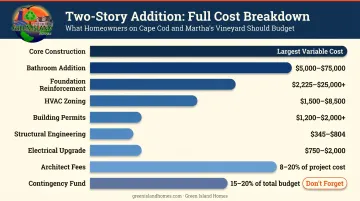
Here's how a realistic total project budget stacks up across all cost categories:
| Cost Category | Typical Range | Notes |
|---|---|---|
| Structural engineer assessment | $345–$804 | Required before design begins |
| Foundation reinforcement (if needed) | $2,225–$25,000+ | Highly variable — inspect first |
| Architect fees | 8–20% of construction cost | Higher end for complex or custom designs |
| Building permits | $1,200–$2,000+ locally | Use town fee schedules, not national estimates |
| Core construction (framing, roofing, exterior, finishes) | Largest line item | Labor premium applies in coastal MA |
| HVAC zoning | $1,500–$8,500 | Usually required for meaningful additions |
| Electrical panel upgrade | $750–$2,000 | Often needed when adding significant square footage |
| Bathroom addition (if included) | $5,000–$75,000 | Wide range based on scope and finish level |
| Contingency fund | 15–20% of total budget | Non-negotiable — see below |
Ongoing costs homeowners often miss:
- Property taxes will increase after assessed value rises
- Homeowner's insurance premiums adjust upward for additional square footage
- Maintenance costs grow proportionally with the new space
HomeAdvisor's 2025 data puts architect fees at 8–20% of total project cost for second-story and complex addition work. On a $300,000 construction budget, that's $24,000–$60,000 in design fees — before permits or engineering.
Building Up vs. Building Out: Which Costs Less?
The honest answer depends on your lot, your budget, and how much structural work the tie-in requires.
Single-story ground-floor addition:
- Lower total project cost
- Simpler structural tie-in
- Consumes yard space
- One foundation, one roof — but only for one floor of new space
Two-story addition (new two-story wing):
- Higher total cost
- One foundation and one roof serves two floors
- Preserves yard space
- Better cost-per-square-foot when the structural tie-in costs stay manageable
National data puts single-story additions at $80–$210 per square foot, while two-story work runs $100–$300 per square foot, with high-end projects reaching $500. The two-story calculation works in your favor when your lot is constrained, property values are strong, and structural costs don't dominate the budget.
Build out when: Budget is tight, the site has ample yard space, and structural complications are unlikely.
Build up when: The lot is limited, you need substantial square footage, and the property value in your area supports the investment. On Cape Cod and Martha's Vineyard — where buildable land is scarce and property values are among the highest in New England — two-story additions routinely make financial sense.
What Most Homeowners Get Wrong When Budgeting
Anchoring to the Per-Square-Foot Number
A $250/sq ft estimate on a 600 sq ft addition looks like a $150,000 project. But add architect fees (say $18,000), structural engineering and permit costs ($5,000–$8,000), HVAC zoning ($5,000), electrical upgrade ($1,500), and a 15% contingency on the base — and that same project is realistically $195,000–$210,000 before the first nail goes in.
Soft costs add 20–30% on top of the base construction quote in many markets. Budget for them from the start, not as surprises at the end.
Assuming Existing Systems Are Adequate
Most homeowners assume their existing foundation and HVAC will handle a new addition. In practice, they rarely do. Common findings include:
- Foundation reinforcement — structural assessments almost always identify some need for additional support
- HVAC expansion — systems sized for the original footprint won't adequately serve a significant addition without a new zone or increased capacity
Skipping the Contingency Fund
Those system upgrades are exactly the kind of mid-project discovery that blows a budget wide open. Without a 15–20% contingency set aside from day one, a single unexpected finding can derail the entire project. This is especially true for older homes — and Cape Cod and Martha's Vineyard have no shortage of them.
According to Houzz renovation research, 35% of homeowners who renovated exceeded their budget, with unexpected construction issues as a primary cause. A contingency fund doesn't mean you expect problems — it means you're prepared for the ones you can't see yet.
How to Set a Realistic Budget for Your Addition
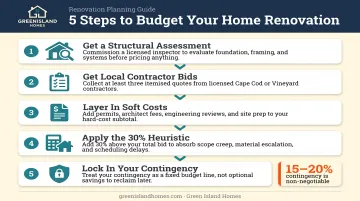
Follow this sequence — in this order:
- Get a structural assessment first. Before committing to any design scope, know what your foundation and framing can support. This $345–$800 investment protects you from designing a project you can't actually build at the assumed cost.
- Get local contractor bids. National cost calculators don't reflect Cape and Vineyard labor rates, permit fees, or logistics. Get at least two or three bids from contractors who regularly work in your specific town.
- Layer in soft costs explicitly. Architect fees, structural engineer stamp, permit fees, and inspection costs should each be a separate line item — not a vague "add 10%" at the end.
- Apply the 30% heuristic as a sanity check. Some advisors suggest not spending more than 30% of your home's current market value on any single renovation to avoid over-capitalizing. With Cape Cod's 2025 median at $790,000, that's roughly $237,000 — though high-value coastal properties often justify higher investment when the ROI against local comps supports it. Treat this as a planning check, not a hard rule.
- Lock in your contingency. 15–20% of total projected spend, held in reserve and not touched unless something unexpected forces the issue.
A contractor with real experience in Cape and Vineyard permitting, local labor, and island logistics will give you numbers that actually hold up. Green Island Homes, based in Edgartown, works specifically on additions and renovations across Cape Cod and Martha's Vineyard — so estimates reflect what projects here genuinely cost.
Frequently Asked Questions
How much does it cost to add a two-story addition to a house?
Total costs typically range from $150,000 to $500,000+, with per-square-foot costs running $150–$500+ depending on size, structural requirements, finish selections, and local labor market. Cape Cod and Martha's Vineyard projects tend toward the higher end of these ranges.
Is it cheaper to add a second story or build out?
Building out typically costs less upfront, but a two-story addition delivers two floors of space from a single foundation and roof — often a better cost-per-square-foot outcome. Structural tie-in costs and regional labor rates can close that gap, so compare bids for both options before deciding.
How long does a two-story home addition take from start to finish?
Design and permitting typically runs 2–4 months; active construction takes another 4–8 months. Total project timelines of 6–12 months are common, with longer timelines possible on complex projects or in towns with slower permit review processes.
Will I need to move out during construction?
Not always, but phases involving roof work or structural tie-in can make the home difficult to live in temporarily. Ask your contractor upfront which phases are most disruptive and budget for short-term housing if those phases apply to your project.
What ROI can I expect from a two-story home addition?
The JLC 2024 Cost vs. Value Report for New England shows major additions recouping roughly 40% of cost at resale — a midrange primary suite addition returned about $69,270 on a $170,310 investment. Think of a two-story addition as a long-term upgrade and an alternative to moving, not a short-term resale strategy.