The catch is that bump-outs aren't as simple as they look. Outcomes vary widely depending on room type, how far the extension needs to go, what the existing structure can support, and what local codes allow. In regulated areas like Cape Cod and Martha's Vineyard, zoning setbacks, Historic District Commission review, and Massachusetts energy code requirements add layers that catch unprepared homeowners off guard.
This guide covers what a bump-out addition is, how to plan one step by step, when it makes sense, what drives costs, and the most common mistakes to avoid.
Key Takeaways
- A bump-out extends an existing room outward — typically 2 to 15 feet — without adding an entirely new room or requiring a full home addition.
- Bump-outs under roughly 2 feet can often be cantilevered off existing joists with no foundation work. Anything deeper almost always needs footings or a slab.
- Costs typically run $10,000–$43,000 ($90–$300 per sq ft), with kitchens and bathrooms at the higher end.
- Bump-outs work best for expanding a specific cramped room, not for creating new ones.
- Always verify zoning setbacks, lot coverage limits, and permit requirements before designing anything, especially on the Cape and Vineyard.
What Is a Bump-Out Addition?
A bump-out addition is a small outward extension of an existing room — not a new room built from scratch. It pushes one wall out to gain functional floor space while keeping the home's basic layout intact. Depths typically run from 2 feet up to 10–15 feet, depending on structural limits, zoning setbacks, and what the project needs to accomplish.
Cantilevered vs. Foundation-Supported
The distinction matters for cost and complexity:
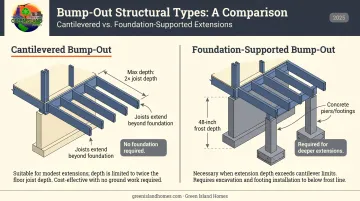
- Cantilevered bump-outs extend off existing floor joists without a new foundation — typically limited to shallower projections based on joist size and load conditions.
- Foundation-supported bump-outs (anything deeper) require concrete piers, footings, or a slab. In Massachusetts, frost depth is 48 inches, which directly affects foundation costs for any grade-level extension.
Under IRC 2021 Section R502.3.3, cantilever spans generally cannot exceed the nominal depth of the joist — meaning a 2x8 joist allows roughly 8 inches of projection under standard conditions. Actual limits depend on load conditions, backspan ratios, and local engineering review.
Once you need foundation work, the project functions structurally like a scaled-down room addition — with corresponding costs.
Common Bump-Out Types
| Room | Typical Use |
|---|---|
| Kitchen | Counter space, island clearance, breakfast nook |
| Bathroom | Soaking tub, double vanity, added storage |
| Bedroom | Sitting area, walk-in closet |
| Living room | Expanded seating, built-in entertainment center |
| Mudroom/entryway | Boot storage, transition space |
Pros and Cons at a Glance
Pros:
- Lower total cost than a full room addition
- Faster timeline (typically weeks, not months)
- Less disruption to the rest of the home
- Strong ROI when applied to high-use rooms like kitchens and bathrooms
Cons:
- Higher cost per square foot than a full addition due to fixed startup expenses
- Permit requirements in virtually every jurisdiction
- Risk of adding space too small to be genuinely useful
How to Plan a Bump-Out Addition: Step by Step
Step 1: Define the Goal and Target Room
Start with a specific functional problem, not a vague desire for more space. The clearest projects produce the best results because scope stays tight and decisions stay grounded.
Ask: what does this room need to do that it currently can't? A kitchen that gains 30–45 square feet for a proper island delivers far more daily value than the same addition tacked onto a living room that's already functional.
Step 2: Check Zoning, Setbacks, and Local Permit Requirements
Under Massachusetts 780 CMR Section 105.1, permits are required before constructing, enlarging, or altering any structure. A bump-out that opens an exterior wall and changes the building footprint falls squarely under this requirement. The ordinary repair exception under Section 105.2.2 explicitly excludes work involving substantial cutting of structural walls.
Before designing anything, verify:
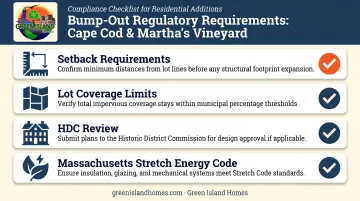
- Setback requirements — front, side, and rear distances from property lines
- Lot coverage limits — many coastal lots are already near their maximum
- HDC review — Barnstable's Old King's Highway Regional Historic District regulates construction, alteration, and demolition of exterior architectural features; Edgartown and other Vineyard towns have similar processes
- Massachusetts Stretch Energy Code (225 CMR 22.00) — additions under 1,000 sq ft must meet prescriptive envelope requirements, including ceiling R-49 and wood-frame wall R-20+5ci or R-13+10ci
Skipping this step is one of the costliest planning mistakes. An unpermitted bump-out in a regulated jurisdiction may have to come down at the owner's expense.
Step 3: Assess Structural and Foundation Requirements
Opening an exterior wall requires a properly sized header, and existing floor joists may not support a cantilever without reinforcement. Frost-depth requirements at 48 inches mean foundation work in New England costs more than comparable projects in warmer climates.
On older Cape Cod-style homes — many with non-standard framing from decades past — get a structural engineer review before finalizing any design.
Step 4: Plan Design Integration and Mechanical Systems
The bump-out must look like it was always part of the original home. Roofline pitch, siding material, trim profiles, and window grid patterns all need to match — mismatches are immediately visible and hurt resale value.
Mechanical systems require separate planning:
- Plumbing — required for kitchen and bathroom bump-outs; new drain lines and supply runs add significant cost
- Electrical — nearly every bump-out needs new circuits; bedroom and living room extensions are typically less expensive here
- HVAC — duct extensions or supplemental heating units; in New England climates, proper insulation to Stretch Code standards is non-negotiable
- Insulation — budget for continuous insulation on exterior walls; R-values required under Massachusetts code often exceed standard batt-only assemblies
Step 5: Hire a Licensed Contractor and Pull Permits
Massachusetts building codes, local historic overlays, and conservation district requirements aren't straightforward to navigate on your own. A licensed, insured contractor handles permit applications, coordinates inspections, and ensures the project meets all applicable codes from day one.
Green Island Homes — fully licensed and insured, based in Edgartown and serving Cape Cod and Martha's Vineyard — manages all phases of construction, from initial design conversations through permit applications and final inspections. One team handling design, permitting, and build means fewer surprises and faster approvals in jurisdictions with complex local overlays.
What Affects the Cost of a Bump-Out Addition?
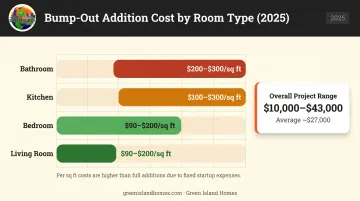
Bump-out costs vary more than most homeowners expect. According to HomeAdvisor's 2025 data, the national normal range runs $10,000–$43,000, with an average around $27,000 and a per-square-foot range of $90–$300. Kitchen bump-outs land at $100–$300/sq ft; bathrooms at $200–$300/sq ft; bedrooms at $90–$200/sq ft.
Several factors drive where your project falls within that range. Here's what matters most.
Size, Scope, and Foundation Type
A true cantilevered bump-out — assuming the existing joists support it — avoids foundation costs entirely. The project is essentially framing, roofing, and exterior work. Once footings or piers enter the picture, costs jump considerably because the structural requirements now mirror a small room addition.
One important note: per-square-foot costs on bump-outs are typically higher than on full additions, not lower. Fixed startup costs — design, permitting, opening the wall, tying into the existing roof — get spread over fewer square feet.
Mechanical System Extensions
This is where kitchen and bathroom bump-outs differ considerably from bedroom and living room projects:
- New drain lines and supply pipes can add thousands to a bathroom or kitchen project
- Gas line extensions (for ranges or water heaters) require licensed plumbers and inspections
- Electrical work is nearly always needed but is less costly than full plumbing runs
- Massachusetts Stretch Code insulation requirements apply to the new conditioned envelope for every room type
Exterior Integration and Finish Level
Matching a decades-old Cape Cod cottage — cedar shingles, custom trim profiles, small-pane windows — often requires sourcing materials that aren't stocked at local suppliers. Custom millwork for a proper match costs more than off-the-shelf alternatives.
Finish level also drives the final number significantly. A basic contractor-grade bump-out and one with custom cabinetry and built-ins aren't in the same budget category.
When Does a Bump-Out Make Sense?
A bump-out is the right call when the goal is improving a specific, heavily-used room — not creating entirely new living space. Kitchens and bathrooms deliver the strongest return. The 2025 JLC Cost vs. Value Report shows minor kitchen remodels recouping 113% of project cost at resale; bathroom work recovers meaningful value as well, though at a lower rate.
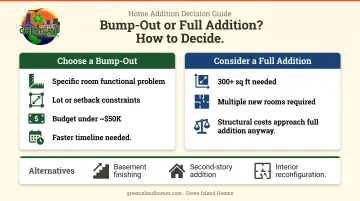
Bump-outs make sense when:
- A specific room has a clear functional problem (no room for an island, tub won't fit, no storage)
- Lot size or setbacks prevent a larger horizontal expansion
- The budget doesn't support a full addition
- A faster timeline matters — bump-outs typically complete in weeks rather than months
Bump-outs are the wrong call when:
- Multiple new rooms are needed (bedroom, home office, family room)
- The existing structure requires so much engineering work that cost approaches a full addition anyway
- The space gained would be under 40 square feet — rarely enough to justify the disruption and investment
- Depth is too shallow to solve the real problem — a 2-foot kitchen bump-out, for example, still won't provide clearance for a functional island
If your situation checks the right boxes, a bump-out can be one of the most cost-efficient ways to solve a space problem without the scope of a full addition.
Bump-Out vs. Full Addition: When to Go Bigger
The decision framework is straightforward: choose a bump-out when the goal is improving one room's function, the budget is under roughly $50,000, and lot conditions support a modest expansion.
A full room addition (with a national range of $20,000–$80,000 for ground-level build-outs and an average around $65,000) makes more sense when multiple rooms are needed or when the structural investment for even a modest bump-out approaches the cost of building a full addition anyway.
Consider a full addition when:
- The household needs 300 or more square feet of new space
- Multiple new functions are required (bedroom + bathroom, for example)
- The structural work required for even a modest bump-out is extensive
Alternatives worth considering when exterior expansion isn't feasible:
- Basement finishing: often the highest-value path to added square footage without touching the exterior footprint; Angi reports costs around $15,000–$75,000
- Second-story addition: worth exploring when lot coverage is maxed out
- Interior reconfiguration: wall removal and layout changes can deliver more functional improvement than adding square footage
On Cape Cod and Martha's Vineyard, where lot sizes are tight and setback restrictions are real, the bump-out vs. full addition question often gets answered by the zoning map before it gets answered by the budget.
Common Mistakes to Avoid
Most bump-out problems are avoidable — they stem from skipping steps early in the process or underestimating what a small addition actually involves. Watch for these four:
- Skipping zoning and permit verification. In towns with HDC oversight or conservation overlays — common across Cape Cod and Martha's Vineyard — designing without checking regulations first leads to delays, forced redesigns, or outright denials. An unpermitted exterior modification may need to come down entirely.
- Underestimating structural complexity. Opening an exterior wall requires proper headers. Existing joists may not support a cantilever. Foundation requirements can surface late in planning. Get a licensed contractor involved during the assessment phase — before design is locked in — to catch these before they become expensive surprises.
- Designing a space too small to be functional. Less than 40 square feet rarely justifies the investment. Before committing to a depth, be specific about what needs to fit: actual furniture, real workflow, proper fixtures.
- Failing to match the existing exterior. A mismatched roofline, different siding texture, or wrong window style signals "afterthought" to any future buyer. Matching pitch, overhang depth, trim profiles, and window proportions takes planning — but the payoff is an addition that looks intentional, not bolted on.
Frequently Asked Questions
Frequently Asked Questions
Is a bump-out addition worth it?
Bump-outs deliver the best return when they solve a real functional problem in a heavily-used room. Kitchens and bathrooms see the strongest ROI at resale. Projects that add space too small to use practically don't pay back well.
How much does a bump-out addition cost?
National costs run $10,000–$43,000 with an average around $27,000 and a per-square-foot range of $90–$300. Bathroom bump-outs land at the higher end; bedroom projects at the lower. Regional factors, foundation requirements, and mechanical system extensions all affect the final number.
How large can a bump-out addition be?
Bump-outs typically range from 2 to 15 feet in depth. Cantilevered versions are limited by existing joist size under IRC 2021 guidelines, with no universal 2-foot rule, and require engineering review. Anything beyond what the framing can support needs foundation work and is considered a full room addition.
Do bump-out additions require permits?
Yes, in virtually all cases. Massachusetts 780 CMR Section 105.1 requires permits for construction, enlargement, or alteration of any structure. In HDC-regulated towns on Cape Cod and Martha's Vineyard, exterior changes may also require Historic District Commission approval before construction begins.
Can a bump-out be cantilevered without a foundation?
Small extensions can be cantilevered off existing floor joists, but the maximum depth is governed by joist size and IRC structural rules, not a simple rule of thumb. Anything beyond what the existing framing can support requires footings, piers, or a slab.
How long does a bump-out addition take to complete?
Construction typically runs 4–8 weeks once work starts. Total project timeline — including design, permit review, and material lead times — runs longer, and projects involving plumbing, foundation work, or HDC review can extend the schedule further.