

Poor upfront planning — not the actual construction — is why projects blow budgets and stretch timelines. According to Angi's 2026 survey, 52% of Americans believe home renovations take longer than planned, and 20% had no idea what permits their project would require. That's not a construction problem. That's a planning problem.
This guide covers everything you need before a single wall comes down: setting clear goals, building a realistic budget, understanding renovation sequencing, navigating permits, and deciding what to DIY versus hand off to a professional.
Key Takeaways
- Define your renovation goal first (livability, resale, or energy efficiency) — it shapes every decision that follows
- National kitchen averages run ~$27K; bathrooms ~$12K; whole-home averages ~$52K
- Always renovate in the right order: structural first, finishes last
- Set aside 10–20% contingency for hidden issues behind walls, which are more common than most homeowners expect
- Exterior upgrades (garage doors, entry doors, siding) consistently deliver the strongest ROI
What to Know Before You Start: Setting Your Renovation Goals
Before anything else, get clear on why you're renovating. The answer shapes scope, budget, and material choices more than anything else.
Common renovation motivations, per the NAR 2022 Remodeling Impact Report:
- 30% upgraded worn-out surfaces and finishes
- 20% wanted to add features and improve livability
- 84% felt a greater desire to be home after completing their renovation
Needs vs. Wants: Build Your Priority List
Before you talk to a single contractor, write down two lists:
Non-negotiables (needs):
- Leaking roof or failing foundation
- Outdated electrical or knob-and-tube wiring
- Active plumbing leaks or water damage
- HVAC systems past their service life
Desirable upgrades (wants):
- Kitchen aesthetic refresh
- Bathroom tile or fixture updates
- Expanded living space
- New flooring throughout
This list keeps the project from expanding when budgets tighten. When money gets tight, safety and infrastructure hold the line — discretionary upgrades don't.
Cape Cod and Martha's Vineyard Considerations
Once your priorities are set, factor in the planning variables specific to this region — they can affect timelines and material choices before a single permit is filed:
- Salt air corrosion — FEMA's Coastal Construction Manual recommends stainless steel connectors over galvanized hardware; salt and moisture accelerate metal degradation faster than inland environments
- Historic district regulations — Cape Cod Commission districts require review for exterior alterations visible from a public way; demolition delay bylaws can add 6–18 months to a project timeline
- Martha's Vineyard Commission — Projects classified as Developments of Regional Impact require MVC approval before any town board issues permits
- Contractor availability — Summer demand on both islands is intense; locking in a contractor well before the season is a practical necessity
How to Build a Realistic Home Renovation Budget
Current Cost Benchmarks
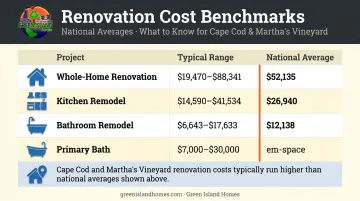
National averages from HomeAdvisor's 2025 data give a useful baseline — but Cape Cod and Martha's Vineyard typically run higher, thanks to island logistics, seasonal labor demand, and limited contractor availability:
| Project | Typical Range | National Average |
|---|---|---|
| Whole-home renovation | $19,470–$88,341 | $52,135 |
| Kitchen remodel | $14,590–$41,534 | $26,940 |
| Bathroom remodel | $6,643–$17,633 | $12,138 |
| Primary bath | $7,000–$30,000 | — |
Kitchen projects vary widely depending on how much you're changing. A scope breakdown:
- Minor/budget: $10,000–$20,000
- Major: $20,000–$65,000
- Full makeover: $65,000–$130,000+
The 30% Rule
A widely cited rule in renovation planning: don't spend more than 30% of your home's current market value on renovations. The logic is simple — over-improving relative to your neighborhood creates a ceiling on what buyers will pay. In vacation and second-home markets like Cape Cod and Martha's Vineyard, neighboring comparable sales set that ceiling firmly.
Funding Options
| Option | Best For | Key Consideration |
|---|---|---|
| Cash | Smaller projects, no debt | No interest cost; limits scope to savings |
| HELOC | Larger phased projects | Uses home as collateral; variable rates |
| MassHousing HILP | Owner-occupants needing fixed rates | Fixed-rate loans of $7,500–$50,000; income requirements apply |
| HUD Title I | Repairs and alterations | Balances over $7,500 must be secured against the property |
Build a Contingency Buffer
Both This Old House and Angi recommend setting aside 10–20% of your total budget for unexpected costs. Once walls open, it's common to find water damage, outdated wiring, or failing plumbing that wasn't visible during planning.
Put contingency in the budget as a line item from day one — not as a mental backup plan.
What Is the Correct Order to Renovate a House?
Sequencing matters because some work simply can't happen until other work is done. Flooring laid before drywall gets damaged. Paint applied before plumbing fixtures means repainting after installation. Doing things out of order creates rework — and rework costs real money.
The Renovation Sequence
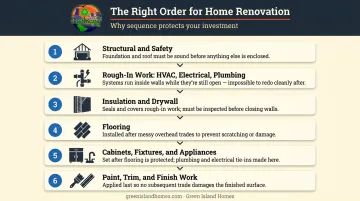
Follow this order on any project, whether a single room or whole-home:
Address structural and safety issues first — Foundation, roof, siding, windows with leaks. Nothing else should proceed until the building envelope is sound.
Rough-in work — HVAC, electrical, and plumbing run through open walls and ceilings before anything closes up.
Insulation and drywall — Only after rough-in inspections are passed. Close up the walls.
Flooring — Installed after walls and ceilings are complete to avoid damage from subsequent trades.
Cabinets, fixtures, and appliances — Once flooring is down and protected.
Paint, trim, molding, and finish work — Always last. After everything else is in place.
Tips That Keep Projects on Track
A few things consistently trip up homeowners when it comes to sequencing:
- Exterior work — siding, gutters, landscaping, driveways — can run parallel to interior phases, compressing the overall timeline
- Single-room renovations follow the same logic in miniature: deal with anything structural or hidden (subfloor, plumbing stub-outs, electrical boxes) before touching surfaces
- Ask your contractor for a written schedule with milestone dates and subcontractor sequencing — verbal timelines fall apart quickly once the project starts
- On island projects especially, factor in material delivery lead times; a delayed shipment can idle multiple trades at once
How to Plan Your Design, Permits, and Timeline
Designing Your Space
Before permits or bids, develop a clear design brief. The more specific your vision, the more accurate your contractor quotes will be — and the fewer change orders you'll deal with mid-project.
Think practically when reviewing designs:
- Does traffic flow work for how the space is actually used?
- Does furniture fit without blocking natural light?
- Where does storage go?
- How does the renovated room connect to adjacent spaces?
A beautiful design that ignores how people actually live in the space rarely works. Prioritize function, then aesthetics. Once your design is locked down, permits are the next step — and one of the most misunderstood parts of any renovation.
Understanding Permits and Building Codes
Most structural, electrical, plumbing, and HVAC work requires permits. Skipping them creates real problems:
- Fines from local building departments
- Required demolition to expose and inspect unpermitted work
- Complications (and potential deal-killers) when selling the home
Massachusetts requires Home Improvement Contractor (HIC) registration for anyone working on existing owner-occupied 1–4 unit residential properties. Trade licenses — electrical, plumbing, HVAC — are separate and also state-regulated.
Permit timelines vary widely depending on where you're building:
| Location | Typical Permit Timeline |
|---|---|
| Cambridge, MA | ~30 days after payment |
| Cape Cod (Commission review required) | Add weeks to months |
| Martha's Vineyard (MVC review required) | Add weeks to months |
A licensed contractor typically pulls and manages permits on your behalf — saving you time and reducing the risk of costly compliance mistakes.
Building a Realistic Timeline
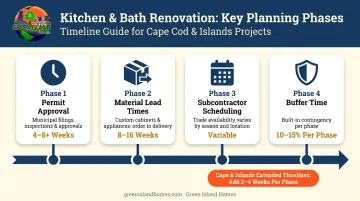
Start with your target completion date and work backward:
- Permit approval — Budget at least 4–8 weeks minimum; longer for Cape and Islands projects with historic or environmental review
- Material lead times — Custom cabinets, appliances, and specialty fixtures can run 8–16 weeks
- Subcontractor scheduling — Trades book up, especially during peak season on the Cape and Vineyard
- Buffer time — Build in 10–15% extra time at each phase for weather delays, inspection scheduling, and decision-making
DIY vs. Hiring a Professional Remodeler
What Intermediate DIYers Can Reasonably Handle
With the right skills and preparation, homeowners can take on:
- Demolition of non-load-bearing walls (after confirming no hidden utilities)
- Painting interior and exterior surfaces
- Installing laminate or floating flooring
- Hanging drywall (taping and finishing is a separate skill)
- Basic fixture swaps — light fixtures, faucets, cabinet hardware
- Some tile work in low-risk areas
These tasks can reduce labor costs meaningfully when done correctly.
What Always Requires a Licensed Professional
Some work should never be DIY territory:
- Electrical — State licensing and permits are required; Massachusetts licenses individual electrical workers
- Plumbing and gas — Licensed tradespeople required under the Board of State Examiners of Plumbers and Gas Fitters
- HVAC/sheet metal — Permit required from a building inspector before any installation, alteration, or replacement
- Structural work — Load-bearing walls, foundation work, and beam installation demand professional engineering
- Any permitted scope — If a permit is required, a licensed professional must pull it
Improper work in these areas costs far more to fix than it saves upfront — and in Massachusetts, using unlicensed tradespeople on permitted work carries real legal consequences.
What to Look for When Hiring a Contractor
- Valid HIC registration (verifiable through Mass.gov's license check)
- Workers' compensation and general liability insurance
- Verified references who would hire them again
- Multiple competitive bids (minimum three for significant projects)
- A clear written contract with scope, schedule, and payment terms
If you're renovating on Cape Cod or Martha's Vineyard, Green Island Homes checks every box on that list. The company holds HomeAdvisor Screened & Approved, Top Rated, and Elite Service accreditations, covers all phases of construction and remodeling, and clients regularly point to fair pricing and clear communication as reasons they'd hire them again.
How to Maximize ROI on Your Home Renovation
Projects With the Strongest Returns
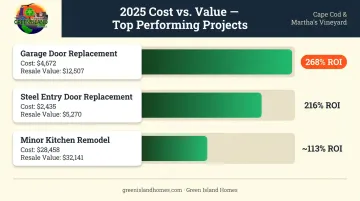
The 2025 Cost vs. Value Report from JLC/Zonda confirms what most experienced contractors already know: exterior upgrades dominate ROI.
| Project | National Cost | Resale Value | Cost Recouped |
|---|---|---|---|
| Garage door replacement | $4,672 | $12,507 | 268% |
| Steel entry door replacement | $2,435 | $5,270 | 216% |
| Minor kitchen remodel | $28,458 | $32,141 | ~113% |
NAR's 2022 data fills in the interior picture:
- Hardwood floor refinishing recovered 147%
- New wood flooring recovered 118%
- Insulation upgrades recovered 100%
- Full kitchen renovations recovered 75%; bathrooms, 71%
Interior renovations add real livability value — but rarely return dollar for dollar.
Renovate to the Neighborhood Standard
Over-improving relative to comparable homes nearby rarely returns full value at resale. In Cape Cod and Martha's Vineyard — where vacation homes, second homes, and investment properties all shape the market — neighboring sales create a real ceiling on what buyers will pay.
Mid-range finishes in a mid-range neighborhood consistently outperform luxury finishes in that same neighborhood. Buyers won't pay for upgrades that exceed what the street supports.
Common Mistakes That Erode Value
Even well-intentioned renovations lose value when planning breaks down. The most common culprits:
- Trendy finishes that look dated in five years (specific tile patterns, bold cabinet colors)
- Layout changes that don't match how people actually use the space
- Underestimating scope, which inflates costs as the project progresses
- Starting construction before finalizing design decisions — change orders are expensive
Frequently Asked Questions
Frequently Asked Questions
Is $50,000 enough to renovate a home?
At the national average, $50,000 can cover a solid kitchen remodel (average: $26,940), two bathroom renovations, or a partial whole-home refresh. It won't stretch to a full whole-home renovation, which averages $52,135 nationally. In higher-cost coastal markets like Cape Cod and Martha's Vineyard, that budget goes less far than national benchmarks suggest.
What is the correct order to renovate a house?
Start with structural and safety repairs, then rough-in work (HVAC, electrical, plumbing), then insulation and drywall, then flooring, then cabinets and fixtures, and paint and finish work last. Skipping ahead in this sequence creates rework and damaged finishes.
What is the 30% rule in home renovation?
The 30% rule advises homeowners not to spend more than 30% of their home's current market value on renovations. Over-investing relative to your property's value or comparable homes nearby rarely returns full cost at resale, particularly in markets with a defined price ceiling.
What remodeling projects add the most value?
Garage door replacement and steel entry door replacement lead national ROI data at 268% and 216% respectively. Minor kitchen updates, bathroom refreshes, and insulation upgrades also perform consistently well. Major kitchen and bathroom overhauls add value but typically don't return their full cost.
Should I live at home during a renovation?
For single-room renovations, living on-site is usually manageable. Whole-home projects involving kitchen or bathroom downtime, structural work, or heavy dust and noise make temporary relocation the more practical choice for most families.