

Introduction
Renovation projects that run over time, over budget, or stall mid-construction almost always share one root cause: a poorly built timeline at the start.
According to the 2024 Houzz U.S. Houzz & Home Study, 39% of renovating homeowners exceeded their budget in 2023, with higher-than-expected costs and added project complexity as the top culprits. Meanwhile, Angi's 2024 State of Home Spending report found over 50% of homeowners encountered surprise material and labor expenses, and 54% struggled to find qualified professionals.
The difference comes down to preparation. Permit timelines, material lead times, contractor availability, and the strict sequence in which trades must work all need to be mapped out before a single wall comes down.
This guide walks through how to build a realistic renovation timeline — in the right sequence, with the contingency buffers that keep your project on track.
Key Takeaways
- Build your renovation timeline before hiring any contractor or ordering materials
- Renovation phases must follow a strict sequence: rough work before finishes, flooring last
- Permits can take 4–12 weeks or more; start the process before anything else
- Set aside a contingency buffer — most renovations exceed their initial budget estimate
- Cabinets, countertops, and appliances have lead times of 6–10 weeks — order them early
How to Build Your Home Renovation Timeline Step by Step
Step 1: Define the Scope of Your Project
Before any timeline can exist, you need a written scope of work — room by room. Without it, contractors can't give you accurate estimates, and you can't prioritize intelligently when time or budget tightens.
When defining scope, separate two categories:
- Must-haves: Structural repairs, code compliance, non-negotiable functional upgrades
- Nice-to-haves: Aesthetic upgrades, wish-list items, premium finish selections
This distinction matters because if your budget or schedule comes under pressure mid-project, lower-priority items can be deferred without derailing core work. Also clarify your renovation's end goal — livability, resale value, or aesthetics. That answer shapes which trade-offs are worth making when something has to give.
Step 2: Research Permit Requirements Early
Permits are one of the most underestimated variables in any renovation timeline. Structural changes, electrical, plumbing, and HVAC work nearly always require permits under Massachusetts residential building code — and approval timelines must be factored in before scheduling any other work.
Under 780 CMR, Massachusetts code officials must issue or deny permit applications in writing within 30 days of filing. In practice, local timing varies:
- Oak Bluffs (Martha's Vineyard): Simple projects — 1–2 weeks; larger projects — 3 weeks; projects requiring a public hearing — add 1–2 months
- Orleans (Cape Cod): Inspections are generally scheduled Monday–Friday, 1–4 p.m.
Contacting your local building department should be one of your first steps — not an afterthought after the contractor is already booked.
Step 3: Hire Your Contractor and Build the Timeline Together
Your contractor co-owns the schedule as much as you do. They know subcontractor availability windows, realistic phase durations, and regional material sourcing lead times that rarely show up in any planning template.
When vetting contractors:
- Get at least three quotes
- Ask each to provide a phased project timeline alongside their cost estimate — not just a start and end date
- Ask how they handle change orders and what their communication cadence looks like during construction
Consistent communication throughout a project makes a measurable difference. Green Island Homes, serving Cape Cod and Martha's Vineyard, is known among clients for exactly that — one homeowner described them as "the dream construction person" and specifically noted "great communication with us through the entire project."
Step 4: Order Long-Lead Materials Before Construction Starts
One of the most common — and avoidable — causes of renovation delays is ordering materials after demolition begins. According to NKBA's Q3 2024 Kitchen & Bath Market Index, average lead times in 2024 were:
| Material | Average Lead Time |
|---|---|
| Cabinets | 7.9 weeks |
| Countertops | 7.4 weeks |
| Vanities | 6.1 weeks |
| Refrigerators | 5.9 weeks |
| Tile | 5.8 weeks |
| Custom cabinetry | 12–18 weeks |
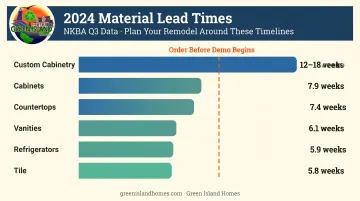
Finalize all material selections during the design phase and place orders before your project start date. Once walls are open, every week waiting for a backordered cabinet is a week of idle labor costs.
Step 5: Map Out Phases with Milestone Dates
A renovation timeline needs phases with specific milestone dates — not just a start and end date. Each milestone should be tied to a deliverable: rough inspection passed, cabinets delivered, flooring installed.
Track dependencies carefully. Some phases cannot begin until others are complete and inspected. A simple spreadsheet works fine for most homeowners. Document the sequence and get sign-off from your contractor in writing before work begins.
The Right Order to Do Home Renovations
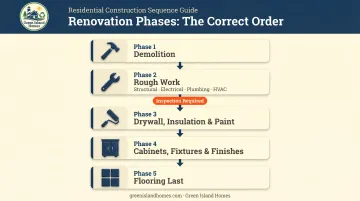
Renovation work follows a strict sequence. Doing things out of order leads to rework, damaged finishes, and real added cost.
Phase 1: Demolition
Demolition comes first: removing old fixtures, cabinets, flooring, and walls down to the studs as needed. This phase often uncovers hidden problems: mold, faulty wiring, damaged framing. Whatever is found must be addressed before moving forward. Do not schedule demolition before permit status is confirmed for any permitted scope.
Phase 2: Rough Work — Structural, Electrical, Plumbing, HVAC
All inside-the-wall work happens next. This includes:
- Framing changes and structural modifications
- Electrical rough-in
- Plumbing rough-in
- HVAC installation
Under IRC R109, rough plumbing, mechanical, gas, and electrical systems must be inspected before concealment. Massachusetts code requires inspections within 2 business days after notice. Walls stay open until every inspection clears.
Phase 3: Drywall, Insulation, and Paint
Once rough inspections are cleared, insulation and drywall go in. Paint follows — before cabinets and trim are installed. Painting first means you're rolling and cutting open walls rather than masking around finished cabinetry and trim, which saves time and produces cleaner results.
Phase 4: Cabinets, Fixtures, and Finishes
Cabinets are installed after paint dries. From there, tradespeople (plumbers, electricians) return to complete their finish work alongside the rest of the install sequence:
- Countertops and cabinetry hardware
- Plumbing fixtures and faucets
- Lighting, outlets, and switches
- Trim and interior doors
Phase 5: Flooring Last
Flooring is always last. Hardwood, tile, and carpet are all vulnerable to damage from heavy foot traffic, tool drops, and debris from every prior phase. Doors are typically hung just before or alongside flooring installation.
Key Variables That Affect Your Renovation Timeline
Even a well-planned timeline will be shaped by factors outside your control. Here's what to account for:
Project Scope and Complexity
Scope is the single biggest driver of duration. Rough benchmarks by project type:
| Project Type | Approximate Duration |
|---|---|
| Cosmetic bathroom update | 2–3 weeks |
| Full kitchen remodel | 6–10 weeks (construction phase) |
| Home addition | 3–6 months |
| Full home gut renovation | 6–15 months |
Note: Houzz reported kitchen renovations averaged 9.6 months of planning and 5.1 months of building in 2023 — reinforcing that planning starts long before demolition.
Permit and Inspection Scheduling
Permits must be approved before structural work begins. Rough-in inspections must be completed before walls are closed. These are hard stops — any delay here cascades into every downstream phase. On Martha's Vineyard, projects requiring a public hearing can add 1–2 months to approval alone.
Contractor and Subcontractor Availability
Even after your general contractor is hired, each trade — electrician, plumber, tile setter — runs their own schedule. In high-demand coastal markets like Cape Cod and Martha's Vineyard, subcontractor availability during peak construction season can push start dates or mid-project phases by weeks. On Cape Cod and Martha's Vineyard, booking trades 3–6 months ahead of your target start date is common practice during peak season.
Material Lead Times
Supply chain delays on specialty materials can throw off an entire phase sequence. Confirm lead times at the point of ordering — especially for:
- Custom cabinetry, windows, and doors (often 6–12 week lead times)
- Imported tile, fixtures, or hardware
- Structural materials during high-demand seasons
Build buffer time around anything non-standard. If a single item arrives late, it can stall the entire phase that depends on it.
How to Budget in Line With Your Renovation Timeline
Budget and timeline are the same problem. Scope creep — adding or changing work mid-project — doesn't just cost more money. It disrupts subcontractor scheduling, forces material re-orders, and can push your completion date by weeks. Getting both locked in before work starts is how you avoid that cascade.
Set Your Budget Before Finalizing Scope
Get multiple contractor estimates before finalizing numbers. Costs vary widely by project type and region:
- Minor kitchen remodel (midrange): $28,458 — JLC 2025 Cost vs. Value Report
- Bathroom addition (midrange): $60,645 — JLC 2025 Cost vs. Value Report
- Median renovation spend nationally: $24,000 in 2023, up 60% from $15,000 in 2020 (Houzz)
Those national figures don't include Cape Cod or Martha's Vineyard regional premiums, permits, design fees, or hidden-condition costs — all of which can push your actual number significantly higher.
Build a Contingency Into Every Phase
Given that 39% of homeowners exceeded their 2023 renovation budgets and over 50% encountered surprise expenses, a contingency reserve isn't optional — it's a baseline requirement.
A commonly cited framework:
- Cosmetic-only projects: 10% contingency
- Projects involving structural, plumbing, or electrical work: 20% contingency
Set this money aside before construction begins and treat it as off-limits unless a genuine unexpected cost arises. A $100,000 renovation budget does not mean $100,000 in construction work — permits, design, labor, and contingency all draw from the same pool.
Common Mistakes That Derail Renovation Timelines
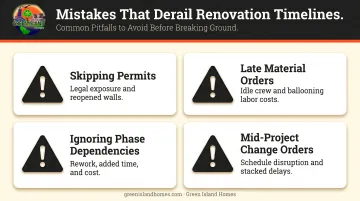
Most renovation delays are predictable. These are the ones that come up repeatedly:
- Skipping or deferring permits: Permits are typically the homeowner's responsibility to initiate. Assuming the contractor will handle it — or skipping permits entirely to save time — creates legal exposure and can mean reopening finished walls for inspection.
- Late material orders cost more than people expect. Cabinet lead times average nearly 8 weeks; custom cabinetry runs 12–18 weeks. Waiting until walls are open means idle crew time and a ballooning labor bill.
- Ignoring phase dependencies — Installing flooring before trim is done, or painting before drywall is fully sanded, creates rework. Rework adds both time and cost.
- Frequent mid-project change orders disrupt subcontractor schedules, trigger material re-orders, and push out your completion date. Each change adds its own delay — and they stack.
Frequently Asked Questions
In what order should home renovations be done?
The correct sequence is: demolition → rough work (framing, electrical, plumbing, HVAC) → rough inspections → drywall and paint → cabinets and fixtures → flooring and final trim. Each phase must be completed and, where required, inspected before the next begins.
How far will $100K go in remodeling?
Nationally, $100K can cover a full kitchen remodel and a bathroom addition — before regional premiums or hidden-condition costs apply. On Cape Cod or Martha's Vineyard, where labor and logistics run higher, match your scope to realistic contractor estimates before committing to a budget.
What is the 30% rule for renovations?
The 30% rule suggests homeowners avoid spending more than 30% of their home's current market value on renovations, since over-investing rarely yields proportional returns at resale. Use it as a rough benchmark and confirm thresholds with a licensed contractor who knows your local market.
How long does a full home renovation take?
A full renovation typically takes 6–15 months depending on scope, permit timelines, material lead times, and contractor availability — on Cape Cod and Martha's Vineyard, seasonal demand can push timelines toward the longer end. Planning and design often take as long as construction itself.
What causes the most delays in home renovation timelines?
Permit and inspection scheduling, material backorders, and mid-project change orders are the three most common culprits. All three can be substantially reduced through thorough planning before construction begins.
How do I plan a renovation while still living in my home?
Phase work room by room where possible and set up temporary kitchen or bathroom arrangements in advance. Communicate clearly with your contractor about which areas must stay livable, and prepare for noise and dust in adjacent spaces even when those rooms aren't actively under construction.