

The challenge? Kitchen renovation costs span an enormous range. A cosmetic refresh and a full gut renovation are completely different projects with completely different price tags. And in coastal Massachusetts, local labor markets and — for Martha's Vineyard specifically — the reality of island logistics mean regional costs often land above national benchmarks.
This guide breaks down realistic price ranges by scope, the factors that move costs up or down, a component-by-component budget breakdown, and practical planning advice for homeowners on Cape Cod and Martha's Vineyard.
Key Takeaways
- National cost ranges: Budget refresh ($10K–$20K), mid-range remodel ($20K–$65K), full gut renovation ($65K–$130K+) — regional projects on Cape Cod and Martha's Vineyard typically run toward the top of each range
- Top cost drivers: Scope of work (layout changes vs. same footprint), material selections, and regional skilled trade labor rates
- Cosmetic updates with no layout changes keep costs down; structural work, custom cabinetry, and Martha's Vineyard logistics push them up
- Most common budget mistake: Not accounting for hidden costs discovered during demo — build a buffer into your budget from the start
How Much Does a Kitchen Renovation Cost?
There is no single answer. According to Angi's 2026 data, the national average kitchen remodel costs $26,940, with a typical range of $14,589–$41,536 and a per-square-foot range of $75–$250. That spread comes down to one thing: scope.
What goes wrong when homeowners skip this context: they anchor to a single number, underbudget, and stall mid-project — or choose mismatched upgrades that don't reflect what the home actually needs. Understanding the three scope tiers prevents that.
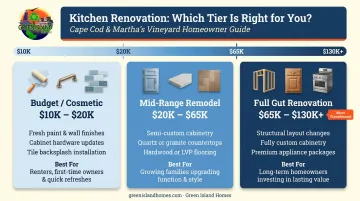
Budget / Cosmetic Update: $10,000–$20,000
This tier covers aesthetic updates without touching the layout — paint, new hardware, backsplash, light fixtures, and appliance swaps. Cabinets are typically painted or refaced, not replaced.
Covers surface-level updates, minor fixture replacements, and cosmetic flooring. New cabinetry, countertop replacement, plumbing or electrical work, and layout changes are all out of scope at this budget.
Best for: Homeowners planning to sell within two years, renters refreshing a dated but functional kitchen, or anyone whose kitchen layout and structure are sound.
Mid-Range / Full Remodel: $20,000–$65,000
This is where most full renovations land. New semi-custom cabinets, countertops, appliances, and flooring — but the plumbing, electrical, and layout stay in the same footprint.
Typical scope includes:
- Semi-custom cabinetry, new countertops, and updated appliances
- New flooring and refreshed lighting
- Plumbing and electrical updated in place (no relocation)
Moving walls, relocating plumbing stacks, custom cabinetry, and premium appliance suites push costs into the next tier.
Best for: Homeowners planning to stay long-term who want a functional and aesthetic upgrade without the complexity of structural work.
High-End / Full Gut Renovation: $65,000–$130,000+
Full gut renovations involve custom cabinetry, luxury countertops, layout reconfigurations, structural changes, and premium or professional-grade appliances. The JLC/Zonda 2025 Cost vs. Value Report benchmarks a major upscale kitchen remodel at $164,104 — a useful ceiling reference for custom work.
On Martha's Vineyard, costs at this tier regularly exceed national benchmarks. Off-island material transport, ferry fees for workers and deliveries, and limited availability of specialized trades all add up on a project of this scale.
Best for: Forever-home renovations, luxury property owners, or homeowners expanding the kitchen footprint with an addition.
Where you land within these tiers depends on material choices, labor complexity, and your kitchen's existing condition — all factors worth mapping before you commit to a budget.
Key Factors That Affect Kitchen Renovation Cost
Kitchen renovation pricing is shaped by a combination of scope, materials, location, and project complexity. Understanding these factors helps homeowners make smarter trade-offs instead of guessing where to cut.
Kitchen Size and Layout
Square footage drives nearly every line item: cabinet count, countertop linear footage, flooring area, and labor hours. A larger kitchen costs more in absolute terms, though cost-per-square-foot can decrease slightly at scale.
Layout changes are where costs jump. Moving plumbing, relocating the range, or removing walls adds structural, plumbing, and electrical work that can add tens of thousands of dollars to a project. Keeping the same footprint is the single most effective way to control renovation costs.
Scope of Work: Cosmetic vs. Structural
The difference between a $15,000 refresh and a $75,000 renovation often comes down to one question: are you moving anything?
- Cosmetic scope: Paint, hardware, backsplash, appliances — no permits required, lower overall cost
- Full renovation scope: New cabinets, countertops, flooring, updated wiring and plumbing — requires permits and coordination across multiple trades
- Structural scope: Load-bearing wall removal, window additions, kitchen expansion — requires building permits, engineering review, and inspections under Massachusetts 780 CMR (the state building code)
In Massachusetts, any work involving electrical, plumbing, gas, or structural changes requires separate trade permits from the local building department. Permit fees vary by municipality but are calculated as a percentage of construction value, with additional fees for plumbing and electrical. These soft costs add up. Unpermitted work also creates real problems at resale, so budgeting for permits from the start matters.
Materials and Finishes
Cabinet selection alone typically represents 30–40% of the total kitchen renovation budget. The three tiers:
| Cabinet Type | What It Means | Relative Cost |
|---|---|---|
| Stock | Pre-built in standard sizes, limited finish options | Lowest |
| Semi-custom | More size flexibility, broader finish selection | Mid-range |
| Fully custom | Built to exact dimensions, premium materials, plywood boxes | Highest |
Countertop costs span an equally wide range by material:
- Laminate: $15–$40/sq ft installed
- Quartz: $70–$200/sq ft installed
- Quartzite: $80–$220/sq ft installed
Heavier stone materials also increase installation costs — fabrication, support structures, and careful handling add labor that laminate doesn't require.
Location and Labor Costs
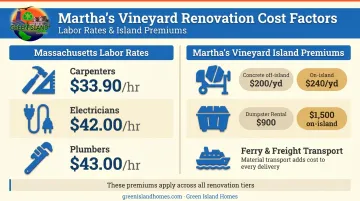
Labor doesn't cost the same everywhere. BLS May 2023 wage data shows Massachusetts skilled trade mean hourly wages well above many national benchmarks:
- Carpenters: $33.90/hr mean wage
- Electricians: $42.00/hr mean wage
- Plumbers: $43.00/hr mean wage
On Martha's Vineyard, labor costs layer onto logistics costs. Most construction materials must be brought from off-island, and that adds up fast. A 2026 MV Times report documented concrete running $200/yard off-island versus $240/yard on-island, and dumpster rental at $900 versus $1,500. Kitchen renovations are subject to the same freight premiums on materials, waste removal, and trade travel time.
Appliances
Appliance packages for a full renovation range from a few thousand dollars (builder-grade range, standard dishwasher, basic refrigerator) to $20,000 or more for professional-grade suites with panel-ready integrated refrigerators. This line item is easy to underestimate, especially when the contractor's quote excludes them and homeowners assume they're included.
Full Cost Breakdown of a Kitchen Renovation
Understanding each cost category helps homeowners build a realistic total budget rather than anchoring to a single quote.
Cabinets (30–40% of total budget)
Cabinets are the largest single line item in most renovations. Stock options are the most affordable but come with limited sizing and finish choices. Semi-custom adds flexibility without the full custom price tag.
Fully custom cabinetry — built to spec with plywood boxes and dovetail joinery — commands a significant premium. That investment pays off in coastal environments like Cape Cod and Martha's Vineyard, where particleboard is prone to swelling in humid conditions.
Countertops and Backsplash
Material choice is the primary cost driver here. Laminate at $15–$40/sq ft installed is budget-friendly; quartz at $70–$200/sq ft is the mid-range workhorse; quartzite at $80–$220/sq ft sits at the premium end. Backsplash tile is a separate line item — typically $500–$1,500 — that most early budgets overlook entirely.
Labor and Installation (20–35% of total budget)
Labor — demolition, carpentry, plumbing, electrical, and finish work — typically accounts for 20–35% of total renovation cost. On Cape Cod and Martha's Vineyard, skilled trade labor commands a regional premium, and seasonal scheduling (particularly on the Vineyard) can extend lead times and affect project sequencing.
Permits and Inspections
- Barnstable: Building permit $5.10/$1,000 construction value; plumbing starts at $40/first fixture
- Massachusetts: Separate permits required for electrical (527 CMR 12.00), plumbing/gas (Board of State Examiners), and structural work (780 CMR)
- Martha's Vineyard towns (Edgartown, Oak Bluffs): Building, plumbing, gas, and wiring permits each required — consult the town's current fee schedule
Unpermitted work complicates resale and creates liability if something goes wrong — permit fees are modest compared to that risk.
Appliances and Ongoing Costs
Upfront appliance costs vary widely by tier. Beyond the purchase price, factor in these ongoing expenses:
- Natural stone countertops typically need annual resealing
- Wood cabinetry in humid coastal climates benefits from periodic treatment
- High-end appliances can carry significant service costs when repairs are needed
Budget vs. Premium Kitchen Renovations
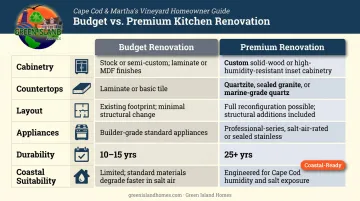
A $25,000 update and a $125,000 renovation both transform a kitchen. What differs is scope, durability, and what you get for the money.
| Budget Renovation | Premium Renovation | |
|---|---|---|
| Cabinetry | Stock or semi-custom, particle board construction | Fully custom, plywood boxes, premium hardware |
| Countertops | Laminate or entry-level quartz | Quartzite, marble, or thick-slab quartz |
| Layout | Same footprint | Reconfigured or expanded |
| Appliances | Builder-grade or mid-tier | Professional-grade, panel-ready |
| Durability | 10–15 years before showing age | 25+ years with proper maintenance |
| Coastal suitability | May require earlier replacement | Spec'd for coastal moisture and salt air |
When spending more makes sense:
- The home's value supports the investment (a standard planning benchmark is 5–15% of home value for a kitchen renovation)
- You plan to stay in the home for 10+ years
- The existing kitchen is functionally broken — poor layout, failed surfaces, outdated wiring
When spending less is smarter:
- You plan to sell within two years
- The kitchen is structurally sound and only needs a visual refresh
- A minor remodel already delivers strong ROI — the 2025 Cost vs. Value Report benchmarks a minor midrange kitchen remodel at $28,458 in cost and $32,141 in resale value, recouping 113%
On Martha's Vineyard and Cape Cod, where high-value properties sit in a competitive buyer's market, kitchen quality is a visible differentiator. A premium renovation built to coastal specs — moisture-resistant materials, durable finishes — holds its value for 25+ years and consistently commands attention at resale.
How to Estimate the Right Budget for Your Kitchen
The right budget aligns with your home's value, your plans for the property, and the actual scope of work — not just a round number you feel comfortable with.
Answer these questions before setting a number:
- What is your home's current market value, and what percentage does your renovation represent?
- Are you changing the layout, or keeping the same footprint?
- Do you plan to stay for 10+ years, or sell within 2–3 years?
- What is non-negotiable (cabinet quality, countertop material) vs. where can you trade down without sacrificing durability?
- Have you accounted for soft costs — permits, design fees, temporary kitchen setup, and the unexpected?
Once you've worked through those questions, get two or three detailed quotes from licensed local contractors. On Martha's Vineyard and Cape Cod, project costs vary significantly based on familiarity with island logistics, permit processes, and regional material sourcing — so local experience matters.
Green Island Homes serves both markets and provides realistic, locally-grounded estimates for kitchen renovations. Reach out at sales@greenislandhomes.com or call 774-563-9714.
What Most People Get Wrong About Kitchen Renovation Costs
Focusing Only on the Upfront Quote
A low quote can grow fast once demo begins. Older Cape Cod and Vineyard homes regularly reveal outdated knob-and-tube wiring, moisture damage behind cabinets, out-of-level subfloors, or compromised plumbing once walls open up. None of these are visible until demolition starts.
Common hidden costs to budget for include:
- Outdated electrical wiring (knob-and-tube is frequent in older homes)
- Moisture or rot damage behind cabinets and walls
- Out-of-level subfloors requiring correction before tile or flooring
- Plumbing that doesn't meet current code

Build a meaningful contingency into your budget from day one — the older the home, the more buffer you need.
Underestimating Soft Costs
Many homeowners budget for materials and forget labor, permits, and logistics. For Martha's Vineyard projects specifically, ferry transport for materials and workers is a real cost line — not a minor footnote. On island projects, these soft costs — labor, permits, and ferry logistics — can account for 30–40% of the total budget on top of materials.
Cutting Corners on the Wrong Things
Skimping on cabinet box quality (particleboard vs. plywood) or waterproofing in a coastal environment is a costly mistake in the long run. In Cape Cod and Martha's Vineyard homes, humidity and salt air are genuine performance factors. Materials that might hold up fine in a dry inland climate can fail prematurely here.
Moisture-resistant materials and quality construction cost more upfront — but far less than replacing cabinets or countertops a decade ahead of schedule.
Conclusion
Kitchen renovation costs vary enormously based on scope, materials, size, and local market conditions. In coastal Massachusetts — on Cape Cod and especially on Martha's Vineyard — expect project costs to run above national averages due to regional labor rates and island logistics.
A sound renovation budget accounts for three things:
- Your home's current value and resale potential in the local market
- Long-term plans — whether you're staying, renting, or selling
- The material and workmanship quality that a coastal environment demands
Working with a locally experienced, licensed contractor is the most reliable way to set realistic expectations and avoid mid-project surprises. Green Island Homes serves homeowners across Cape Cod and Martha's Vineyard. Contact us for a consultation at sales@greenislandhomes.com or 774-563-9714.
Frequently Asked Questions
What is a realistic budget for a kitchen remodel?
Nationally, expect $10,000–$20,000 for a cosmetic refresh, $20,000–$65,000 for a full mid-range remodel, and $65,000–$130,000+ for a complete gut renovation. On Cape Cod and Martha's Vineyard, regional labor rates and island logistics typically push costs toward the higher end of each range.
What is the most expensive part of a kitchen renovation?
Cabinetry is usually the largest single line item, accounting for roughly 30–40% of the total budget. Labor (demolition, plumbing, electrical, carpentry) comes next, followed by countertops and appliances.
Does a kitchen remodel add value to your home?
Yes — particularly for mid-range refreshes. The 2025 Cost vs. Value Report shows a minor midrange kitchen remodel recouping 113% at resale. In high-demand markets like Martha's Vineyard, an updated kitchen drives stronger offers and faster sale timelines.
How long does a kitchen renovation take?
Cosmetic refreshes typically take 1–2 weeks; a full mid-range remodel runs 8–12 weeks; a full gut renovation can take 4 months or longer. On Martha's Vineyard, seasonal contractor availability and ferry delivery logistics can extend any of these timelines.
Do I need permits for a kitchen renovation in Massachusetts?
Yes — permits are required for any work involving electrical, plumbing, gas, or structural changes under Massachusetts state code. Each trade (electrical, plumbing, gas) requires its own separate permit, so confirm your contractor pulls all of them — it protects you at resale.
Can I save money by doing part of my kitchen renovation myself?
Confident DIYers can reasonably handle demo, painting, hardware installation, and simple backsplash tile. Electrical, plumbing, gas lines, structural work, and countertop fabrication must be hired out — both for code compliance and safety.