
Key Takeaways
- Most 1960s ranch kitchens share the same problems: closed layout, outdated systems, and hazardous materials behind the walls
- Massachusetts requires asbestos surveys before any demolition — skipping this step carries legal and health consequences
- Opening the kitchen to a living or dining area is the single highest-impact change you can make
- New England remodel costs range from $28,936 (cosmetic) to $172,718 (full gut), per 2025 Cost vs. Value data
- Always budget a 15–20% contingency — older homes routinely hide expensive surprises
What Makes a 1960s Ranch Kitchen Different (and Challenging)
Walk into an original 1960s ranch kitchen and you'll notice the same things every time: a galley or U-shaped layout boxed in by walls, fluorescent overhead lighting, laminate counters, and linoleum or vinyl tile underfoot. These kitchens were designed as work rooms — efficient, contained, completely separate from wherever the family gathered.
That design logic made sense in 1965. It doesn't work for how people live now.
But the layout is only part of the challenge. Beneath the dated finishes, homes from this era carry infrastructure issues that catch homeowners off guard.
The Hidden Problems Behind the Walls
- Electrical service: Panels from before 1965 commonly ran on 30- to 60-amp fuse service — far short of what a modern kitchen demands
- Asbestos materials: The CPSC identifies vinyl-asbestos floor tiles, asphalt tiles, and flooring adhesives as common asbestos-containing materials in older homes
- Plumbing: Cast iron drain piping was standard in homes built before the 1970s and may show its age during a remodel
- Lead paint: Any surface painted before 1978 is a potential lead hazard
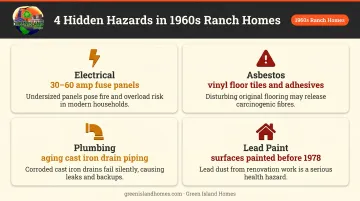
Each of these issues affects your timeline, your budget, and who you need on your crew — which is why a thorough pre-demo assessment matters before anything comes off the wall.
Start Here: What to Assess Before Your Remodel Begins
Skipping a pre-remodel assessment is the most common — and most expensive — mistake homeowners make. Spend time here before you spend money anywhere else.
Walk the Kitchen With a Checklist
Before talking to a designer or contractor, inspect what you have:
- Cabinet boxes: Solid wood boxes are salvageable; particle board usually isn't worth saving
- Under the sink and behind appliances: Water damage often hides here and may indicate plumbing issues that need fixing first
- Ceiling height variations: Low spots near exterior walls can limit upper cabinet placement
- Flooring layers: Original vinyl tile may sit under newer flooring, and it may contain asbestos
Load-Bearing vs. Non-Load-Bearing Walls
In a 1960s ranch, walls running perpendicular to the floor joists are often load-bearing. Removing one without a structural engineer's assessment is both dangerous and illegal in Massachusetts. Before you assume any wall can come down, get professional confirmation. An unpermitted removal can halt your project — and cost more to undo than the wall removal itself.
Hazardous Materials Testing — Required in Massachusetts
Hazardous materials are the other structural reality to address before demo day. MassDEP requires a thorough asbestos survey before any demolition or renovation activity, regardless of the building's age. Under OSHA standards, vinyl and asphalt flooring installed no later than 1980 must be treated as asbestos-containing unless proven otherwise.
Two additional requirements apply to most 1960s homes:
- Lead paint: Any paid work disturbing more than 6 square feet indoors in a pre-1978 home requires a licensed lead-safe renovation contractor under Massachusetts law
- Asbestos removal notification: MassDEP requires submission to be filed 10 working days before work begins under 310 CMR 7.15
Do not demo first and test later. Fines and remediation costs far exceed the cost of upfront testing.
Electrical Panel Reality Check
If your kitchen runs on an original 60-amp panel, you cannot safely add a modern refrigerator, dishwasher, and range without an upgrade. In Massachusetts, a standard 100-amp to 200-amp panel upgrade runs $5,000–$8,000 — budget for this early so it doesn't blindside you mid-project.
Phase Planning: When You Can't Do Everything at Once
If a full gut remodel isn't financially viable right now, sequence the work deliberately:
- Phase 1: Structural changes, hazardous material removal, electrical, plumbing
- Phase 2: Cabinets, countertops, flooring, lighting, finishes
This order matters. If you install new flooring before addressing asbestos tile underneath, you'll be tearing it out later.
Opening Up the Kitchen: Layout and Structural Changes
Removing the wall between a 1960s ranch kitchen and the adjacent living or dining room is often more dramatic than any surface upgrade. The kitchen footprint doesn't change, but natural light travels further into the home and the space reads entirely differently.
A 1967 ranch renovation documented by Houzz in Denver is a useful benchmark: the team removed a wall, relocated the kitchen into the former dining area, and installed a large structural beam to support the new open plan. The transformation was fundamental, not cosmetic.
What Load-Bearing Wall Removal Actually Costs
When a wall is load-bearing, a structural engineer must design a beam — typically steel or LVL lumber — to carry the load above. According to HomeAdvisor's 2025 national data:
- Most wall-removal projects: $1,000–$10,000, average $3,000
- Single-story load-bearing wall removal: $1,200–$5,000
- Steel support beams: $1,300–$5,000; LVL beams: $55–$400 plus $200–$400 labor per beam
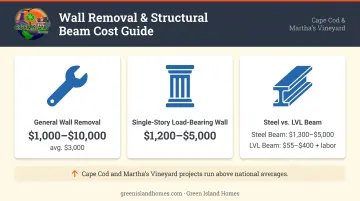
Cape Cod and Martha's Vineyard projects typically run above national averages due to contractor demand and material logistics. Treat these as floor figures, not ceilings.
When Full Removal Isn't the Right Move
Full wall removal isn't always necessary to open up the space. Effective alternatives include:
- Widening an existing pass-through opening
- Removing a single doorway to improve sightlines
- Converting a swinging door to a pocket or barn door
These options cost significantly less and still change how the kitchen connects to the rest of the home.
Adding an Island to a Former Galley Kitchen
NKBA recommends a minimum 42-inch work aisle for a single cook and 48 inches for multiple cooks. If your post-remodel layout can accommodate that clearance on all sides, an island is viable. Building one from repurposed base cabinets keeps costs down. Smart island placement can also cover flooring transition gaps left from a wall removal.
Permits Are Not Optional
In Massachusetts — including Cape Cod and Martha's Vineyard — structural modifications, electrical upgrades, and plumbing changes all require permits. Pulling proper permits protects you legally and at resale. On the islands especially, unpermitted structural work can complicate future sales and title transfers. Confirm that your contractor pulls permits before work begins — and get that commitment in writing.
Making the Big Design Decisions
Cabinets: Repaint, Reface, or Replace?
| Option | Approximate Cost | Best For |
|---|---|---|
| Repaint existing | $425–$3,200 | Sound boxes, unchanged layout |
| Reface | $4,484–$13,500 | Good boxes, updated look, no layout changes |
| Full replacement | $1,934–$13,000+ (Northeast) | Damaged/particle board boxes, new layout |
Solid wood cabinet boxes from the 1960s — if the joinery is tight and there's no water damage — can be worth keeping. A well-applied neutral white or a mid-century tone like sage, deep green, or warm navy can make them look like a deliberate design choice rather than a compromise.
Replacement makes sense when boxes are particle board, show significant moisture damage, or when the layout is changing enough that the original configuration no longer fits.
Countertops and Backsplash
For material selection, current 2026 national benchmarks give a useful frame:
- Laminate: $8–$27/sq ft — a solid option for budget-conscious refreshes
- Quartz: $15–$70/sq ft — durable, low-maintenance, works with both modern and mid-century aesthetics
- Butcher block: approximately $70–$150/sq ft — warm, visually distinct, excellent for islands or accent sections
Get local estimates from Cape Cod or Martha's Vineyard suppliers; regional pricing varies meaningfully from national figures.
For the backsplash, simple white subway tile keeps the space feeling light and timeless. Zellige or handmade tile adds texture and mid-century character at relatively low cost — the backsplash is one of the better places to spend for visual impact without breaking the budget.
Flooring
Before anything else: original vinyl or linoleum tile from the 1960s may contain asbestos. Professional abatement is required before removal — budget for it and add time to your timeline.
Once the floor is cleared, your main options are:
- Match existing hardwood — if you're opening to an adjoining room, refinish both surfaces at the same time for a seamless result
- Large-format tile — a strong alternative that transitions cleanly without needing to match wood grain
Lighting
A single fluorescent fixture cannot do the work of a modern kitchen. Plan a layered approach:
- Recessed LED cans for ambient coverage
- Pendant lights over the island for task lighting and visual interest
- Under-cabinet lighting for the countertop workspace
A kitchen remodel is the right time to add lighting circuits while the walls are already open. Doing it mid-project costs a fraction of what it would cost as a standalone job afterward.
What to Budget for a 1960s Ranch Kitchen Remodel
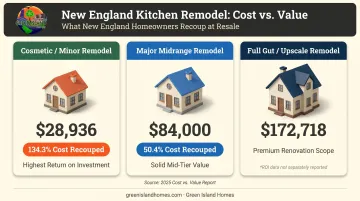
The 2025 Cost vs. Value Report for New England breaks down kitchen remodel costs by scope — and the numbers vary widely depending on how deep you go:
| Tier | Average Cost (New England) | Cost Recouped |
|---|---|---|
| Cosmetic/minor remodel | $28,936 | 134.3% |
| Major midrange remodel | $84,000 | 50.4% |
| Full gut/upscale remodel | $172,718 | — |
Hidden Costs That Routinely Surprise Homeowners
Budget separately for these items — they're common in 1960s homes and rarely show up in an initial estimate:
- Asbestos abatement: National average $1,215–$3,281; Massachusetts-specific costs vary by project scope
- Electrical panel upgrade: $5,000–$8,000 in Massachusetts for a standard 100- to 200-amp upgrade
- Plumbing rerouting: Often required when adding a dishwasher or relocating a sink
- Permit fees: Required for structural, electrical, and plumbing work
This Old House recommends holding 15–20% of your renovation budget in reserve specifically because older homes hide problems behind walls and under floors. In a 1960s ranch, that reserve gets used — not just held.
Where to Spend vs. Where to Save
Spend here:
- Structural work (load-bearing beam, wall removal)
- Quality countertops
- Appliances
Save here:
- Cabinet boxes — IKEA or stock cabinets with upgraded hardware or custom fronts
- Open shelving instead of upper cabinets
- Light fixtures (these can be swapped later without major renovation)
Hiring a Contractor for Your Cape Cod or Martha's Vineyard Ranch Kitchen
Finding a contractor who knows 1960s construction is different from finding someone who can build new. The quirks of a ranch-era home — the structural surprises, the hazardous materials, the undersized systems — require experience that not every remodeler has.
For Cape Cod and Martha's Vineyard homeowners, Green Island Homes (based in Edgartown, MA) handles all phases of residential construction and remodeling throughout the region. They're fully licensed and insured, HomeAdvisor Top Rated and Elite Service recognized, and known for fair pricing and clear communication from start to finish.
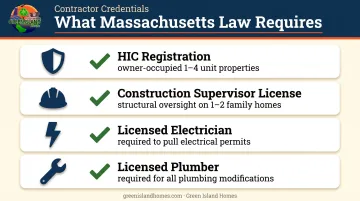
What Massachusetts Law Requires of Your Contractor
Before signing anything, confirm your contractor meets these legal minimums:
- HIC registration — covers work on owner-occupied 1–4 unit properties
- Construction Supervisor License (CSL) — required for structural oversight on 1–2 family homes
- Licensed electrician — the only person authorized to pull an electrical permit in Massachusetts
- Licensed plumber — required for any plumbing modifications
Questions to Ask Before You Sign
Massachusetts law requires written contracts for work over $1,000, with a detailed scope, total price, and payment schedule. Deposits are capped at one-third of the total contract price — confirm this before signing. Beyond the legal baseline, ask:
- How do you handle unexpected discoveries — asbestos, outdated wiring, failing plumbing — mid-project?
- Do you pull all required permits?
- Who manages subcontractors on-site?
- What does the payment schedule look like?
In a 1960s ranch, unexpected discoveries are the rule, not the exception. A contractor who answers these questions clearly upfront is far less likely to leave you exposed when they surface.
Frequently Asked Questions
How much does it cost to remodel a 1960s ranch kitchen?
In New England, a cosmetic refresh averages around $28,936, while a full gut renovation runs $172,718 or more, per 2025 Cost vs. Value data. These figures run higher than national averages — get multiple local estimates before budgeting.
Do I need a permit to remove a wall or remodel a kitchen in Massachusetts?
Yes. Structural changes, electrical work, and plumbing modifications all require permits under Massachusetts building code, including on Cape Cod and Martha's Vineyard. A licensed contractor handles permit applications as part of the project.
Can I reuse the original cabinets in a 1960s kitchen remodel?
Solid wood boxes in good condition are often worth keeping — repainting or refacing them is a common cost-saving strategy. Particle board boxes with moisture damage or failing joinery aren't worth saving — inspect both before deciding.
What hazardous materials should I watch out for in a 1960s kitchen?
Asbestos in vinyl floor tiles and adhesives, and lead paint on cabinets and walls, are the primary concerns. Massachusetts requires a professional asbestos survey before any demolition. Both issues need testing before demo begins — not after.
How long does a 1960s ranch kitchen remodel take?
A cosmetic refresh typically takes 2–4 weeks. A full remodel with structural work, systems upgrades, and new finishes runs 8–16 weeks or longer. Permit approval (up to 30 days under Massachusetts code) and material lead times often extend the schedule.
Is it better to do a full gut remodel or a phased refresh?
Phased remodeling works well when the layout and systems are sound. If you need structural changes, asbestos removal, or systems upgrades anyway, a full gut remodel is more efficient — mobilizing crews and opening walls once is almost always cheaper than doing it in separate projects.