The blueprint rarely causes those problems. The builder does.
There's no shortage of advice on what to look for when hiring a custom home builder. Far less attention goes to the specific mistakes homeowners make during the selection process — the ones that seem minor upfront but compound into serious headaches. This article covers the seven most common ones.
Key Takeaways
- Mistake 1: Skipping verification of licensing, insurance, and workers' compensation coverage
- Mistake 2: Choosing the lowest bid without understanding what's missing from it
- Mistake 3: Relying on website photos instead of actual reference checks
- Mistake 4: Hiring a builder without local knowledge of your specific market and regulations
- Mistake 5: Ignoring communication red flags before you've signed anything
- Mistake 6: Signing a vague contract that leaves materials and pricing open to interpretation
- Mistake 7: Failing to ask who the subcontractors are
What's Really at Stake When You Choose the Wrong Builder
A custom home is the largest financial decision most people will ever make. In coastal Massachusetts, the stakes are even higher.
According to NAHB's 2024 Construction Cost Survey, the average construction cost for a new single-family home nationally was $428,215 — roughly $162 per finished square foot. Massachusetts runs well above that baseline. Fixr estimates the 2024 average for a 2,500-square-foot home in Massachusetts at approximately $542,081. On Cape Cod, the June 2024 median listing price in Barnstable County reached $999,000, up 6.3% year over year. On Martha's Vineyard, the 2024 median home price hit a record $1.6 million.
At those numbers, the margin for error is thin.
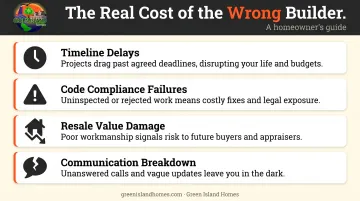
Pick the wrong builder and the damage extends well beyond a blown budget. A bad hire can cost you in ways that compound across the entire project:
- Delayed timelines that stretch a 12-month build into 18 or more
- Code compliance failures that stall inspections or require costly rework
- Resale value damage from substandard finishes or unpermitted work
- Months of poor communication that turns the build into a daily stressor
Most homeowners only recognize these patterns after the fact. The seven mistakes below are the ones worth knowing before you sign anything.
7 Mistakes to Avoid When Choosing a Custom Home Builder
Mistake 1: Not Verifying Licensing and Insurance Before Anything Else
Many homeowners assume any contractor operating openly must be licensed. That assumption has cost people real money.
In Massachusetts, contractors performing work on owner-occupied residential properties must register as a Home Improvement Contractor (HIC) through the Office of Consumer Affairs and Business Regulation. Separately, a Construction Supervisor License (CSL) is required for certain structural work — and the two credentials are not interchangeable.
Before signing anything, verify:
- HIC registration — searchable through Mass.gov
- Construction Supervisor License — check the Office of Public Safety and Inspections
- Workers' compensation coverage — Massachusetts requires all employers to carry it; Mass.gov warns homeowners can be held personally liable if an uninsured worker is injured on their property
- General liability insurance — request a certificate of insurance directly from the builder
A builder who hesitates to provide any of these documents is telling you something important. Green Island Homes is fully licensed and insured, and holds HomeAdvisor Screened & Approved, Top Rated, and Elite Service designations — all of which involve third-party credential checks before a homeowner even makes first contact.
Mistake 2: Choosing Based on the Lowest Bid
When one bid comes in noticeably lower than the rest, something is usually missing from it.
Common reasons a bid comes in low:
- Cheaper or unspecified materials substituted in the line items
- Less experienced (or less expensive) subcontractors priced in
- Key scope items omitted, intended to reappear as change orders once work begins
- Minimal supervision costs built in
The BBB is direct on this point: the lowest bid may not be the best bid, especially when one offer is noticeably lower than the rest. Massachusetts's own HIC consumer guidance recommends getting at least three written estimates and comparing them item by item — not just the final number.
When comparing bids, look at:
- Material specifications (brand, grade, model)
- What's included in general conditions and site overhead
- How the builder handles contingencies
- The markup structure and supervision costs
A complete bid costs more on paper. It rarely costs more in the end.
Mistake 3: Skipping Reference Checks and Portfolio Reviews
A builder's website shows their best work on their best day. References show you everything else.
NAHB recommends that homeowners ask builders for contact information for recent clients — and actually call them. A confident builder with a solid track record will welcome this. One who deflects or offers vague responses to the request is worth reconsidering.
When you speak with past clients, ask:
- Did the project finish on time and within budget?
- How were unexpected issues handled?
- Was the builder responsive when problems came up?
- Would you hire them again?
Better still: ask for the address of a recently completed home and drive past it. Look at rooflines, trim details, and how the exterior finishes meet — those are the places shortcuts show up. If the builder has active job sites, ask whether you can visit one. How a site is organized and maintained tells you a lot about how a project is run.
Mistake 4: Overlooking Local Knowledge and Experience
An impressive portfolio in another region doesn't automatically translate to a smooth build on Cape Cod or Martha's Vineyard. These markets have regulatory and logistical layers that catch out-of-area builders off guard.
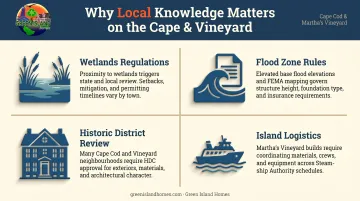
What local expertise covers:
- Wetlands regulations — The Massachusetts Wetlands Protection Act applies to construction within a 100-foot buffer zone of wetland resource areas; local conservation commissions administer the process, and filings like a Notice of Intent can add weeks to a project timeline
- Flood zone rules — Coastal properties face state building code requirements, Title V regulations, and FEMA's National Flood Insurance Program standards (including the 50% substantial-improvement threshold)
- Historic district review — Towns like Sandwich require a Certificate of Appropriateness before certain work can proceed
- Island logistics — On Martha's Vineyard, materials arrive by ferry, contractor availability follows seasonal rhythms, and permitting offices have limited bandwidth
A builder who knows your town's building department, has relationships with local inspectors, and understands the actual sequence of approvals won't just save you headaches — they'll save you months.
Mistake 5: Ignoring Communication Red Flags Early On
How a builder communicates before you sign is a preview of how they'll communicate during a build that could run 12 months or longer.
Pay attention to these warning signs during the initial consultation:
- Slow or inconsistent responses to emails and calls
- Vague answers to direct questions about timeline, process, or materials
- Reluctance to provide documentation (licenses, insurance, references)
- A tendency to overpromise on timelines without explaining how they'd be met
- Rushing toward a price before genuinely listening to your vision
The Consumer Federation of America's 2024 complaint report ranked home improvement contractors as the second most frequent consumer complaint category in 2023. Quality of work, failure to complete, and communication breakdowns all featured prominently.
The way a builder handles your questions before any money changes hands is the most reliable signal you'll get. If they're evasive then, they'll be evasive when a problem comes up mid-build.
Mistake 6: Signing a Contract That Lacks Specifics
Vague contracts are where the most expensive disputes begin. Phrases like "high-quality finishes" or "standard materials" mean different things to different people — and when there's ambiguity, the interpretation that wins is rarely the homeowner's.
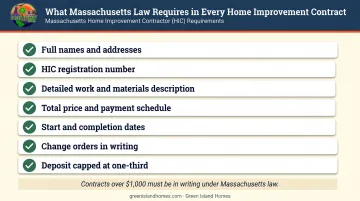
Under Massachusetts law, all home improvement contracts over $1,000 must be in writing. Required elements include:
- Full names and addresses of both parties
- The contractor's HIC registration number on the first page
- Detailed description of the work and specific materials
- Total price and payment schedule
- Start and completion dates
- All change orders in writing, signed by both parties
- Deposit capped at one-third of the total contract price
Beyond legal minimums, a well-structured custom home contract should also include milestone-based scheduling, warranty terms, and a dispute resolution process. If a builder offers you a contract without these components, ask for them explicitly. A builder who pushes back on adding specifics is showing you their hand.
Mistake 7: Failing to Ask About Subcontractors
Most homeowners negotiate with the general contractor and never think to ask about the people who will actually build the house. That's a gap worth closing.
NAHB research found the average new single-family home involves 24 different subcontractors. Electrical, HVAC, plumbing, foundation work — all of these are typically handled by specialists the builder brings in. The quality and reliability of those relationships directly affects your job site.
Ask any builder you're seriously considering:
- Which subcontractors do you use regularly?
- How long have you worked with them?
- Are you willing to share their names so I can look them up?
A builder with established subcontractor relationships has better scheduling leverage and a clearer line of accountability when something needs to be redone. One who hires whoever's available creates variability — and you'll see it in the finished product.
A confident builder answers this question without hesitation. If they can't tell you who does their electrical or framing work, that's worth pressing on.
Why Green Island Homes Addresses These Mistakes Before You Ask
Green Island Homes is a fully licensed and insured custom home builder based in Edgartown, MA, serving homeowners across Cape Cod and Martha's Vineyard. The company holds HomeAdvisor Screened & Approved, Top Rated, and Elite Service designations. These third-party credentials cover several of the verification steps outlined above before a first conversation even takes place.
The company handles all phases of construction, from traditional custom home builds to energy-efficient modular home options. Clients consistently describe the experience in terms that map directly to what this article warns against:
- Fair, transparent pricing with no surprise markups
- Clear communication from initial plans through final walkthrough
- Reliable, knowledgeable service that keeps projects on track
If you're beginning a custom home search on Cape Cod or Martha's Vineyard and want an honest, no-pressure conversation about your project, you can reach Green Island Homes at 774-563-9714 or sales@greenislandhomes.com.
Conclusion
The seven mistakes covered here aren't about catching dishonest builders — they're about giving you the right questions and criteria before you commit to one of the largest decisions you'll ever make.
The right custom home builder isn't necessarily the most visible name in the market or the one with the lowest number on a bid sheet. It's the builder who is properly credentialed, genuinely familiar with your local market, transparent about pricing and process, and consistent in their communication from the first phone call through the final walkthrough. Those qualities are findable. On Cape Cod and Martha's Vineyard, Green Island Homes is built around exactly that standard — licensed, locally experienced, and focused on keeping homeowners informed at every stage. Start by asking the right questions, and the right builder becomes easier to spot.
Frequently Asked Questions
How do I choose the right custom home builder?
Start by verifying licensing, insurance, and workers' compensation coverage. Then check references, review completed projects in person if possible, and assess how the builder communicates before you've committed to anything. Local experience in your specific market — including familiarity with permitting, wetlands rules, and regional logistics — matters more than portfolio size alone.
Is $300,000 enough to build a house on Cape Cod or Martha's Vineyard?
The 2024 national median for contractor-built homes was $356,200 — and Massachusetts runs higher. With Barnstable County's median listing at $999,000 and Martha's Vineyard's at $1.6M, a $300,000 budget would require tight scoping of size, site work, and finishes. A local builder can tell you exactly what's realistic for your lot.
What questions should I ask a custom home builder before hiring them?
Ask: How many projects are you managing right now? Can I speak with past clients? Who are your subcontractors? What does your contract cover? How do you handle change orders and delays? A builder worth hiring will answer every one of these directly.
What are the biggest red flags when hiring a custom home builder?
Watch for: pressure to decide quickly, no proof of licensing or insurance, large upfront deposit requests (Massachusetts caps deposits at one-third of the contract price), vague contract language, or evasive communication before you've even signed. Any single one of these is worth pausing over.
How long does it take to build a custom home?
NAHB's analysis of 2024 Census data puts contractor-built homes at roughly 12 months from permit to completion. On Cape Cod and Martha's Vineyard, expect longer — permitting backlogs, seasonal contractor schedules, and ferry-dependent deliveries on the Vineyard all add time. Plan for buffer from the start.