The custom home building market is crowded. Every builder claims quality, experience, and great communication. Sorting out who actually delivers requires knowing what to look for, what questions cut through the sales pitch, and what warning signs to walk away from.
According to a 2025 Homes.com survey cited by NAHB, 35% of new-home buyers identified hidden costs or unexpected upgrades as their top pain point — suggesting most dissatisfaction is preventable with better upfront due diligence.
This guide covers how to evaluate custom home builders, what questions to ask before signing anything, how to understand costs honestly, and what red flags should end a conversation immediately.
Key Takeaways
- Custom builders work to your specs; production builders offer fixed plans with limited changes, and upgrade costs add up fast
- Verify licensing, insurance, and third-party credentials before anything else
- Ask five specific questions before signing: pricing inclusions, subcontractor management, timeline, portfolio visits, and warranty terms
- Budget a 10–15% contingency on top of your quoted cost — always
- Coastal markets like Cape Cod and Martha's Vineyard add regulatory and logistical layers that demand local builder expertise
Custom Home Builder vs. Production Builder: What's the Difference?
These two builder types serve fundamentally different buyers — and choosing the wrong one can cost you months, money, and compromises you didn't expect.
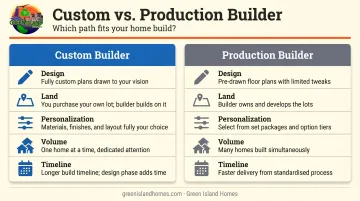
| Custom Builder | Production Builder | |
|---|---|---|
| Design | Built from scratch to your specifications | Pre-designed floor plans with limited modifications |
| Land | You own or select the lot | Developer-owned community lots |
| Personalization | Full control over layout, materials, finishes | Menu of options and upgrades |
| Volume | Often fewer than 10 homes per year | Dozens to hundreds per year |
| Timeline | Longer, more variable | Faster, more predictable |
The Upgrade Cost Reality
Production builders often present an attractive base price — then make significant margin on options and upgrades. This isn't speculation: Toll Brothers' FY2024 10-K filing shows structural and finishing options averaged $206,000 per home, equal to 24.9% of base sales price. For detached homes, that figure climbed to $232,000 — 27.3% of base price.
When you factor in those additions, the "more affordable" production home closes the gap with custom builds significantly — sometimes by six figures.
Modular Construction: The Middle Ground
Some custom builders — including Green Island Homes on Cape Cod and Martha's Vineyard — offer energy-efficient modular construction. Factory-built sections are assembled on a permanent foundation at the build site, constructed to the same building codes as traditional stick-built homes. The result: faster build timelines, tighter quality control, and often lower costs — without sacrificing customization.
For coastal climates with extreme weather demands, modular construction's precision manufacturing can actually improve long-term energy performance.
What to Look for in a Custom Home Builder
Licensing and Insurance
Any builder you consider must hold a valid state contractor's license and carry current liability and workers' compensation insurance. In Massachusetts, residential builders require a Construction Supervisor License (CSL) for one- and two-family homes. Verify it yourself through the Mass.gov OPSI license verification tool — don't take a builder's word for it.
Proper licensing and insurance protects you from liability if a worker is injured on-site, financial exposure if the project stalls, and legal disputes with subcontractors.
Third-Party Credentials
Self-reported quality claims are easy to make — third-party vetting is harder to fake. Designations like HomeAdvisor Screened & Approved, Top Rated, and Elite Service require background checks, verified licensing, and documented client satisfaction scores (Elite Service requires a 4.5+ overall rating with at least five five-star reviews).
Green Island Homes holds all three HomeAdvisor designations — a useful example of what verified credibility looks like versus a builder with only self-described accolades.
Portfolio and Project Experience
Attractive photos don't tell the full story. When reviewing past work, ask:
- Have they built homes similar in size and complexity to what you want?
- Did projects finish on time and within budget?
- How did they handle unexpected complications?
A portfolio that only shows best-case finished photography tells you little. Ask to see homes with comparable scope to yours.
Communication Throughout the Build
NAHB advises buyers to establish communication frequency and methods early, noting that early communication practices set the tone for the entire relationship. How a builder communicates before you sign is how they'll communicate during construction — a process that runs 10 to 18 months.
Ask specifically:
- How often will I receive project updates?
- Through what channels (email, phone, site visits)?
- Who is my dedicated point of contact?
A builder who can't answer these questions clearly hasn't thought them through.
References From Recent Projects
Go beyond star ratings. Ask for two or three references from projects completed in the last two years. When you speak with past clients, ask specifically:
- How did the builder handle problems that came up unexpectedly?
- Did the final cost match the original estimate?
- Would you hire them again for a project of similar complexity?
Questions to Ask Before You Hire a Custom Home Builder
These five questions get past polished sales pitches and reveal how a builder actually operates.
1. What's included in your base price, and how do change orders work?
Base prices vary enormously in what they actually cover. Some builders include permits, site preparation, and allowances for fixtures; others quote a construction-only number and add everything else separately. Get a written line-item breakdown.
Change orders — modifications after the contract is signed — are where many buyers get surprised. Ask how change orders are priced, approved, and documented before work proceeds.
2. How do you manage subcontractors, and who is on-site daily?
Build quality is largely determined by the subcontractor network: electricians, plumbers, framers, insulators. Ask who they use, how long those relationships have been in place, and whether the general contractor or a project manager is physically present each day or managing remotely.
A builder who can't name their regular subs — or who outsources project management entirely — is a red flag worth taking seriously.
3. What does your timeline look like, and what causes delays?
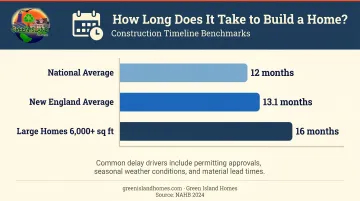
According to NAHB's 2024 analysis of Census data, homes built by hired contractors averaged 12 months from authorization to completion. In New England, that average extends to 13.1 months. Complex homes over 6,000 sq. ft. often approach 16 months.
A builder who promises dramatically shorter timelines without explaining how should raise questions. Common delay drivers include permitting backlogs, weather, and material lead times. The honest answer here reveals planning experience.
4. Can I visit a recently completed home similar to what I want?
Photos don't tell you how a door closes, whether flooring transitions are clean, or how well the trim work holds up. A site visit to a finished home gives you hands-on, real-world evidence of craftsmanship quality — and shows whether the builder's work holds up outside curated photography.
5. What warranty do you offer, and what does it cover?
Builder warranties typically address three areas: workmanship, mechanical systems, and structural components — often with different coverage durations for each. NAHB recommends clear written warranty documentation and legal review before signing.
A builder with no formal warranty — or who can't clearly explain what it covers — is telling you exactly how much they stand behind their work.
Understanding Custom Home Costs
Why Per-Square-Foot Pricing Misleads
NAHB's 2024 Cost of Constructing a Home survey puts the national average construction cost at $162 per sq. ft. — but that number is nearly useless for planning purposes. The same 2,500 sq. ft. footprint can cost dramatically more or less depending on:
- Lot conditions and foundation requirements
- Finish selections (interior finishes account for 24.1% of construction cost nationally)
- Location and local labor rates
- Structural complexity
Two similar-sized homes on the same street can diverge by six figures based on finishes alone.
Where the Money Actually Goes
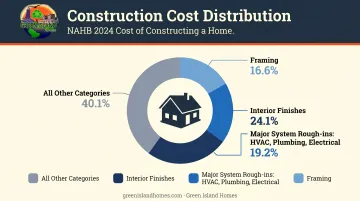
NAHB's 2024 data breaks down average construction costs this way:
| Cost Category | % of Construction Cost |
|---|---|
| Interior finishes | 24.1% |
| Major system rough-ins (HVAC, plumbing, electrical) | 19.2% |
| Framing | 16.6% |
| All other categories | 40.1% |
Beyond construction, buyers often underestimate pre-construction costs: land acquisition, site grading, utility connections, and permitting. These categories are real money — NAHB reports finished lot cost alone averaged 13.7% of a home's total sales price in 2024.
Construction Loans vs. End Loans
Two primary financing paths exist for custom builds:
- Construction loan: Funds are drawn in stages as work progresses, then converted to a permanent mortgage at completion. More complex to manage but can reduce total closing costs with a one-time close structure
- End loan: A traditional mortgage secured after construction is complete using builder financing during the build period
Discuss financing before you sign anything. Some builders have established lending relationships; others work with any lender you bring. Knowing your financing structure upfront keeps the project on schedule once ground breaks.
Budget for Overruns and Change Orders
Your financing structure also determines how much flexibility you have when costs climb — and they often do. NAHB advises a 10% contingency buffer on top of project costs, rising to 20% if you're serving as your own general contractor. The most common overrun drivers:
- Change orders mid-build (scope additions or modifications)
- Unforeseen site conditions (rock, poor soil, drainage issues)
- Material price changes between quote and delivery
Ask every builder you interview how they handle change orders — what triggers one, how it's priced, and how quickly you'll be notified. The answer tells you a lot about how the project will actually run.
What Coastal and Island Buyers Need to Know
Building on Cape Cod or Martha's Vineyard isn't like building inland. The regulatory environment is more complex, the logistics are genuinely harder, and an inexperienced builder will learn on your time and your money.
Regulatory Layers
Coastal construction in Massachusetts involves approvals and restrictions that don't exist elsewhere:
- Wetlands Protection Act: Work within 100 feet of a wetland requires a Notice of Intent and an Order of Conditions from the local Conservation Commission — a process that takes real expertise to navigate on schedule
- FEMA flood zones: Properties in Special Flood Hazard Areas face NFIP building requirements that affect foundation design, first-floor elevation, and materials selection
- Historic districts: Massachusetts Historical Commission guidelines govern exterior features visible from public ways — siding, windows, foundations, and accessory structures — which matters in many older Cape Cod neighborhoods
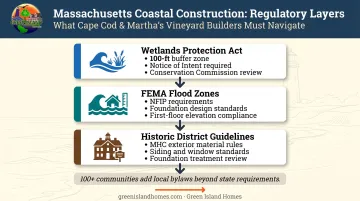
Over 100 Massachusetts communities have also adopted local wetlands bylaws beyond the state Act, adding a third layer of review on top of state and federal requirements.
Martha's Vineyard Logistics
Island construction carries costs and complexities that mainland projects don't. Commercial trucks 20 feet or longer must be pre-booked through the Steamship Authority's reservation office. Vehicles wider than 8 ft. 6 in. are charged double fare — and peak-period one-way vehicle fares can exceed $168. Material deliveries depend on ferry schedules and capacity, adding lead time and cost to every order.
Labor pools on the island are smaller, and scheduling subcontractors requires more advanced planning than mainland projects.
Why Local Knowledge Matters
Green Island Homes is based in Edgartown and serves both Cape Cod and Martha's Vineyard. That local foundation — established subcontractor relationships, familiarity with Conservation Commission processes, and experience coordinating island logistics — shapes project timelines and total costs in ways that matter. A builder who has never navigated these systems will encounter learning curves that delay your project.
Red Flags to Avoid When Choosing a Custom Home Builder
Vague or Verbal-Only Agreements
Any reputable builder provides a written contract covering scope of work, payment schedule, timeline milestones, change order process, and warranty terms before work begins. Massachusetts requires home improvement contracts over $1,000 to be in writing. If a builder resists detailed paperwork or asks you to trust their word on key terms, walk away.
Bids That Are Significantly Below Competitors
The FTC advises getting at least three written estimates before proceeding. A bid that comes in 20–30% below everyone else is a red flag, not a bargain. Something is likely excluded, corners will be cut, or the builder underpriced to win the job and will recover margin through change orders later. Compare bids line by line, not just total number.
Poor Communication Before You Sign
How a builder responds to your emails and questions during the sales process is exactly how they'll perform during a 12-month build. Watch for these patterns before you sign:
- Slow or inconsistent responses to basic questions
- Evasive answers about licensing or subcontractors
- Reluctance to provide references from past clients
- Pressure to sign quickly before you've done your research
None of these behaviors improve once the contract is in place.
Frequently Asked Questions
How much does it cost to build a custom home?
Costs vary widely based on location, size, finishes, and lot conditions. NAHB's 2024 data puts average construction cost at $162 per sq. ft. nationally, but coastal Massachusetts typically runs higher. Get itemized bids and add a 10–15% contingency to whatever figure you receive.
What is the difference between a custom builder and a production builder?
Custom builders work from your specifications on land you own; production builders offer pre-designed plans with limited options in set communities. Custom isn't always more expensive once production upgrade costs — which can add 25%+ to a base price — are factored in.
How long does it take to build a custom home?
Homes built by hired contractors averaged 12 months from authorization to completion nationally in 2024; New England averaged 13.1 months. Coastal and island markets can extend that further due to Conservation Commission reviews, permitting steps, and island logistics.
Is a modular home considered a custom home?
Yes — modular homes can be fully custom. Factory-built sections are assembled on-site to the buyer's specifications, built to the same codes as site-built construction, and often offer better energy efficiency and faster build timelines than traditional methods.
What questions should I ask a custom home builder before hiring?
Ask about:
- Pricing inclusions and change order policies
- How subcontractors are selected and managed
- Realistic timelines for your specific project
- Whether you can visit a recently completed comparable home
- What warranty coverage is provided after completion
How do I verify that a custom home builder is legitimate?
- Verify their Construction Supervisor License via the Mass.gov OPSI tool
- Request current proof of insurance directly from their carrier
- Look for third-party accreditations like HomeAdvisor Screened & Approved
- Speak with two or three recent past clients — not references they hand you
- Independently confirm any credentials they claim