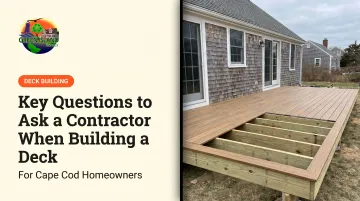
The good news: asking the right questions before signing anything separates skilled, trustworthy builders from those who cut corners. This guide covers exactly what to ask — and what the answers should sound like.
Key Takeaways
- Verify both HIC registration and a Construction Supervisor License (CSL) — Massachusetts deck builds require both
- Ask specifically how the contractor handles coastal conditions: fastener grade, framing treatment, and hardware coatings matter
- Get a fully itemized written quote; Massachusetts law requires any contract over $1,000 to be in writing
- Confirm the contractor pulls all permits; homeowners who pull their own lose access to the state Guaranty Fund
- Watch for vague answers, pressure to skip permits, and bids that are dramatically lower than others
Questions to Ask About Credentials and Experience
Hiring the wrong contractor on Cape Cod or Martha's Vineyard can mean stalled permits, surprise costs, or worse — liability for injuries on your property. These questions separate qualified builders from the rest.
Are you licensed and insured, and can you provide proof?
In Massachusetts, residential deck construction requires two separate credentials: a Home Improvement Contractor (HIC) registration and a Construction Supervisor License (CSL). These are not the same thing. HIC covers consumer protection and business practices; CSL applies to structural building work. Ask for both numbers.
You can verify them yourself:
- HIC registration: Search the MA Contractor Hub directly
- CSL: Check through the Office of Public Safety and Inspections (OPSI) via Mass.gov
On insurance, request current certificates for both general liability and workers' compensation. Massachusetts requires workers' comp for any employer with one or more employees. If an uninsured worker is injured on your property, you could be held liable — so don't skip this step.
How long have you been building decks, and do you have local experience?
Years in business matter less than regional experience. A contractor who regularly builds on Cape Cod or Martha's Vineyard understands local permit requirements, coastal exposure conditions, and how each town's building department operates.
Ask for examples of past projects in similar coastal environments — not just a general portfolio.
Can you provide references from recent deck projects?
Speaking with past clients is one of the most reliable vetting steps. When you call references, ask:
- Was the crew respectful of the property?
- Were there any surprises in the final cost?
- Did the project finish on time?
- Would you hire them again?
Do you handle permits and local building code compliance?
Most deck builds in Massachusetts require a building permit. Under Massachusetts law, if the homeowner pulls the permit instead of the contractor, the homeowner becomes ineligible for the state Guaranty Fund — which can compensate up to $25,000 for unpaid judgments against a registered contractor. Let the contractor handle permitting.
Any contractor who suggests skipping permits is someone to walk away from, regardless of how much time they claim it saves.
Questions to Ask About Materials and Build Quality
What a contractor recommends — and how confidently they explain it — reveals how well they understand long-term performance. Vague answers like "we use good materials" tell you nothing useful — especially on the Cape or Vineyard.
What materials do you recommend, and why?
A knowledgeable contractor should walk through real trade-offs between pressure-treated wood, composite, and PVC decking — not just name a brand.
Here's what the data shows:
| Material | Typical Lifespan | Maintenance | Coastal Fit |
|---|---|---|---|
| Pressure-treated wood | 10–15 years | Annual cleaning, staining, sealing | Lower upfront cost; higher long-term effort |
| Composite | 25–50 years | Occasional cleaning | Strong moisture resistance; popular in coastal climates |
| PVC / capped polymer | 30+ years, lifetime warranties on some lines | Minimal — no sanding or staining | Excellent for high-humidity, salt-air environments |
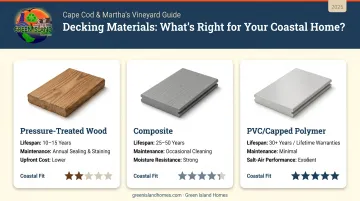
For Cape Cod and Martha's Vineyard, composite and PVC options often justify the higher upfront cost through reduced maintenance and longer service life.
What grade of lumber and treatment level do you use for framing?
The framing beneath your deck boards carries the load — and it degrades faster than the surface if specified poorly. Quality contractors use No. 1 or No. 2 grade pressure-treated lumber for structural framing, with higher treatment levels for ground-contact posts.
The relevant AWPA use categories to ask about:
- UC3B — above-ground exterior with weather exposure
- UC4A — general ground contact, difficult-to-replace components
- UC4B — heavy-duty ground contact, including salt-water splash zones
Ask to see lumber tags or spec sheets confirming the correct use category for your site.
What fasteners and hardware will you use?
Coastal-aware contractors answer this without hesitation. According to the AWC Deck Construction Guide (DCA6), decks within 300 feet of a saltwater shoreline require stainless steel Type 304 or 316 fasteners and connectors. Hot-dipped galvanized hardware is acceptable farther inland, but must meet ASTM A153 (fasteners) or ASTM A653/G185 (connectors).
The wrong fasteners corrode, react with treated lumber, and cause boards to warp or loosen — sometimes within a few years on the Cape or Vineyard.
How will you ensure the structure is safe and durable over time?
Listen for specifics: footing depth relative to the 48-inch Massachusetts frost line, proper joist spacing, beam sizing, ledger attachment method, and load capacity. "We just build it right" is not an answer — it's a deflection.
Questions to Ask About Project Logistics and Cost
Even a highly qualified contractor can create problems if timelines, costs, and expectations aren't defined in writing.
What does your written estimate include, and could there be additional costs?
Under Massachusetts law, any home improvement contract over $1,000 must be in writing, and must include scope, registration number, permit responsibility, and cancellation terms. A reliable contractor provides a fully itemized quote covering:
- Materials (species, grade, brand)
- Labor
- Permit fees
- Hardware and fasteners
- Site cleanup
Ask directly about scenarios that trigger change orders: unexpected rot in existing structures, design changes, or material price shifts.
Also note: Massachusetts law limits upfront deposits to one-third of the total contract price unless special-order materials are involved. If a contractor asks for more, ask why.
When can you start, and how long will the project take?
Contractors on Cape Cod and Martha's Vineyard book out quickly during spring and summer. Get realistic start and end dates in writing.
A typical residential deck project runs:
- Design/planning — 1 to 3 weeks
- Permit approval — 1 to 4 weeks (varies by municipality)
- Footings — 2 to 5 days
- Framing and decking — 3 to 10 days
- Railings and stairs — 2 to 5 days
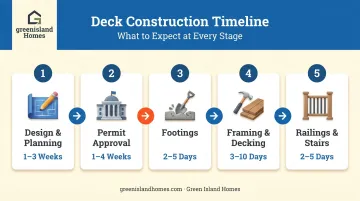
Total: roughly 2 to 6 weeks of active construction, though permitting can extend the overall timeline. A transparent contractor will tell you where the schedule is firm and where it isn't.
Who will be on-site doing the work?
Some contractors use their own trained crews; others subcontract labor. Before signing anything, clarify:
- Who will be on-site daily
- How the contractor oversees subcontracted work
- Whether the same supervisor is present throughout the project
What warranty do you offer on labor and materials?
Warranties signal how much confidence a contractor has in their own work. Understand:
- How long the labor warranty lasts
- What it covers and what voids it
- How it differs from any manufacturer warranty on materials
Get all warranty terms in writing before signing the contract.
Red Flags to Watch For
Knowing the right questions is only half the job. How a contractor responds matters just as much. Watch for these warning signs before signing anything:
- Won't produce documentation or references — Any legitimate contractor hands over HIC registration, CSL, insurance certificates, and references without hesitation. "My license is being renewed" is not an acceptable answer for a major investment.
- Pushes to skip permits or skip a written contract — Unpermitted deck work can complicate a home sale or mortgage refinance. Fannie Mae requires appraisers to comment on additions made without required permits, which affects assessed market value. No verbal agreement is sufficient for a project of this scale.
- Bids significantly lower than everyone else — This usually signals cut-rate materials, unlicensed subcontractors, or planned change orders that inflate the final cost.
If a bid comes in far below the rest, ask the contractor to walk through their numbers line by line. Compare scope carefully — not just the bottom figure.
Why Green Island Homes Is Worth Asking These Questions First
Green Island Homes is a fully licensed and insured residential builder serving Cape Cod and Martha's Vineyard, based in Edgartown, MA. The company has been screened, top-rated, and recognized as an Elite Service Provider through HomeAdvisor — which independently verifies contractor credentials and customer satisfaction before awarding those designations.
For coastal homeowners, local knowledge isn't optional — it's the difference between a smooth build and costly delays. Working on the Cape or Vineyard means dealing with:
- Specific municipal permit offices and coastal exposure requirements
- Logistical realities of island access that outside contractors routinely underestimate
- All phases of construction under one roof, so nothing falls through the cracks
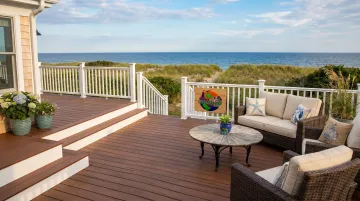
That full-service approach means homeowners aren't left coordinating multiple contractors or chasing down oversight gaps.
Past clients describe the experience as working with the "dream construction person" — fair pricing, clear communication from first quote to final walkthrough, and reliable follow-through. If that's what you're looking for in a deck contractor, here's where to start:
- Phone: 774-563-9714
- Email: sales@greenislandhomes.com
Frequently Asked Questions
What questions should I ask a contractor when building a deck?
Cover these categories: licensing and insurance (HIC + CSL in Massachusetts), local experience and references, specific materials and why they're chosen, permit handling, timeline, written and itemized quote, and warranty terms for both labor and materials.
What is the average cost to build a 20x20 deck?
Nationally, deck costs average around $8,291 with a typical range of $4,339 to $12,625, though installed costs can run $30 to $60 per square foot depending on materials and labor. Coastal markets like Cape Cod typically run higher due to material requirements, permitting complexity, and local labor rates.
How do I verify a contractor's license and insurance in Massachusetts?
Check HIC registration through the MA Contractor Hub and verify the CSL through the Office of Public Safety and Inspections (OPSI) via Mass.gov. Request copies of current liability and workers' compensation certificates directly — don't rely on verbal confirmation.
How long does it typically take to build a deck?
Active construction on a standard deck generally takes two to six weeks. Factor in permit approval (one to four weeks depending on the town), and the full timeline from contract signing to completion can reach two to four months — particularly during peak summer season on Cape Cod and the Vineyard.
What is the difference between composite and pressure-treated wood decking?
Pressure-treated wood costs less upfront but lasts 10 to 15 years and requires annual maintenance — cleaning, sanding, staining, and sealing. Composite costs more initially, carries warranties of 25 to 50 years, and needs only occasional cleaning — a practical trade-off in high-moisture coastal environments.
Should I get multiple quotes before hiring a deck contractor?
Yes — get at least three written quotes. Multiple bids help you gauge fair pricing and flag outliers. The cheapest quote rarely delivers the best value, especially on Cape Cod and the Vineyard where material quality and execution standards directly affect how long the deck holds up.