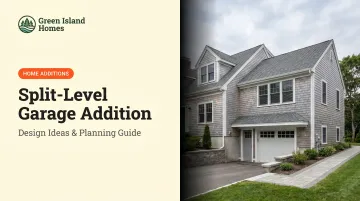
What makes split-level garage additions genuinely different is the interplay between grade change, multiple floor levels, and an unconventional structural layout. Every design decision — from where the garage door faces to how the roof ties in — needs to account for these variables simultaneously.
This guide covers the structural challenges unique to split-level homes, the four most practical garage configurations, what permitting looks like in Massachusetts (including Cape Cod and Martha's Vineyard), and realistic cost ranges so you can plan your budget before the first shovel hits the ground.
Key Takeaways
- Garage additions work on split-level homes — but require careful planning around grade, structural layout, and rooflines
- Four common configurations: tuck-under, attached side-entry, detached with breezeway, and garage with living space above
- Budget $40,000–$100,000+ for a standard garage addition; living space above typically starts at $120,000–$200,000+
- Every Massachusetts garage addition requires a building permit — coastal towns add zoning complexity
- Start planning early; permitting alone can take 4–10 weeks, longer on Martha's Vineyard
Is a Garage Addition Right for Your Split-Level Home?
A garage addition delivers on multiple fronts: vehicle protection, added storage, improved curb appeal, and a meaningful bump in resale value. Angi reports garage additions return roughly 60–70% of their cost at resale — a respectable return for a permanent structural improvement.
Before committing to a design, two questions matter most:
- Does your lot have the space and grade? Is there enough room to meet setbacks while accommodating a driveway approach that works for the garage configuration you want?
- Can your existing foundation and framing support it? If you're planning to add living space above the garage, this becomes critical — the existing structure may need reinforcement before any addition can be built.
Split-level homes are actually well-suited to certain garage configurations. The home's natural grade change — the same feature that makes them feel architecturally awkward — works in your favor for a tuck-under or lower-level attached garage.
The slope does the excavation work for you, which can reduce foundation costs significantly compared to adding a garage to a flat-site ranch or colonial.
Unique Structural Challenges of Split-Level Garage Additions
Floor Level Alignment
Split-level homes have staggered floors, and the garage floor slab must coordinate with the interior connection point — usually a door into a mudroom, laundry room, or lower-level hallway. If these don't align properly, you end up with awkward step transitions or a door landing that creates a trip hazard.
Common solutions include:
- Adjusting the garage wall plate height to shift the ceiling and threshold relationship
- Adding subfloor build-up at the interior connection point
- Designing a stepped entry with a proper landing that meets code
None of these are difficult, but they need to be resolved at the design stage, not discovered during framing.
Roofline Integration
Split-level rooflines are rarely simple. They're often asymmetrical, with varying pitches and ridgelines running in multiple directions. Tying a garage addition into that profile without creating water intrusion points or visual mismatches requires a deliberate decision about roof form early in the design process.
Three roof forms handle this well:
- Shed roof — simple, lower cost, works well for side-entry garages with modest height
- Gabled roof — provides more interior headroom, easier to match pitch to existing rooflines
- Hip roof — better wind resistance, a strong choice on Cape Cod and the Vineyard, though more complex to frame
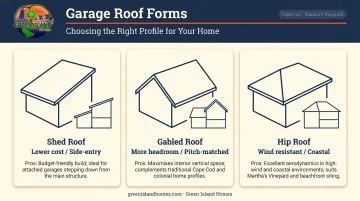
An architect or experienced designer should evaluate which form ties most cleanly into your home's existing profile before any structural plans are drawn.
Long-Span Floor Framing (For Living Space Above)
Garage bays are typically 20–24 feet wide with no interior load-bearing walls. When you put a room above that open span, the floor system has to carry that load without support in the middle. Standard dimensional lumber usually can't do it without excessive bounce or code violations.
The fix is engineered floor joists — I-joists or LVL beams sized to span the full width. Per IRC Chapter 5 floor construction requirements, the structural design must be documented and approved through plan review. Budget accordingly: adding conditioned space above a garage typically runs 40–60% more than the garage structure itself, largely because of this framing requirement.
HVAC and the Thermal Boundary
The floor above an unheated garage is one of the most thermally vulnerable assemblies in residential construction. Without proper treatment, that room will be cold in winter and hot in summer regardless of how well the rest of the house is conditioned.
The DOE recommends air sealing all floor gaps and rim joists before insulating. Three practical steps for this assembly:
- Air seal first — close all penetrations between the garage and conditioned space above
- Use spray foam insulation — open-cell at 5.5 inches or closed-cell at 1.5 inches functions as both insulation and air barrier
- Install a dedicated mini-split — extending existing ductwork into a garage addition adds cost and complexity; a mini-split handles the load cleanly
Exterior Material Matching
Split-levels built between the 1960s and 1980s often have siding profiles, brick courses, or trim details that are no longer manufactured. A garage addition that doesn't match reads as an obvious afterthought and undermines the curb appeal you're trying to create.
Two workable approaches:
- Source salvaged or specialty-order matching materials (time-consuming but seamless)
- Make a deliberate design contrast using complementary materials that clearly belong together
The second approach, done well, often looks more intentional than a forced match. Ask your contractor to show examples of both strategies before committing to a direction.
Split-Level Garage Addition Design Ideas
Tuck-Under Garage (Lower-Level Integration)
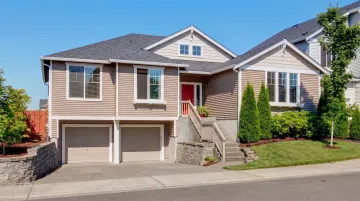
The tuck-under garage is the most natural fit for a split-level. The lower level already sits partially below grade, so a garage door can open at street level while the main living floor remains one story up. In most cases, this eliminates significant excavation and produces an addition that looks like it was always part of the home.
Key design considerations:
- The driveway slope and approach angle must provide adequate vehicle clearance — typically a maximum 14% grade for the last 20 feet before the door
- Interior access usually connects through a mudroom or laundry room at the lower level
- Structural headers above the garage door opening must be properly engineered to carry the floor load above
Attached Side-Entry Garage
For split-levels with wider lots, an attached side-entry garage is the most cost-effective option. It shares one wall with the home, reducing material costs compared to fully detached construction, and connects directly via a fire-rated door (required by IRC R302.5.1).
The garage floor level needs to coordinate with the home's lower or mid-level entry. This is typically managed with a single step or a sloped driveway approach. The roofline tie-in is the most demanding part of the design, but a well-executed side-entry garage blends cleanly into many split-level profiles.
Detached Garage with Covered Breezeway
When lot setbacks, existing utilities, or the home's footprint make attachment impractical, a detached garage with a breezeway connector is the right answer. The covered breezeway provides weather protection and a functional connection without requiring the structural complexity of tying into the split-level's roofline and framing.
The trade-off is cost. A separate foundation, additional walls, and breezeway structure add meaningful expense over an attached configuration — but you gain flexibility in placement, size, and orientation that attached designs rarely allow.
Garage Addition with Living Space Above
Adding a suite, home office, or accessory dwelling unit above the garage maximizes the addition's long-term value. Angi reports that room-over-garage additions return 60–80% of their cost, with an average ROI of 69% — among the better returns for any residential addition type.
Cost ranges run $100–$300 per square foot for general living space. ADU or in-law suite configurations reach $80,000–$210,000 nationally due to added plumbing, electrical, and HVAC complexity. On Cape Cod and Martha's Vineyard, local labor and materials push those numbers higher.
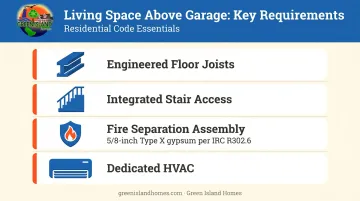
This configuration demands the most structural planning of any option. Requirements include:
- Engineered floor joists sized for habitable loads above a garage span
- Integrated stair access coordinated with the split-level's existing floor plan
- Fire separation assemblies per IRC R302.6: 5/8-inch Type X gypsum between garage and habitable space above
- Dedicated HVAC for the upper-level space, separate from the garage
It's best suited to split-level homes where the garage addition roofline can align with or complement the upper level.
Key Planning Steps: Permits, Zoning, and Timeline
Permitting in Massachusetts
Every garage addition in Massachusetts requires a building permit. Under 780 CMR R105.1, construction without required permit approval is unlawful — no exceptions for small structures or simple additions.
Zoning rules vary by municipality and regularly affect garage addition projects. Common restrictions to verify before designing include:
- Setbacks from property lines (front, side, and rear)
- Maximum lot coverage percentages for structures and paving
- Height restrictions for accessory structures
- Flood zone and coastal overlay requirements in shoreline areas
On Martha's Vineyard, the Martha's Vineyard Commission (MVC) DRI review process adds another layer. Under DRI Checklist Version 15 (effective January 1, 2026), projects creating five or more dwelling units trigger mandatory MVC review — this applies if your garage addition includes an ADU or rental unit. Municipal agencies can also make discretionary referrals for projects with potential regional impact. Screen your project against these thresholds early to avoid mid-design surprises.
Green Island Homes works with homeowners across Cape Cod and Martha's Vineyard and can help map out local permitting requirements before design work begins.
Project Timeline
| Phase | Typical Duration |
|---|---|
| Design and planning | 4–8 weeks |
| Permitting | 4–10 weeks |
| Site prep and foundation | 2–4 weeks |
| Framing and roofing | 3–6 weeks |
| Exterior and interior finishes | 4–8 weeks |
| Final inspection and punch list | 1–2 weeks |
Total: roughly 6–12 months from design kickoff to move-in. Coastal Massachusetts markets — particularly the Vineyard — tend toward the longer end due to permit timelines and contractor availability during peak season. Starting in fall or early winter for a spring construction start typically avoids the worst scheduling delays.
Plan for a 10–20% contingency on top of your base project cost. Older split-levels frequently surface hidden conditions — outdated wiring, under-insulated walls, or unexpected foundation situations — that must be resolved before the addition can proceed.
How Much Does a Split-Level Garage Addition Cost?
Standard Garage Addition Ranges
National benchmarks from Fixr place attached garage additions at $23,000–$45,000 on average, with one-car configurations running $14,400–$19,200 and two-car configurations reaching $24,000–$46,000. For split-level homes, the structural complexity of roofline integration and floor level coordination typically pushes costs toward the upper end of those ranges or beyond.
A more practical planning range for a split-level garage addition in coastal Massachusetts: $40,000–$100,000+, depending on size, configuration, and finishes.
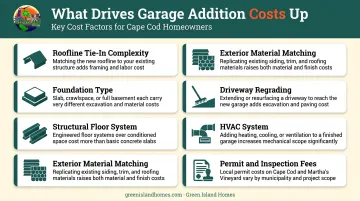
What Drives the Cost Up
- Roofline tie-in complexity — the more asymmetrical the existing roofline, the more labor-intensive the connection
- Foundation type — slab vs. stem wall vs. full foundation varies significantly in cost
- Structural floor system — engineered joists for above-garage living space add cost over standard framing
- Exterior material matching — sourcing discontinued siding or trim profiles takes time and money
- Driveway regrading — tuck-under approaches may require grading work for proper vehicle clearance
- HVAC extension or separate system — mini-splits for upper-level rooms are an added line item
- Local permit and inspection fees — vary by municipality
Living Space Above the Garage
Adding a suite or ADU above the garage is a different financial category. Expect costs to start at $120,000–$200,000+ for a split-level home with upper-level living space, driven by structural engineering, fire-rated wall and ceiling assemblies, plumbing rough-in, and dedicated HVAC.
The upfront cost is higher — but so is the long-term return. On Cape Cod and Martha's Vineyard, additional living space consistently commands premium value, making the investment case stronger than in most inland markets.
When gathering bids, ask for itemized breakdowns by trade. A contractor like Green Island Homes, with documented experience on Cape Cod and Martha's Vineyard, can flag hidden costs — roofline transitions, coastal material requirements, local permitting — before they appear mid-project.
Frequently Asked Questions
Can you add a garage addition to a split-level house?
Split-level homes are well-suited to garage additions, particularly tuck-under or lower-level attached configurations. The grade change that defines a split-level actually works in your favor for these designs. The project does require careful structural planning around staggered floor levels and roofline integration.
What is the average cost of a garage addition to a split-level house?
Most split-level garage additions fall between $40,000 and $100,000+ depending on configuration, size, and finishes. Adding living space above the garage typically starts at $120,000–$200,000+. Local labor rates on Cape Cod and Martha's Vineyard run above national averages, so get local bids.
Do I need a permit to add a garage to a split-level home?
A building permit is required in every Massachusetts municipality under 780 CMR. Setbacks, lot coverage, and height restrictions vary by town and must be reviewed before design begins. Martha's Vineyard adds MVC DRI review for certain projects, including those that create dwelling units.
Should I build an attached or detached garage for my split-level home?
Attached garages cost less and provide direct interior access, but require tying into the existing roofline and framing. Detached garages offer more placement flexibility — often the better trade-off on constrained lots despite the added cost.
How long does it take to build a garage addition on a split-level house?
From design through final inspection, expect 6–12 months. Permitting is often the longest single phase, particularly on Martha's Vineyard where MVC review may apply. Starting the design and permitting process early is the best way to avoid delays.
What is the best placement for a garage addition on a split-level home?
It depends on topography and the home's lower-level layout. A tuck-under configuration is usually the most natural fit, though homes with wider lots and sufficient side setbacks often do better with an attached side-entry garage.