According to HomeAdvisor's 2025 wood siding cost guide, the national average project cost runs $12,500, with most homeowners spending between $7,000 and $23,000 for a full installation. That's a wide range — and it exists for good reason.
Pricing varies based on wood species, siding style, home size, regional labor rates, and the condition of the existing exterior. A budget pine installation on a small ranch-style home looks nothing like a premium cedar shake project on a multi-story coastal property. This guide breaks down every cost component so you can build a realistic budget before the first board goes up.
Key Takeaways
- Installed wood siding costs $3–$20+ per square foot depending on species, style, and labor complexity
- Most full-home projects run $8,500 to $31,500; the national average is around $12,500
- Cedar, redwood, and cypress handle coastal salt air and moisture far better than pine
- Budget beyond installation: painting, staining, and routine maintenance are recurring costs that add up
- Always get itemized written quotes from licensed contractors before committing to a price
How Much Does Wood Siding Installation Cost?
Wood siding doesn't have a single price. Species, style, home size, and local labor markets all pull the number in different directions — so misreading the range is the most common reason homeowners underbudget.
Here's how the three cost tiers break down:
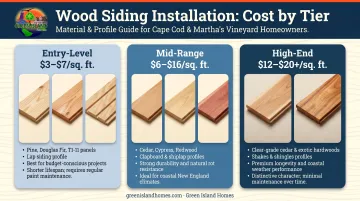
Entry-Level: $3–$7 per Square Foot Installed
This tier covers:
- Pine, T1-11 plywood, or Douglas fir (some T1-11 and engineered wood jobs reach $8–$9/sq. ft.)
- Simple profiles: lap siding, board and batten
- Standard utility-grade materials
Best for budget-conscious homeowners, outbuildings, or homes where the siding will be painted and natural grain isn't a priority. Pine requires more frequent sealing and repainting than premium species, so factor that into the long-term math.
Mid-Range: $6–$16 per Square Foot Installed
This tier covers:
- Cedar (mid-grade), cypress, or redwood at standard grades
- Popular profiles: clapboard, lap, shiplap
- Covers most standard residential installations
- Cedar mid-grade pricing spans a wide range — mid-grade sits toward the lower end, while clear-grade pushes into the high-end tier
This is the most common tier for Cape Cod and Martha's Vineyard homes. Cedar offers a genuine balance of natural durability, aesthetics, and cost, which is why it dominates the region.
High-End: $12–$20+ per Square Foot Installed
This tier covers:
- Premium clear-grade cedar, redwood, or exotic hardwoods
- Complex profiles: shakes ($8.50–$23/sq. ft.), shingles ($7.50–$21/sq. ft.), tongue-and-groove ($7–$20/sq. ft.)
- Multi-story homes requiring scaffolding
- Higher material and labor costs that reflect longer service life — premium species can last 30–50 years with proper maintenance
This tier suits homeowners prioritizing longevity, historically accurate restoration, or the shingled aesthetic that defines Vineyard architecture. Keep in mind that within any tier, labor — not just materials — is often the bigger variable, especially on multi-story or complex facades.
Key Factors That Affect Wood Siding Installation Cost
Wood siding quotes vary widely — and the gap between a $12,000 job and a $40,000 job usually comes down to five variables. Knowing what drives each one puts you in a much stronger position before contractors arrive.
Wood Species and Grade
Species is one of the biggest levers in the entire budget:
- Pine is the most affordable option and widely available, but it lacks natural decay resistance — expect more aggressive sealing requirements in humid or coastal settings
- Cedar is the go-to for most coastal New England homes; natural extractives in the heartwood resist moisture, rot, and insects, per the American Wood Council
- Redwood and cypress offer premium durability in salt-air environments; the Western Red Cedar Lumber Association confirms Western red cedar performs especially well in coastal conditions
Grade matters just as much as species. Angi's 2026 wood siding data puts low-grade material at $1–$3/sq. ft., mid-grade at $2–$12/sq. ft., and premium/clear grade at $3–$30/sq. ft. Within cedar alone, the jump from knotty utility grade to clear vertical grain can double or triple material cost.
Siding Style and Profile
Profile choice affects both material cost and labor hours:
| Style | Installed Cost Range |
|---|---|
| Board and batten | $5–$14/sq. ft. |
| Shiplap / clapboard | $8.50–$21/sq. ft. |
| Tongue and groove | $7–$20/sq. ft. |
| Shingles | $7.50–$21/sq. ft. |
| Shakes | $8.50–$23/sq. ft. |
Cedar shingles and white clapboard are the two dominant styles across Cape Cod and Martha's Vineyard — the shingled house is essentially synonymous with Vineyard architectural identity. Shakes and shingles require more cutting and fitting than lap profiles, so labor hours (and costs) run higher.
Home Size, Stories, and Complexity
Larger homes need more material and more hours. Multi-story homes or those with dormers, bay windows, or complex rooflines require scaffolding, additional safety measures, and more precise cuts — all of which add cost. Keep in mind that exterior wall area is typically less than total floor area, so avoid using living space square footage as your measurement baseline when estimating material quantities.
Labor and Regional Rates
National wood siding labor runs $2–$5 per square foot, representing 20–50% of total project cost. In Massachusetts, labor runs higher: CareerOneStop's 2024 data shows Massachusetts carpenters earning a median of $34.19/hour, compared to the BLS 2023 national carpenter median of $27.09/hour. Any Cape Cod or Vineyard budget should account for that premium from the start.
Summer is peak season for contractors in both areas, so scheduling in late fall or early spring typically means better availability and fewer schedule conflicts.
Condition of the Existing Exterior
Homes needing old siding removed, house wrap replaced, or rot remediated before new siding can go up will see costs climb. Older Cape Cod and Vineyard homes sometimes reveal pest damage, deteriorated sheathing, or moisture intrusion once old siding is stripped — none of which is visible until the work starts. Budget a 10–15% contingency on top of your base quote to cover discoveries like these.
Full Cost Breakdown: What's Actually in Your Quote
The price of wood boards and installation labor is only part of the total. Here's what a complete project actually includes:
| Line Item | Typical Cost Range | Notes |
|---|---|---|
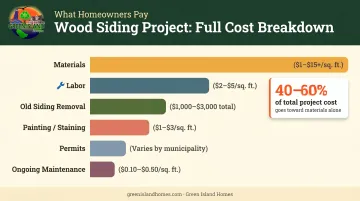
| Wood siding materials | $1–$15+/sq. ft. | Largest variable; 40–60% of total project cost |
| Labor and installation | $2–$5/sq. ft. | Surface prep, moisture barrier, cutting, nailing, trim |
| Old siding removal | $0.25–$0.75/sq. ft. ($1,000–$3,000 typical) | Plus dumpster rental avg. ~$385 |
| Painting or staining | $1–$3/sq. ft. add-on | Required at install; recurring every few years after |
| Permits | Varies by municipality | Falmouth: $8/$1,000 construction value, $100 min.; Oak Bluffs: $75 flat fee for siding |
| Ongoing maintenance | $0.10–$0.50/sq. ft. for pressure washing; $4–$13/sq. ft. for repairs | Annual inspections recommended |
Keep these recurring costs in mind when budgeting:
- Painting and staining is a recurring expense, not a one-time line item. Finish intervals vary by product: clear water-repellent finishes last about one year, semi-transparent latex stains two to four years, and solid-color stains up to five to six years (per the Western Red Cedar Lumber Association).
- Permits vary by town. Confirm requirements with your specific municipality before budgeting; the examples above are illustrative, not universal.
- Repairs average $1,830 for a 100 sq. ft. repair, with larger repairs ranging $2–$50/sq. ft. depending on damage extent.
Low-Cost vs. High-Cost Wood Siding — What's the Real Difference?
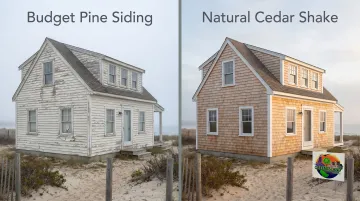
The gap between a $4/sq. ft. pine installation and a $16/sq. ft. cedar shake project reflects genuine differences in how each material performs over time, not just aesthetics.
| Factor | Budget Options (Pine, Utility Grade) | Premium Options (Cedar, Redwood, Cypress) |
|---|---|---|
| Weather resistance | Absorbs moisture; requires treatment and sealing | Naturally resistant to rot, decay, and insects (heartwood) |
| Coastal suitability | Needs aggressive sealing in salt-air environments | Cedar and redwood identified as naturally durable for coastal exposure |
| Finish maintenance | More frequent touch-ups required | Longer intervals possible with quality finish systems |
| Aesthetic quality | Visible knots, more variation | Clear grade offers uniform, refined appearance |
| Upfront cost | Lower | Higher |
For homeowners on Cape Cod and Martha's Vineyard, the case for naturally durable species is particularly strong. Salt air, high humidity, and driving rain accelerate wood degradation faster than in inland climates.
Cedar, redwood, and cypress contain heartwood extractives that resist decay — pine does not have this natural protection and will need more frequent maintenance in a marine environment.
The honest long-term math often favors the premium tier. A well-maintained cedar or redwood installation outperforms a pine installation that's been repainted or resealed every few years — and the accumulated maintenance costs on budget wood can close or exceed the initial price gap within 10–15 years.
How to Set the Right Budget for Your Wood Siding Project
The right budget isn't the lowest number you can find — it's the one that accounts for everything that will actually happen during and after the project.
Before setting a number, answer these questions:
- How large is the home, and how complex is the exterior (stories, dormers, angles)?
- Does old siding need to be removed, and what might be hiding underneath?
- What wood species makes sense for the local climate and your maintenance commitment?
- What finishing and repainting schedule are you realistically prepared to maintain?
Getting Accurate Estimates
Always get multiple detailed written estimates from licensed, insured contractors — not verbal ballparks. A proper quote should itemize materials, labor, removal, finish work, and permit costs separately. Bundled single-line estimates make it impossible to compare bids or identify where costs differ.
That said, not all estimates are created equal — and local expertise changes what's included. For Cape Cod and Martha's Vineyard homeowners, working with contractors who understand coastal New England conditions matters. Salt-air environments, local permitting requirements, and moisture management demands here differ significantly from inland Massachusetts projects.
Green Island Homes is a fully licensed and insured contractor based in Edgartown, MA, serving both Cape Cod and Martha's Vineyard, and can provide project-specific estimates for wood siding installation and exterior work.
Practical Ways to Manage Costs
- Choose cedar over exotic hardwoods — it's widely used throughout the Northeast, which keeps material and shipping costs down
- Schedule for late fall or early spring; contractor availability is better and pricing is often more competitive than summer peak season
- Opt for mid-grade over clear-grade if the siding will be painted; the grain won't be visible and the performance difference is negligible once the wood is painted
Frequently Asked Questions
How much does labor cost to install wood siding?
Wood siding labor typically runs $2–$5 per square foot, depending on the style, crew experience, and local market. Complex profiles like shakes or tongue-and-groove cost more in labor than simpler lap or clapboard installs because they require more cutting and fitting time.
How much does it cost to side a 2,000 sq. ft. house?
A 2,000 sq. ft. home typically has approximately 1,700–2,000 sq. ft. of exterior wall area to be sided. At installed wood siding rates, that puts the total project in the range of $8,500 to $28,000 depending on species, style, and local labor rates.
Is wood siding cheaper than vinyl siding?
Vinyl typically costs less upfront — Fixr's 2026 vinyl siding data puts installed vinyl at $3–$12/sq. ft. versus wood at $4–$14/sq. ft. installed. Wood offers better insulation, a longer service life with proper care, and stronger curb appeal. Total cost of ownership over decades often closes the gap, particularly when you factor in vinyl's replacement cycles.
How long does wood siding last?
Well-maintained wood siding lasts 20–50 years, depending on species. The American Wood Council recognizes cedar, redwood, and cypress as naturally durable options resistant to insects, moisture, and decay. Service life varies based on grade, installation quality, finish schedule, and exposure conditions.
What's the best wood siding for coastal homes?
Cedar is the top choice for coastal environments — the Western Red Cedar Lumber Association specifically rates it as durable in salty, marine conditions. Cypress and redwood are solid alternatives. Pine and Douglas fir can work but require more aggressive sealing and more frequent upkeep near the water.
How often does wood siding need to be repainted or restained?
It depends on the finish type. Cedar clear water-repellent finishes last about one year; semi-transparent latex stains last two to four years; solid-color stains can last up to five to six years. Sides of the home with the most sun, wind, or moisture exposure — common on coastal properties — will need attention more frequently.