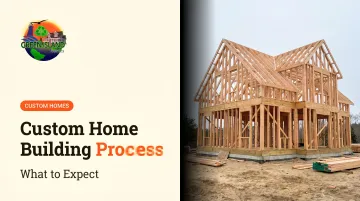
The gap between expectation and reality tends to show up in the same places: homeowners who didn't know permits could take months, who made expensive selections mid-construction, or who thought the process started when ground broke rather than a year before. That confusion leads to stress, budget overruns, and decisions made under pressure instead of with care.
This guide walks through every stage of the custom home building process — from your first conversation with a builder to the day you collect your keys — with specific attention to what makes building on the Cape and Vineyard different from anywhere else.
Key Takeaways
- The full process typically spans 12–18 months, with pre-construction planning taking as long as construction itself
- Seven distinct stages: consultation, site evaluation, design, selections and budget, permitting, construction, and final walkthrough
- Finalize material selections and budget before construction begins — changes after breaking ground cost significantly more
- Cape Cod and Martha's Vineyard add time through coastal regulations, Conservation Commission review, Title 5 septic rules, and island logistics
- A builder like Green Island Homes who handles all construction phases simplifies coordination and keeps communication consistent
What Is the Custom Home Building Process?
A custom home build is a structured, multi-stage sequence that takes a homeowner from concept and empty land to a fully finished, move-in-ready home built to their exact specifications. Unlike production or semi-custom builds, you control every decision — including:
- Floor plan and layout
- Exterior and interior materials
- Finishes and fixtures
- Special features and upgrades
That control is valuable, but it comes with a longer timeline and more active involvement than buying a production or semi-custom home.
The other thing most people don't realize: the process doesn't start when ground breaks. Design, selections, and permitting all happen before a single shovel touches dirt — and they're equally time-intensive. Rushing or skipping these early stages doesn't save time. It creates problems downstream.
The Custom Home Building Process Step by Step
The full process typically spans 12–18 months end-to-end. NAHB's analysis of Census Survey of Construction data found that hired-contractor homes averaged about 12 months from permit authorization to completion nationally, while New England averaged 13.1 months — and that's before accounting for the design and planning that happens before permits are even filed.
The process breaks into two broad phases:
- Pre-construction — consultation, site evaluation, design, selections, permitting
- Construction — site prep through final landscaping
Step 1: Initial Consultation and Vision Setting
This is where you meet with your builder to define what you actually want. A good builder asks about lifestyle needs, rough budget parameters, preferred size and style, and how you intend to use the home. On Cape Cod and Martha's Vineyard, that often includes questions about seasonal versus year-round use, proximity to water, and long-term maintenance priorities.
The builder's job at this stage is to listen and ask probing questions. It's also a good time to discuss whether traditional stick-built construction or energy-efficient modular construction better fits your timeline and goals — two paths that Green Island Homes offers to clients across both markets.
Step 2: Site Selection and Evaluation
A site visit covers more than just whether the land looks nice. The builder and often a civil engineer will assess:
- Soil conditions and bearing capacity
- Topography and natural drainage
- Access to utilities (water, sewer or septic, electrical)
- Zoning classification and any HOA restrictions
- Proximity to wetlands, coastal resources, or flood zones
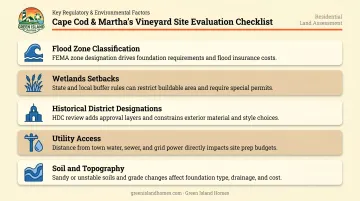
On Martha's Vineyard and coastal Cape Cod, this step carries extra weight. Flood zone classification directly affects foundation design and cost. Wetlands setbacks can limit where on a lot you can build. Historical district designations — such as those enforced by the Edgartown Historic District Commission — can affect what your home looks like from the street. Identifying these constraints early prevents expensive design revisions later.
Step 3: Architectural Design and Planning
Design typically starts with loose concept sketches and refines through iterative meetings until you have a complete set of architectural drawings. That process can take several months when done properly.
Having your builder involved during design — not just after plans are finalized — matters. Builders can flag constructability issues and real cost implications before they're locked into drawings.
A roofline that looks elegant on paper might cost significantly more to frame. A mechanical room placed in the wrong location might add $20,000 in plumbing runs. Catching these issues in design is free. Catching them mid-construction is not.
Step 4: Material Selections and Budget Finalization
Once design is locked, the next priority is finalizing selections — flooring, cabinetry, countertops, lighting, plumbing fixtures, hardware — before construction begins. When selections happen mid-build, they create schedule gaps and generate change orders that consistently push budgets higher.
According to NAHB's 2024 Construction Cost Survey, interior finishes represent 24.1% of average construction cost — the single largest cost category. That makes selection decisions one of the most consequential budget levers available to homeowners.
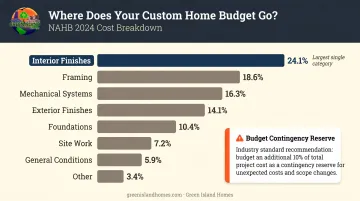
On contingency: NAHB guidance states most lenders advise a reserve of at least 10% of total project cost for unforeseen expenses. On coastal and island projects where site conditions, ferry logistics, and regulatory variables add uncertainty, a higher buffer is worth discussing with your builder at the outset.
Step 5: Permitting and Pre-Construction
The builder submits architectural drawings and supporting documentation to the local building department and any other required review bodies. On Cape Cod and Martha's Vineyard, that often means multiple simultaneous tracks:
- Local Building Department — standard building permit review
- Conservation Commission — required for lots near wetlands; Massachusetts regulations mandate a public hearing within 21 days of a complete Notice of Intent submittal
- Board of Health — Title 5 septic approval must be received before work can begin
- Cape Cod Commission — Development of Regional Impact (DRI) review can suspend town permitting entirely, with a process that can extend several months
- Martha's Vineyard Commission — similar DRI screening applies to Vineyard projects
No site work can begin until all required approvals are in hand. Building these review windows into your schedule from day one — rather than discovering them after design is complete — is one of the most practical things a locally experienced builder can do for you.
Step 6: Construction
Active construction runs roughly 6–10 months for most custom single-family homes, consistent with national benchmarks, though larger or more complex projects take longer.
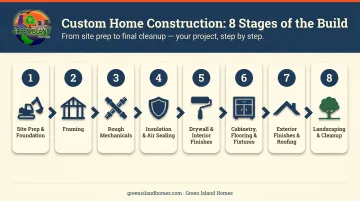
The typical sequence:
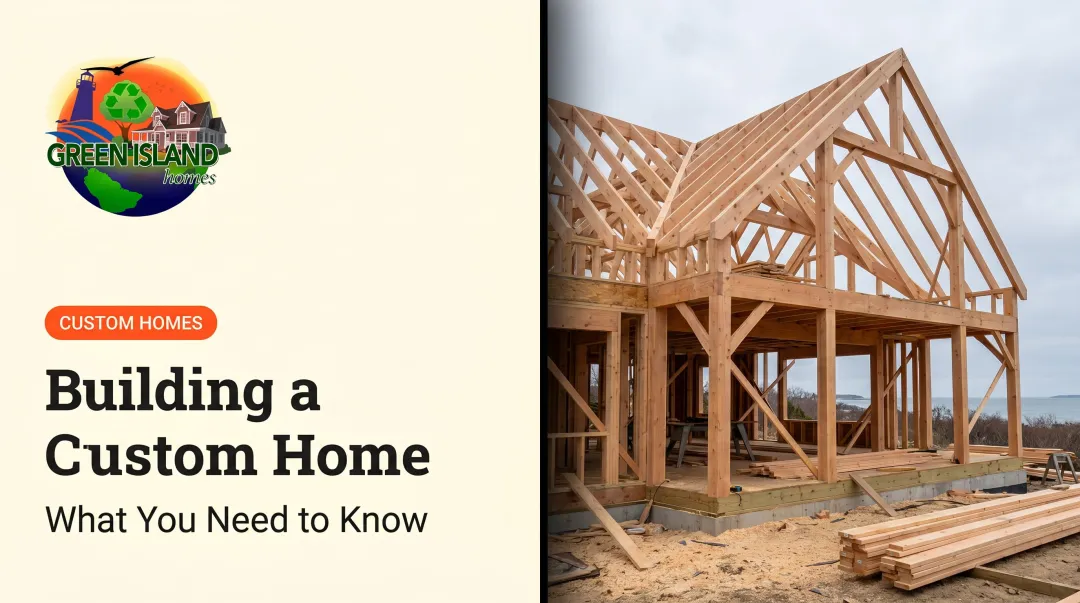
- Site preparation and foundation
- Framing (or modular module assembly and setting)
- Rough mechanicals — plumbing, electrical, HVAC
- Insulation and air sealing
- Drywall and interior finishes
- Cabinetry, flooring, fixtures, trim
- Exterior finishes, roofing, decking
- Final landscaping and site cleanup
Green Island Homes handles all phases of construction, which reduces coordination overhead and means homeowners aren't juggling separate contractors across different stages. Regular on-site walkthroughs at key milestones — after framing, after rough mechanicals, before drywall closes walls — give homeowners a chance to see the work and ask questions before it's covered up.
A note on modular construction: For Martha's Vineyard projects in particular, energy-efficient modular homes offer a practical advantage. Modules are built off-site in a controlled factory environment, reducing weather-related delays and the on-site construction window. They're built to the same Massachusetts building codes as stick-built homes and are often more energy efficient — relevant for a market where heating and cooling costs are a real consideration. Ferry logistics still apply for delivery, but the compressed assembly timeline can offset that coordination effort.
Step 7: Final Walkthrough, Punch List, and Move-In
Before closing, you and your builder walk the completed home together. The purpose is to document any items that need attention — the punch list — which typically includes things like touch-up paint, hardware adjustments, or minor finish corrections. All punch list items are resolved before keys change hands.
The walkthrough is also when your builder walks you through how home systems operate: HVAC controls, water shut-offs, electrical panel, and any smart-home or energy management systems. Ask about warranty coverage at this stage — what's covered, for how long, and who to contact if something comes up after move-in.
Key Factors That Affect Your Timeline and Budget
Design Complexity
A home with custom millwork, complex rooflines, or specialty imported materials takes longer to source and longer to build. Straightforward plans cost less and move faster. This isn't a reason to avoid complexity — it's a reason to make those decisions intentionally and early.
Decision-Making Pace
Delays in approving drawings, selecting materials, or responding to builder questions create downstream schedule gaps. Subcontractors book out in advance; if your framing crew is scheduled and your permit isn't ready, that slot may not be available when you need it. Responsive clients consistently have smoother builds.
Martha's Vineyard Logistics
Building on Martha's Vineyard adds a logistical layer that mainland projects don't face. All materials and equipment arrive by ferry. Commercial vehicles over 20 feet require advance booking through the Steamship Authority freight office, which operates Monday through Friday during business hours only. Building materials compete within a ferry-dependent freight system alongside food, fuel, and consumer goods.
Peak construction season on the island intensifies this. Contractor schedules fill early, material lead times extend, and delivery windows tighten. Projects that account for these constraints in the initial schedule — rather than treating them as problems to solve later — run more smoothly and stay closer to budget.
Local Regulatory Complexity
Cape Cod and Martha's Vineyard projects involve multiple overlapping regulatory frameworks. Flood zone classification (A Zone or V Zone) affects foundation design and cost. V Zone properties require a 2-foot freeboard above Base Flood Elevation for the lowest structural member — a design requirement that needs to be established before architectural drawings are finalized, not after. Coastal dune sites face additional restrictions from MassDEP that can affect feasibility entirely.
Regulatory review is a sequencing issue as much as a compliance one. Each of the following can create dependencies that must be resolved before normal permitting proceeds:
- Conservation Commission approval
- Septic design and Title 5 review
- Flood zone design certification
- DRI (Development of Regional Impact) screening
- Historic district review (where applicable)
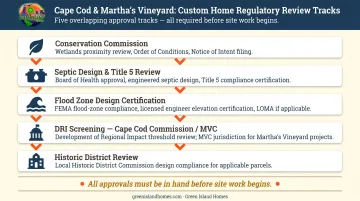
Experienced local builders map these gates into the schedule from day one.
Common Misconceptions About Custom Home Building
"Custom always costs more than buying."
Not necessarily. Because you control specifications, you can prioritize budget intentionally — investing in what matters to you and value-engineering what doesn't. A production home with an extensive upgrade list can easily exceed a comparable custom build where choices were made deliberately from the start.
"Construction is where the real decisions happen."
The pre-construction phase is where the most consequential decisions get made. These elements are all locked in before ground ever breaks:
- Layout and floor plan configuration
- Structural systems and load-bearing design
- Mechanical, electrical, and plumbing routing
- Material and finish specifications
Changes after construction starts are significantly more expensive — because work has to be undone and redone, not because builders charge more.
"A long timeline means something's wrong."
A 12–18 month process for a custom home on Cape Cod or Martha's Vineyard isn't slow — it's appropriate. Design takes time when done properly, and coastal permitting involves multiple review bodies with defined statutory windows. Rushing the pre-construction phase to "start sooner" consistently causes the very delays it was supposed to avoid.
Frequently Asked Questions
What are the steps in building a custom home?
The process runs in seven stages: initial consultation and vision setting, site evaluation, architectural design, material selections and budget finalization, permitting, construction, and final walkthrough and move-in. Pre-construction typically takes as long as active construction.
Is $300,000 enough to build a custom home?
NAHB's 2024 data puts the national average construction cost at $428,215 for a typical new single-family home — before land, design, permitting, or site-specific costs. In New England, the custom home median runs above $190 per square foot, and on Cape Cod and Martha's Vineyard, island logistics and coastal standards push that figure higher. Consult a local builder for a realistic current estimate.
How long does it take to build a custom home?
The full process — from initial consultation through move-in — typically takes 12–18 months. Active construction accounts for roughly 6–10 months of that. The rest is design, selections, and permitting, which on Cape Cod and Martha's Vineyard often takes longer than the national average due to coastal regulatory requirements.
Do I need to own land before starting the custom home building process?
You don't need to own land to have an initial consultation. Many builders can help evaluate prospective lots early in the process — assessing zoning, flood zones, wetland setbacks, and utility access before you commit to a purchase. Getting a builder's input before buying land can prevent costly surprises.
What is the difference between a custom home and a modular home?
Traditional custom homes are stick-built on-site; modular homes are built in factory sections, then assembled on the foundation. Both meet the same state and local codes and offer comparable design customization — and modular builds are often more energy efficient. On island projects, the compressed on-site assembly window is an additional practical advantage.
How much should I budget for unexpected costs?
NAHB guidance recommends a contingency reserve of at least 10% of total project cost. On coastal and island projects — where site conditions, septic, flood compliance, and ferry logistics introduce additional variables — discussing a higher buffer with your builder upfront is a practical step, not an overly cautious one.