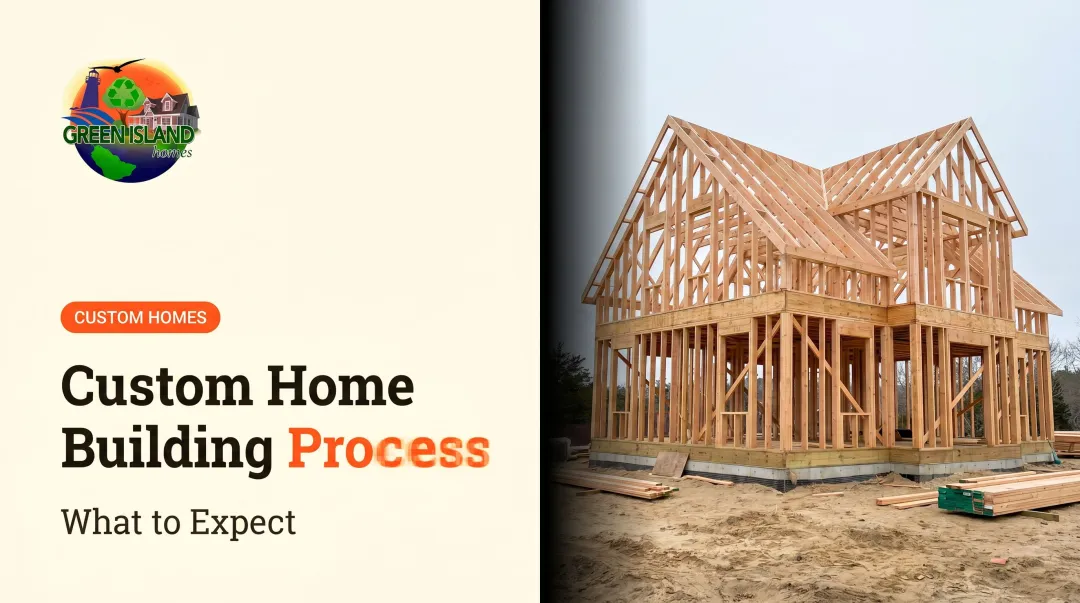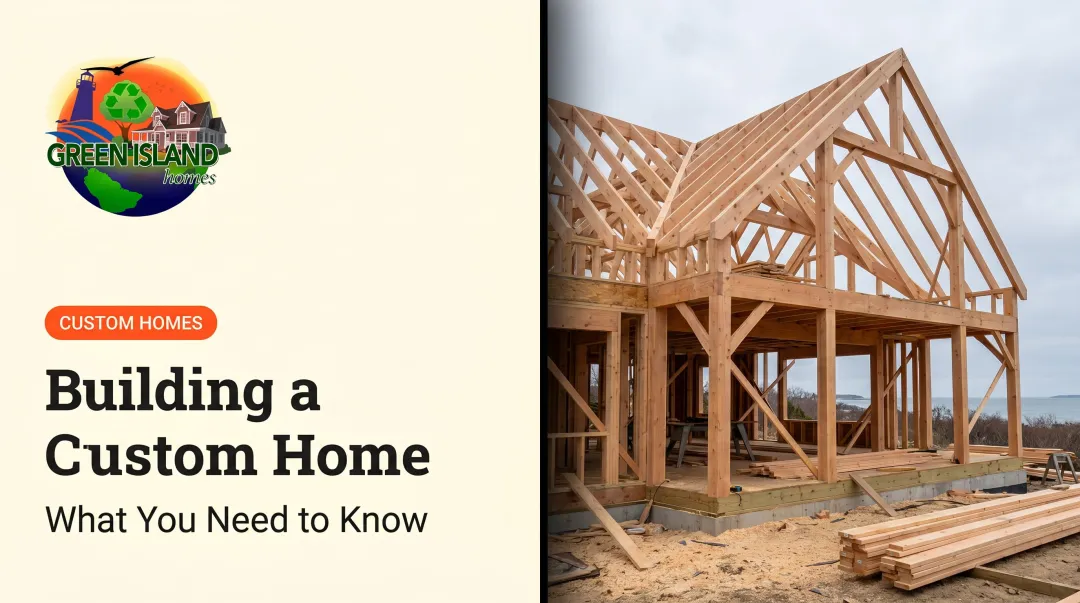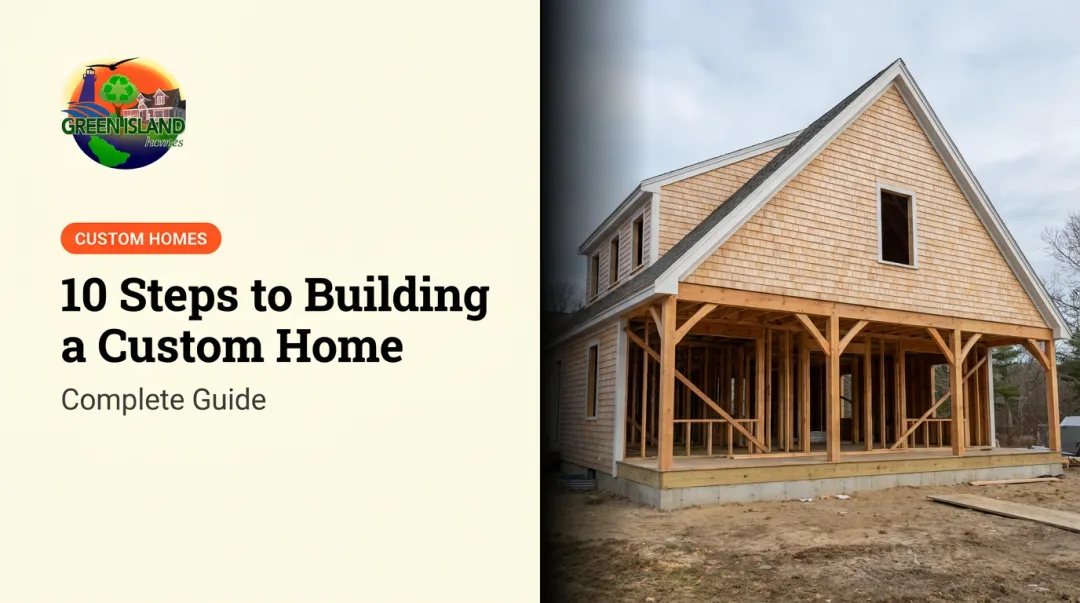
Custom homes let you design for the land you own, the life you actually live, and the coastal environment you're building in. That matters even more here, where lot constraints, zoning variation, and architectural character all work against the cookie-cutter approach production builders rely on.
This guide covers everything buyers in this region should understand: how custom homes differ from production builds, the benefits worth knowing before you commit, the design trends shaping builds right now, and why sustainability has moved from optional to expected.
Key Takeaways
- Custom homes are designed from scratch around each owner's needs and lot — no compromises on a builder's preset floor plan
- New homes have significantly lower operating and maintenance costs than older existing homes
- Outdoor living spaces, ADUs, and flexible floor plans dominate current design trends
- 96% of builders now use at least one green building approach — sustainability is mainstream
- On Cape Cod and Martha's Vineyard, coastal zoning and architectural character make custom building the most practical path for most buyers
Custom Home vs. Production Home: What's the Difference?
Most new homes aren't custom. NAHB data shows custom homes made up just 18.8% of single-family starts in 2023 — the large majority are production or spec builds.
The distinction matters because the experience is fundamentally different.
How Production Builders Work
A production builder purchases land, develops a community, and offers buyers a limited set of pre-designed floor plans. "Customization" in that context usually means choosing a countertop color or cabinet finish from an approved list. The design is done before you arrive.
Key limitations of production builds:
- Floor plans are fixed before any buyer is involved
- Finish selections come from a pre-approved list
- Lot, orientation, and layout aren't negotiable
How Custom Builders Work
A custom builder starts fresh with every project. According to NAHB, custom builders create homes designed individually for each owner — often on client-owned land — with the floor plan, systems, and finishes all built around that specific household's needs.
That process takes more time and requires more communication. Custom builders typically work on fewer projects per year, which is what makes the level of attention possible.
Why This Matters on the Cape and Vineyard
Cape Cod and Martha's Vineyard aren't standard markets. The Martha's Vineyard Commission's 2024 zoning analysis documents significant town-by-town variation in what's allowed and how lots can be developed. The Cape Cod Commission identifies zoning barriers including single-family-only restrictions and dimensional requirements like minimum lot sizes.
Massachusetts coastal and wetlands construction adds another layer: 310 CMR 10.00 governs what can be built and where, requiring site-specific planning that no generic builder's playbook can cover.
For a buyer with a specific lot and a specific vision, a production builder simply isn't set up to help.
Key Benefits of Building a Custom Home
Personalization and Design Control
This is the obvious one, but it runs deeper than most buyers initially realize. You're not choosing between Option A and Option B — you're designing the home around how you actually live.
That could mean:
- A dedicated home office with soundproofing and built-in storage
- A chef's kitchen with a walk-in pantry and professional-grade appliances
- A primary suite on the main floor for aging-in-place functionality
- An outdoor living area connected to the kitchen by retractable doors
Every room, every system, every finish is a deliberate choice.
Quality Materials and Lower Long-Term Costs
Custom builds give you visibility into every material decision — from foundation to roofing. There's no deferred maintenance hidden behind walls, no outdated wiring, no surprise plumbing repairs in year two.
The operating-cost data backs this up. NAHB's analysis of the American Housing Survey found homes built after 2010 averaged annual operating costs of about 3% of home value, while homes built before 1960 exceeded 6%. New owners of pre-1950 homes spend a median $3,900 per year on upkeep — more than double what owners of newer homes pay.
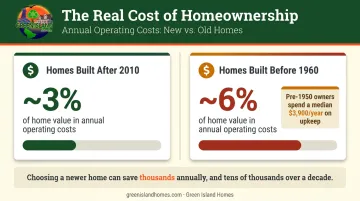
When you buy an older home, you're inheriting its deferred costs. A custom build means every system is current, warrantied, and built to code from day one.
Technology Integration from Day One
Retrofitting smart home systems after construction is expensive and disruptive. These integrations are all straightforward during construction — and costly after the fact:
- Conduit for EV charging stations
- HVAC zoning designed around automation
- Pre-wiring for whole-home audio
- Security systems and energy monitoring
Building these in from the start — rather than retrofitting later — cuts both installation cost and disruption significantly.
Long-Term Investment Value
Custom homes hold strong resale value when they're built with modern systems, energy-efficient features, and layouts buyers actually want. NAHB confirms that most home buyers want an energy-efficient home and are willing to pay more for it — a custom build delivers exactly that from day one, without the upgrade costs a buyer of an older home would have to absorb.
That matters on Cape Cod and Martha's Vineyard, where buyers expect quality construction and where homes built to current energy codes command a premium over aging stock.
Current Custom Home Design Trends
Outdoor Living and Coastal Connection
The AIA's 2025 Q2 Home Design Trends Survey reported outdoor living spaces as a priority for 55% of design projects. On Cape Cod and Martha's Vineyard, that number would be higher — the landscape here isn't a backdrop, it's a reason people build.
Covered patios, retractable glass walls, outdoor kitchens, and wraparound porches that frame water or vineyard views are consistently among the most requested features in coastal custom builds.
Biophilic Design and Natural Materials
Biophilic design — incorporating natural light, organic textures, and views of nature — fits the coastal setting almost automatically. It also has a practical edge: natural materials hold up better against salt air than most synthetic alternatives.
Common material choices in coastal custom builds include:
- Reclaimed wood for flooring, beams, and accent walls
- Natural stone for countertops, fireplaces, and exterior detailing
- Large windows oriented toward the water to maximize light and views
- Cedar cladding and trim that weather gracefully over time
Flexible and Multi-Functional Spaces
Remote work and multi-generational living have changed what rooms need to do. Modern custom homes are being designed with adaptability built in:
- Home offices that double as guest rooms with a Murphy bed
- Finished lower levels that can function as independent living quarters
- Main-floor suites that serve young families now and aging owners later
- ADU-ready layouts that add rental income or family housing options
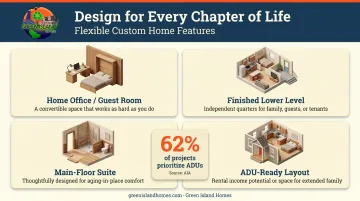
The AIA reports accessory dwellings and rental units as a priority in 62% of projects — especially relevant on the Vineyard, where seasonal guests and extended family are part of the equation.
Coastal Architectural Character
Coastal architectural character is something production builders genuinely cannot replicate. Custom homes on Cape Cod and Martha's Vineyard carry a distinct design identity: shingle-style exteriors, cedar trim that weathers naturally, wraparound porches, dormers, and windows placed to frame specific views.
Materials also need to be chosen with the environment in mind — hardware, roofing, cladding, and finishes that hold up against salt air and coastal weather. A builder who works in this region knows those specifications — and the difference between a roofing material rated for coastal exposure and one that isn't shows up within a few seasons.
Sustainability and Green Building in Custom Homes
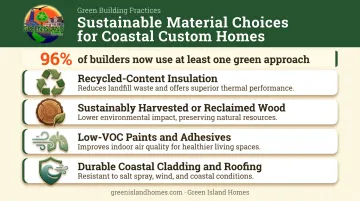
NAHB's 2024 Green and Resilient Single-Family Homes survey found 96% of builders used at least one green approach, and 34% said more than half of their 2023 projects qualified as green. High-performance HVAC was used on more than half of all projects by 87% of builders. Green building is no longer a premium add-on — it's how most homes are built now.
Building Envelope Performance
The biggest efficiency gains come from the building envelope — what keeps conditioned air in and outdoor air out.
- Saves up to 20% on heating and cooling costs through proper insulation and air sealing
- Cuts 25–30% of residential energy loss attributable to windows by specifying high-performance glazing
- Catches air leakage early via blower door testing before it becomes an ongoing energy drain
In a coastal New England climate with high heating demand, these aren't just environmental wins — they translate directly into lower monthly bills. On an island like Martha's Vineyard, where energy infrastructure is finite, that efficiency starts at the walls.
Renewable Energy and Island Resilience
The Martha's Vineyard Commission reports that buildings account for roughly 63% of island energy use — heating, cooling, and electricity combined. Designing a custom home to reduce that load, and potentially generate its own energy, makes practical sense here.
Solar panels, geothermal systems, and battery storage can all be integrated from the design phase. MassCEC notes that a 2,000 sq. ft. home with an 8 kW solar system may generate approximately 10,000 kWh per year and qualify for SMART program incentives. On an island with finite grid infrastructure, energy self-sufficiency isn't just efficient — it's resilient.
Sustainable Materials
Sustainable material choices reduce both environmental impact and long-term maintenance:
- Recycled-content insulation and structural materials
- Sustainably harvested or reclaimed wood
- Low-VOC paints and adhesives for better indoor air quality
- Durable cladding and roofing that resists coastal weathering without frequent replacement
Green Island Homes and Modular Construction
Green Island Homes offers energy-efficient modular homes as part of their custom building services on Cape Cod and Martha's Vineyard. Modular construction builds home sections in a controlled factory environment, reducing material waste at the job site and shortening the on-site construction window — both clear advantages on an island where material logistics and weather can affect stick-built timelines.
Planning for the Future: Multi-Generational Living and Universal Design
A Growing Household Reality
Pew Research found the share of Americans living in multigenerational homes more than doubled from 7% in 1971 to 18% in 2021 — driven by financial pressures, caregiving needs, and changing family structures. On Martha's Vineyard and Cape Cod, where housing costs are high and family connections to the area run deep, multi-generational living is particularly common.
Custom homes can accommodate this directly:
- In-law suites with private entrances and full kitchenettes
- Self-contained lower-level apartments
- Separate primary suites on each floor for shared privacy
- Shared common areas with clearly defined private zones
Multi-generational households also benefit from a parallel design philosophy: Universal Design. Thinking through both together during the planning phase is far less expensive than addressing them through retrofits.
Universal Design: Future-Proofing Without Compromise
AARP's 2024 survey found 75% of adults 50-plus want to remain in their current home as long as possible. Building with Universal Design principles means the home adapts as needs change — without the cost of tearing out finishes or rerouting plumbing down the road.
Key features worth designing in from the start:
- Wider doorways (36 inches minimum)
- Step-free entries with level thresholds
- Lever-style door and faucet hardware
- Blocking in bathroom walls for future grab bar installation
- Roll-in shower capability in at least one bathroom
- Main-floor bedroom and full bath
None of these features compromise design aesthetics. The key is specifying them at the blueprint stage, where the cost is negligible compared to adding them after construction is complete.
Frequently Asked Questions
Frequently Asked Questions
Are custom homes harder to sell?
Custom homes are generally not harder to sell. Their unique design, modern systems, and energy efficiency often make them more attractive to buyers. The key is ensuring the design has broad appeal and the home is priced appropriately for its market.
How long does it take to build a custom home?
NAHB data shows the average single-family home took 9.1 months from permit to completion in 2024, but that covers construction only. Add design, permitting, and site prep, and most custom builds run 12 to 18 months from initial consultation to move-in. Island logistics on Martha's Vineyard and seasonal permitting cycles can push that timeline further.
Are custom homes more expensive than buying an existing home?
Upfront costs are typically higher, but buyers avoid the hidden costs that come with older homes : repairs, outdated systems, energy inefficiency, and deferred maintenance. New owners of pre-1950 homes spend a median $3,900 per year on upkeep. Long-term, the math often favors building new.
What is the difference between a custom home and a semi-custom home?
A semi-custom home starts with a builder's existing floor plan and allows limited modifications. A fully custom home is designed from scratch around your specific preferences and lot — giving far greater flexibility, particularly on constrained or coastal parcels.
What sustainable features should I prioritize in a custom home?
Start with high-performance insulation, air sealing, and windows — these deliver the highest energy savings per dollar spent. Add an efficient HVAC system and design for solar from the start, even if panels come later. Building these in during construction costs a fraction of retrofitting.
Can I build a custom home on any lot?
Most privately owned lots can accommodate custom construction, but zoning rules, soil conditions, utility access, and local building codes all need evaluation first. On Martha's Vineyard and Cape Cod, coastal setback requirements and Conservation Commission review add additional layers that require local expertise to navigate efficiently.