](https://file-host.link/website/greenislandhomes-165dz8/assets/blog-images/083235c5-030d-47c5-80d9-c1bc158f68aa/1780517436478816_dc63f92e2f10472d8da34ba4edde0649/360.webp)
Most homeowners focus almost entirely on price. But the questions you ask before signing anything are what actually separate a successful project from an expensive disaster. This guide covers exactly what to ask — organized by category — so homeowners in Cape Cod, Martha's Vineyard, and across coastal Massachusetts can hire with real confidence.
Key Takeaways
- Verify licensing (HIC registration and CSL), liability insurance, and workers' compensation before discussing price
- Get itemized written estimates from at least two to three contractors — never compare bottom lines alone
- Request references from recent local projects and ask specific questions about budget, timeline, and communication
- Require a written contract that covers materials, scope, dates, cleanup, and warranty terms
- Walk away from cash-only demands, permit refusals, or high-pressure tactics to sign quickly
Questions to Ask About Licensing, Insurance, and Credentials
Before you discuss materials or pricing, verify credentials. In Massachusetts, this isn't a formality — it's how you protect yourself financially and legally if anything goes wrong on your property.
Are you licensed, and can you provide your license number?
Massachusetts residential roofing involves two separate credential paths:
- HIC registration — required for home improvement contractors working on existing 1-to-4 unit owner-occupied homes. Verify through the Massachusetts HIC Contractor Search
- Specialty CSL for roof covering — covers construction, reconstruction, alteration, repair, and removal of roof covering. Verify through the Office of Public Safety and Inspections
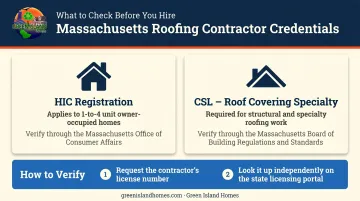
Ask for both numbers, then look them up yourself. Don't take verbal confirmation.
Do you carry general liability and workers' compensation insurance?
These are two separate coverages — and both matter:
- General liability protects your property if the crew damages something during the project
- Workers' compensation covers injuries to workers on your property
Massachusetts law requires all employers to carry workers' compensation, and Mass.gov explicitly warns that homeowners can be held liable if an uninsured contractor is injured on their property. Ask for current certificates of insurance — not verbal assurances — and check the expiration dates.
Are you HomeAdvisor Screened, BBB-rated, or manufacturer-certified?
Third-party vetting adds an additional layer of verification. HomeAdvisor's prescreening process includes trade-license checks, insurance verification, criminal and sex-offender checks, identity verification, and searches for bankruptcies, liens, and civil judgments.
Manufacturer certifications like GAF Master Elite or Owens Corning Preferred require contractors to carry minimum insurance, hold required licenses, and meet workmanship standards — not just pay a fee.
Green Island Homes holds HomeAdvisor Screened & Approved, Top Rated, and Elite Service designations, reflecting background verification and a sustained record of homeowner satisfaction.
How long have you been in business locally, and can you provide references?
A contractor with roots in coastal Massachusetts understands Cape Cod's salt air, high-wind conditions, and freeze-thaw cycles — and knows local permit processes — in a way an out-of-town company doesn't. Ask for at least three references from recent local projects, then call them and ask:
- Did the project come in on budget?
- Did they communicate clearly during delays?
- Would you hire them again?
Questions to Ask About Cost, Timeline, and the Written Contract
A verbal agreement means nothing once a project starts. Get every financial and scheduling detail in writing before work begins.
Can you provide a fully itemized written estimate?
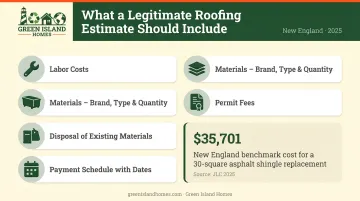
A legitimate estimate breaks down:
- Labor costs
- Materials by brand, type, and quantity
- Disposal of existing materials
- Permit fees
- Payment schedule with dates and amounts
Compare line items across bids — not just the final number. A lower bid often reflects missing scope, cheaper materials, or skipped insurance costs. For context, JLC's 2025 Cost vs. Value report benchmarks a 30-square asphalt shingle replacement at $35,701 in New England — considerably above the national figure, and Martha's Vineyard adds a further logistics premium due to material transport and worker accommodations.
Under Massachusetts HIC rules, written contracts are required for projects of $1,000 or more, and advance deposits cannot exceed the greater of one-third of the contract price or the actual cost of special-order materials.
Who will actually be doing the work?
Understanding the scope of work in your estimate leads directly to the next question: who's actually executing it. Many contractors subcontract labor — that's not automatically a problem, but it does affect accountability. If subcontractors are involved, ask:
- Are they insured independently?
- Will a supervisor from your company be on-site during installation?
- Who is my point of contact if there's a problem mid-project?
Will you pull all required permits?
Under 780 CMR 105.1, it's unlawful to construct, reconstruct, alter, repair, or demolish a structure without a permit from the local building official. Cape Cod and Martha's Vineyard municipalities — including Barnstable, Falmouth, and Edgartown — each have their own permitting systems.
A contractor who suggests skipping permits to "save time" is a serious red flag. Unpermitted work can void your homeowner's insurance, complicate a future sale, and expose you to fines — and the permit is your legal responsibility as the homeowner, not theirs.
What are the start date, completion timeline, and payment terms?
Get start and completion dates in writing. For coastal properties, ask specifically what happens if a nor'easter interrupts the project mid-installation — do they provide temporary weatherproofing? How do they communicate delays?
On payment: reputable contractors typically require a deposit in the range of 10–30%, with remaining payments tied to milestones or completion. Never pay 100% upfront, and never pay in cash without a paper trail.
Questions to Ask About Materials, Warranties, and Site Cleanup
Good credentials don't guarantee good materials or adequate warranty coverage. These questions protect your investment after the crew leaves.
What materials do you recommend, and why?
For Cape Cod and Martha's Vineyard homeowners, coastal durability isn't optional. Ask whether the contractor has experience with wind-rated or impact-resistant shingles suited to high-wind coastal zones. Mass.gov advises that when re-roofing, homeowners should install shingles meeting high-wind standards.
Ask the contractor to walk you through the pros and cons of what they're recommending — not just hand you a brand name alone.
What warranties cover both materials and labor?
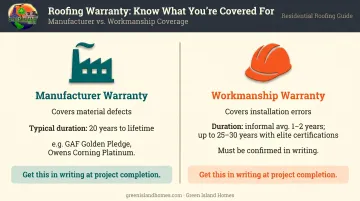
Two separate warranties matter here:
| Warranty Type | What It Covers | Typical Duration |
|---|---|---|
| Manufacturer warranty | Defects in the roofing materials themselves | 20 years to lifetime |
| Workmanship warranty | Installation errors by the contractor | Varies — NRCA reports an informal average of 1–2 years |
The workmanship warranty is where significant variation exists. GAF's Golden Pledge (available through Master Elite contractors) can include up to 25–30 years of workmanship coverage. Owens Corning's Platinum Protection offers limited lifetime workmanship for certified contractors. Ask which specific warranty will be registered after installation — not just which shingle brand is being used.
How will you protect my property and handle cleanup?
A roofing project generates a lot of debris — old shingles, nails, underlayment. Ask the contractor:
- How do you protect landscaping and driveways during tear-off?
- What is your daily cleanup process?
- Do you perform a magnetic nail sweep after completion?
A contractor who has a clear, specific answer to these questions has done this before. Hesitation or generalities are usually a sign of what's coming once work starts.
Will you do a final walkthrough before I release the last payment?
Insist on this. A formal final inspection should confirm that all contracted work is complete, the site is clean, permits are closed, and all warranty documentation has been provided in writing. Don't release final payment until you've walked the property together.
Red Flags That Should Make You Walk Away
Storm chasers are a real problem on Cape Cod and Martha's Vineyard. After a nor'easter or hurricane-season event, out-of-town contractors flood coastal markets with aggressive door-to-door pitches, urgency pressure, and quotes that look attractive until the company is unreachable three weeks later.
The BBB's 2025 scam alert specifically warns against "free inspection" offers following storms, where contractors may fabricate or exaggerate damage to manufacture urgency.
Stick with local, verified contractors who have a permanent address and an established track record in your community.
Watch for these warning signs:
- Demands for full cash payment before work begins
- Refusal to provide a written contract or itemized estimate
- Can't produce proof of insurance or a license number on request
- No verifiable local references
- Vague answers about who will actually be on-site
- Dismissiveness about permits or inspections
- No physical business address
On price: the lowest bid is rarely the best bid. It typically signals corners being cut — on materials, insurance coverage, or labor quality. A contractor who communicates clearly, pulls proper permits, and carries verifiable credentials is worth more than a suspiciously cheap quote from someone you can't reach after the check clears.
Why Green Island Homes Is the Right Call for Cape Cod and Martha's Vineyard
Green Island Homes, based in Edgartown, MA, is a fully licensed and insured residential contractor serving Cape Cod and Martha's Vineyard. They hold HomeAdvisor Screened & Approved, Top Rated, and Elite Service designations — meaning they've passed background checks, insurance verification, and maintained a strong record of homeowner satisfaction.
Working in coastal Massachusetts isn't the same as working anywhere else. Salt air, high winds, heavy snow loads, freeze-thaw cycles, and the logistics of island construction demand local knowledge that out-of-town contractors rarely bring:
- Salt air and wind exposure accelerate wear on roofing materials and fasteners
- Heavy snow loads and freeze-thaw cycles require materials rated for New England winters
- Island logistics — ferry schedules, material lead times, access constraints — require contractors with established local relationships
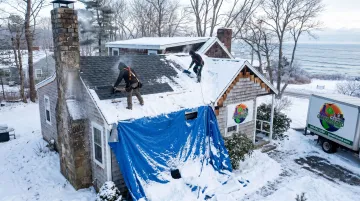
Green Island Homes offers installation, replacement, repair, and maintenance of residential roofing systems as part of their full-service construction portfolio. Their HomeAdvisor reviews point to three things homeowners notice most: fair pricing, clear communication, and a process that stays on track from estimate to completion.
Ready to get started? Reach out directly:
- Phone: 774-563-9714
- Email: sales@greenislandhomes.com
Frequently Asked Questions
How do I choose a good roofing contractor?
Verify HIC registration and CSL licensing, request certificates of insurance for both liability and workers' comp, and collect at least two to three itemized written estimates. Check local references and third-party accreditations. Get every detail — scope, materials, dates, and warranty terms — in writing before signing.
Is $30,000 too much for a roof?
Not necessarily in New England. JLC's 2025 Cost vs. Value data puts a standard 30-square asphalt shingle replacement at $35,701 in New England. A $30,000 quote should be evaluated against your roof's size, pitch, tear-off requirements, material grade, and location — not rejected on price alone.
What is the 25% rule in roofing?
The 25% rule is commonly cited as a threshold that triggers full code compliance when that share of a roof is repaired within a set period. Massachusetts building code applies this differently depending on context — it's not a universal residential rule. Confirm with your local building official or insurer before committing to a partial repair over a full replacement.
What not to say to a roof insurance adjuster?
Avoid speculating about pre-existing conditions, admitting fault, or accepting an initial settlement without review. Document everything with photos, keep receipts for temporary repairs, and never sign over your insurance check or claim rights to a contractor. If unsure, consult a licensed public adjuster.
Should I get multiple quotes before hiring a roofing contractor?
Yes — get at least two to three written quotes. Comparing bids lets you understand fair market pricing for your region, identify what each contractor is (or isn't) including in scope, and evaluate which contractor communicates most clearly and professionally.
What warranties should a roofing contractor offer?
Expect two warranties: a manufacturer's material warranty (typically 20 years to lifetime, covering product defects) and a contractor's workmanship warranty covering installation errors. Confirm the workmanship term in writing — there's no industry standard — and get both documents at project completion.