An in-law suite — a self-contained living space with a bedroom, bathroom, and kitchen on the same property as the main home — makes this possible without sacrificing privacy for anyone.
The good news: homeowners have far more options than they might expect. You can convert an unused basement, reconfigure a ground-floor bedroom, build a purpose-built addition, or place a modular cottage in the backyard. This guide covers 12 distinct approaches so you can match the right solution to your property, budget, and family's situation.
Key Takeaways
- An in-law suite is a private unit — bedroom, bathroom, kitchen or kitchenette — attached to or on the same lot as the primary home
- The 12 ideas covered here span three categories: converting existing spaces, building new additions, and flexible alternatives
- Every suite needs a private entrance, accessible bathroom, and basic kitchen functionality at minimum
- Costs range from roughly $10,000 for simple interior conversions to $285,000+ for detached new construction
- Always verify local zoning rules and permit requirements before settling on a design
12 Ideas for Adding an In-Law Suite to Your Home
Converting Existing Spaces
Idea 1 — Basement Conversion
A finished walk-out basement is one of the most cost-effective starting points. You're working with existing square footage and, in many cases, existing framing and utilities nearby.
Key requirements before you commit:
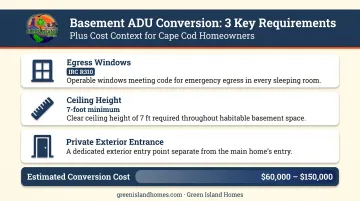
- Egress windows: IRC R310 mandates emergency escape openings in basement sleeping rooms — minimum 5.7 sq ft net clear opening, 24-inch minimum height, 20-inch minimum width, with the sill no higher than 44 inches from the floor
- Ceiling height: Most codes require at least 7 feet for habitable space; measure before planning
- Private exterior entrance: A separate ground-level door keeps occupants independent from the main home
Cost range: according to Angi, a basement ADU conversion runs roughly $60,000 to $150,000 when you factor in bathroom, kitchenette, egress, and code compliance. Raw, unfinished basements cost more to bring up to standard than partially finished ones.
Idea 2 — Garage Conversion
An attached or detached garage can become a comfortable one-bedroom suite, and a two-car garage typically offers enough square footage to feel like a real living space rather than a cramped retrofit.
Upgrades required:
- Insulation (walls, ceiling, and the slab or subfloor)
- HVAC extension or dedicated mini-split system
- Plumbing rough-in for bathroom and kitchenette
- Finished flooring to replace the concrete slab
A full in-law garage conversion typically runs $20,000 to $60,000 depending on what's already in place. Garage ADU conversions with full bathroom and kitchen can reach $60,000 to $150,000 — the starting price of a basic conversion doesn't reflect the full legal ADU scope.
Idea 3 — Spare Bedroom and Bathroom Reconfiguration
If your home has a ground-floor bedroom adjacent to a full or half bath, this may be the lowest-cost, lowest-disruption path available. The concept is simple: wall off that section of the home, add a private exterior entrance, and the existing rooms become a suite with minimal structural work.
This works best when:
- The bedroom and bath are near an exterior wall (making a new door straightforward)
- The floor plan doesn't require cutting through major load-bearing elements
- The homeowner wants to preserve the existing footprint entirely
No new foundation, no addition — just smart reconfiguration.
Idea 4 — Attic Conversion
A finished or partially finished attic can become a suite, but it comes with real constraints worth understanding upfront.
- Structural load: Adding plumbing means routing drain lines and supply lines through floors — this requires engineering review
- Headroom: Most attics need dormers added to create usable ceiling height throughout the space
- Stair access: A fixed staircase is required, but steep attic stairs can be a serious obstacle for elderly occupants
Attic conversions work best for younger family members or guests, not for aging parents who may have mobility concerns now or in the future.
Building New Additions and Expansions
Idea 5 — Single-Story Attached Addition
Building a purpose-built suite onto the side or rear of the home at ground level is the cleanest approach for families prioritizing accessibility. No sacrificed interior space, no stairs, and you get a fully custom layout designed around the occupant's needs from day one.
What's involved:
- New foundation
- Exterior design matched to the existing home (important in historic Cape Cod neighborhoods)
- Dedicated entrance, separate HVAC zone, and full plumbing
Cost typically falls in the $40,000 to $216,000 range for attached additions, depending on size, finishes, and site conditions. Coastal labor and material costs on the Cape and Vineyard can push numbers toward the higher end.
Green Island Homes handles all phases of addition projects — from design coordination through foundation, framing, mechanical work, and finishing — so homeowners work with one contractor from permit through punch list.
Idea 6 — Two-Story Addition with Suite on Ground Floor
A two-story addition solves two problems at once: the ground floor becomes the in-law suite, while the upper level adds living space or bedrooms to the main home. It's an efficient answer when lot size limits how far out you can build.
Consider this layout when:
- The main home also needs more square footage
- You want clear vertical separation between the suite and family living areas
- Budget can support a larger project scope
The ground-floor suite retains accessibility advantages; the upper level connects to the main home and stays private from the in-law occupant.
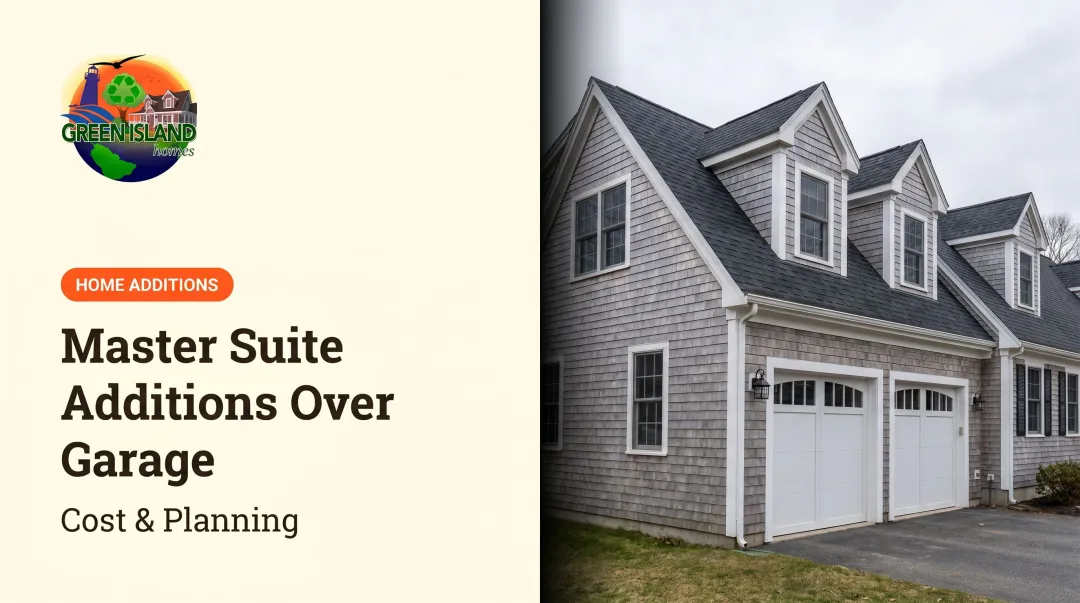
Idea 7 — Above-Garage Apartment
Converting or building out the space above an attached or detached garage is popular precisely because it offers strong separation. The occupant has their own entrance via an exterior staircase and independence from the main household's daily rhythm.
The trade-off: that exterior staircase. This option is well-suited for mobile family members but creates a real barrier for anyone with significant mobility challenges. Plan accordingly.
Idea 8 — Detached Backyard Cottage or ADU
A stand-alone structure in the backyard offers maximum privacy and independence. It functions as a separate home on the same lot, with the most flexibility down the road — including potential rental income if circumstances change.
It also requires the most investment: new foundation, separate utility connections, and full site work. Detached ADU new construction typically runs $110,000 to $285,000.
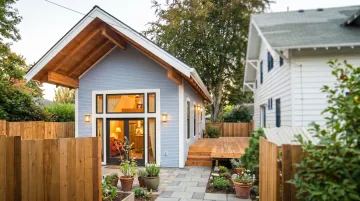
Massachusetts removed a major regulatory hurdle as of February 2, 2025. The state now allows ADUs by right in single-family zoning districts, capped at 900 sq ft or half the gross floor area of the principal dwelling, whichever is smaller. Municipalities can no longer require minimum lot sizes for protected-use ADUs, though local site plan review and Title V septic compliance still apply.
Flexible and Unique Approaches
Idea 9 — Prefab or Modular Detached Suite
Prefab and modular units offer a meaningful advantage over stick-built detached construction: speed. NAHB notes that a modular home can be move-in ready in roughly three months, with nearly 90% of the structure built offsite while site prep happens simultaneously. That compression is significant on a project where families are often working against a timeline.
Modular units are built to the same codes as site-built homes and placed on permanent foundations. For Cape Cod and Martha's Vineyard homeowners who want a high-quality standalone unit with more budget predictability, modular is worth a direct comparison against conventional construction before committing to either path.
Green Island Homes specializes in energy-efficient modular homes and has completed modular installations in both service areas. For specific configurations and what's available for your property, reach out directly at 774-563-9714 or sales@greenislandhomes.com.
Idea 10 — Carriage House or Outbuilding Conversion
Properties across Cape Cod frequently include carriage houses, barns, or large outbuildings that sit largely unused. Converting one into a livable suite preserves historic character while solving a practical housing need — a combination that fits older Cape properties well.
The main challenges: these structures typically lack plumbing, insulation, and HVAC entirely, so utility work can be substantial. Structural assessment is also essential before planning the interior. The bones are already there, and the character of an old carriage house or barn is hard to replicate with new construction.
Idea 11 — Sunroom or Enclosed Porch Expansion
An existing sunroom or large covered porch can be built out and properly insulated into a living wing. It works best as a connector: the expanded space links to an adjacent interior bedroom and bath, creating an accessible suite without breaking ground on a full new foundation.
It's not a standalone solution on its own, but as a starting point for a larger suite layout, it can reduce both cost and disruption compared to a full addition.
Idea 12 — Interior Home Reconfiguration (Sectioning Off a Wing)
Larger homes often have a first-floor master suite or guest wing that can be separated from the main living space with a locked interior door and a new exterior entrance. No addition, no conversion of a separate structure — just thoughtful redesign of what already exists.
From the outside, nothing changes — it's the most seamless option aesthetically. Three things determine whether it's viable:
- Sufficient square footage in the wing being sectioned off
- Noise isolation between the new suite and the main living areas
- A layout that allows a private exterior entrance without major structural cuts
Must-Have Features for Any In-Law Suite
Regardless of which approach you choose, four features belong in every suite.
Private Entrance
A dedicated exterior entry, separate from the main home's front door, is non-negotiable. Occupants need to come and go freely without walking through the main living space. A small covered landing at the entrance adds weather protection and a sense of arrival.
Accessible Bathroom
The AARP HomeFit Guide identifies the following as standard accessible bathroom features:
- Curbless or walk-in shower
- Comfort-height toilet
- Reinforced walls with blocking for future grab bar installation
- Non-slip flooring
- Lever-style faucet handles and D-shaped pulls
- 36-inch doorways or swing-clear hinges
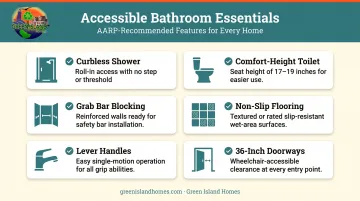
Building these features in from the start costs far less than retrofitting later.
Kitchen or Kitchenette
The right choice depends on local zoning, the occupant's habits, and budget:
- Full kitchen: Range, full refrigerator, dishwasher — best for occupants who cook regularly
- Compact kitchenette: Two-burner cooktop, under-counter refrigerator, microwave, small sink — sufficient for most daily needs
An induction cooktop is a smart safety choice for elderly occupants. It doesn't produce an open flame and automatically shuts off when cookware is removed.
Bedroom with Adequate Space and Light
The bedroom should accommodate a queen-size bed with clearance on both sides — caregivers need room to assist from either side. Doorways should measure at least 32–36 inches wide to accommodate walkers or wheelchairs.
Natural light is easy to overlook in planning, but it meaningfully affects occupant wellbeing over time. Prioritize windows on at least two walls if the layout allows.
Planning Considerations Before You Build
Check Zoning and Permits First
Local zoning laws dictate what's allowed — and the rules vary more than most homeowners expect. Massachusetts now allows ADUs by right in single-family districts statewide (effective February 2025), but local municipalities retain authority over site plan review, septic compliance, and short-term rental restrictions.
Contact your local planning department before committing to any design. What's permitted on a half-acre lot in one Cape town may be restricted on a similar lot two towns over.
Match the Idea to Your Property and Budget
General cost benchmarks (national figures; coastal Cape Cod and Martha's Vineyard markets typically run higher):
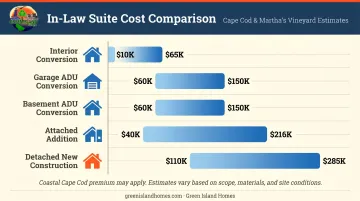
| Project Type | Typical Cost Range |
|---|---|
| Interior conversion (existing rooms) | $10,000 – $65,000 |
| Basement ADU conversion | $60,000 – $150,000 |
| Garage ADU conversion | $60,000 – $150,000 |
| Attached addition | $40,000 – $216,000 |
| Detached new construction ADU | $110,000 – $285,000 |
Interior conversions are the most accessible entry point, while detached new construction carries the highest cost — and the most flexibility for future use.
Design for Current and Future Needs
A parent who walks easily today may use a walker in five years. Build in universal design features from the start rather than retrofitting under pressure:
A parent who walks easily today may use a walker in five years. Build in universal design features from the start rather than retrofitting under pressure:
- No-step entry at all exterior doors
- Wider doorways (36 inches minimum) for wheelchair or walker clearance
- Blocking installed in walls for future grab bars in bath areas
A well-designed suite also retains flexibility. If circumstances change, the same space can serve as a rental unit, guest suite, or dedicated home office. On Cape Cod and the Vineyard, where rental demand stays strong year-round, that adaptability can directly support the property's long-term value.
Conclusion
There's no single right answer here. The best in-law suite is the one that fits your property's layout, your family's needs, your budget, and what your local zoning actually allows. These twelve approaches span a wide range of cost and complexity — the right fit depends on your specific situation, not a one-size-fits-all solution.
If you're a homeowner on Cape Cod or Martha's Vineyard exploring an in-law suite project, Green Island Homes is ready to help. The team is fully licensed and insured, HomeAdvisor Top Rated, and handles every phase of construction from design through build. Reach out to discuss your project and get a clear picture of what's possible on your property.
- Call: 774-563-9714
- Email: sales@greenislandhomes.com
Frequently Asked Questions
Frequently Asked Questions
How much does a mother-in-law suite addition cost?
Costs range from roughly $10,000 to $65,000 for interior conversions of existing space, up to $110,000–$285,000 for detached new construction. Attached additions typically fall in the $40,000–$216,000 range. Cape Cod and Martha's Vineyard markets often see higher labor and material costs than national averages.
Does adding a mother-in-law suite add value?
Generally yes — ADU listings grew an average of 8.6% year over year from 2009 to 2019 according to Freddie Mac, and buyer demand for multigenerational homes has been rising. A well-designed, permitted suite broadens your buyer pool and may support financing through potential rental income.
Can I add a mother-in-law suite to my house?
Most homeowners can add some form of in-law suite, though type and scope depend on local zoning, lot size, HOA restrictions, and property layout. Massachusetts now allows ADUs by right on single-family lots statewide. Contact your local planning department first to confirm what applies to your property.
What is a good layout for a mother-in-law suite?
A functional layout includes a private entrance, bedroom, full bathroom, and kitchen or kitchenette in a single-level flow. A minimum of 400–600 square feet works comfortably for one person. Prioritize no-step entry and an accessible bathroom regardless of size.
What permits do I need to build an in-law suite?
Most projects require a building permit at minimum. In Massachusetts, creating an ADU triggers compliance with the state building code (780 CMR) and may involve local site plan review. Contact your local building department before breaking ground to confirm requirements for your specific project.